
GATE 1999
January 5, 2024GATE 1996
January 5, 2024Question 14304 – Digital-Logic-Design
Consider a Boolean function f(w, x, y, z) such that
f(w, 0, 0, z) = 1
f(1, x, 1, z) = x + z
f(w, 1, y, z) = wz + y
The number of literals in the minimal sum-of-products expression of f is __________.
Correct Answer: A
f(w,0,0,z)= 1 If x=y=0, then the sum of the corresponding minterms be 1.
The minterms with literals x’ and y’ are wx’y’z(9), w’x’y’z(1), wx’y’z’(8), w’x’y’z’(0) .
If x=y=0, then we get wz+w’z+wz’+w’z’ = 1.
f(1,x,1,z)= x+z.
The minterms with variables w and y in true form and x or z or both in true form.
The corresponding minterms are wx’yz(11), wxyz’(14), wxyz(15)
If w=1 and y=1, then we get x’z+xz’+xz= x+z.
f(w,1,y,z)= wz+y
The corresponding minterms are w’xyz’(6), w’xyz(7), wxyz’(14), wxyz(15), wxy’z(13).
If x=1, then we get w’yz’ + w’yz+ wyz’ + wyz+ wy’z = y + wz
So, the function f(w,x,y,z)= Σ(0,1,6,7, 8,9, 11, 13, 14, 15,).
Therefore, the k-map will be:
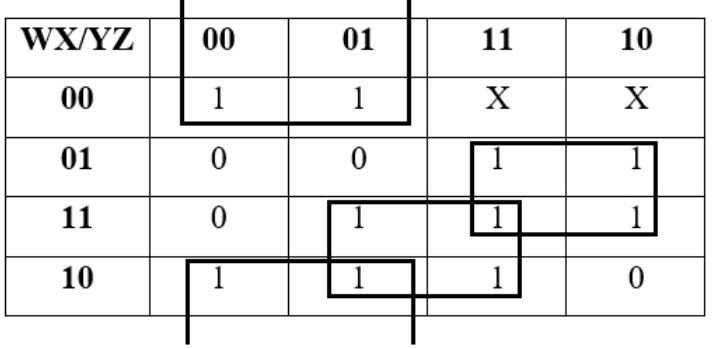
Therefore, the minimal expression will be: X’Y’ + WZ + XY
Thus, the number of literals will be 6.