
Question 8630 – Data-Structures
January 9, 2024Binary-Trees
January 9, 2024Question 8683 – Set-Theory
Let X and Y be finite sets and f: X→Y be a function. Which one of the following statements is TRUE?
Correct Answer: D
Question 30 Explanation:
The function f: x→y.
We need to consider subsets of ‘x’, which are A & B (A, B can have common elements are exclusive).
Similarly S, T are subsets of ‘y’.
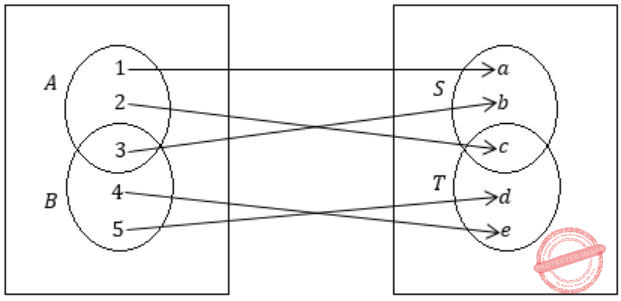
To be a function, each element should be mapped with only one element.
(a) |f(A∪B)| = |f(A)|+|f(B)|
|{a,b,c}|∪|{c,d,e}| = |{a,b,c}| + |{c,d,e}|
|{a,b,c,d,e}| = 3+3
5 = 6 FALSE
(d) To get inverse, the function should be one-one & onto.
The above diagram fulfills it. So we can proceed with inverse.
f-1 (S∩T ) = f-1 (S)∩f-1 (T)
f-1 (c) = f-1 ({a,b,c})∩f-1 ({c,d,e})
2 = {1,2,3}∩{2,4,5}
2 = 2 TRUE
We need to consider subsets of ‘x’, which are A & B (A, B can have common elements are exclusive).
Similarly S, T are subsets of ‘y’.
To be a function, each element should be mapped with only one element.
(a) |f(A∪B)| = |f(A)|+|f(B)|
|{a,b,c}|∪|{c,d,e}| = |{a,b,c}| + |{c,d,e}|
|{a,b,c,d,e}| = 3+3
5 = 6 FALSE
(d) To get inverse, the function should be one-one & onto.
The above diagram fulfills it. So we can proceed with inverse.
f-1 (S∩T ) = f-1 (S)∩f-1 (T)
f-1 (c) = f-1 ({a,b,c})∩f-1 ({c,d,e})
2 = {1,2,3}∩{2,4,5}
2 = 2 TRUE
For any subsets A and B of X, |f(A ∪ B)| = |f(A)|+|f(B)|
For any subsets A and B of X, f(A ∩ B) = f(A) ∩ f(B)
For any subsets A and B of X, |f(A ∩ B)| = min{ |f(A)|,f|(B)|}
For any subsets S and T of Y, f -1 (S ∩ T) = f -1 (S) ∩ f -1 (T)