
Database-Management-System
August 29, 2024Database-Management-System
August 29, 2024Database-Management-System
|
Question 566
|
The maximum number of keys stored in a B-tree of order m and depth d is
|
md+1–1
|
|
|
(md+1–1) / (m–1)
|
|
|
(m–1) (md+1–1)
|
|
|
(md–1) / (m–1)
|
|
|
None of the above
|
Question 566 Explanation:
Order of a B-tree represents the number of children a node can have and we know the number of keys is always equals to the (Order of B-tree) – 1
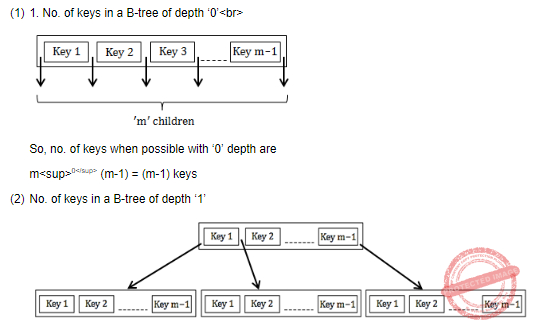
So here each of the ‘m’ children is having (m-1) keys.
Hence total no. of keys = m1 (m-1) keys
(3) Similarly, for a B-tree of order ‘d’ total no. of keys possible = md (m-1) keys
So here each of the ‘m’ children is having (m-1) keys.
Hence total no. of keys = m1 (m-1) keys
(3) Similarly, for a B-tree of order ‘d’ total no. of keys possible = md (m-1) keys
Correct Answer: E
Question 566 Explanation:
Order of a B-tree represents the number of children a node can have and we know the number of keys is always equals to the (Order of B-tree) – 1
So here each of the ‘m’ children is having (m-1) keys.
Hence total no. of keys = m1 (m-1) keys
(3) Similarly, for a B-tree of order ‘d’ total no. of keys possible = md (m-1) keys
So here each of the ‘m’ children is having (m-1) keys.
Hence total no. of keys = m1 (m-1) keys
(3) Similarly, for a B-tree of order ‘d’ total no. of keys possible = md (m-1) keys