![GATE 2014 [Set-3]](https://solutionsadda.in/wp-content/uploads/2019/05/green-new-logo.png)
UGC NET CS 2006 Dec-paper-2
April 2, 2025GATE 2014 [Set-3]
April 2, 2025GATE 2014 [Set-3]
|
Question 39
|
Consider the transactions T1, T2, and T3 and the schedules S1 and S2 given below.
T1: r1(X); r1(Z); w1(X); w1(Z)
T2: r2(Y); r2(Z); w2(Z)
T3: r3(Y); r3(X); w3(Y)
S1: r1(X); r3(Y); r3(X); r2(Y); r2(Z);
    w3(Y); w2(Z); r1(Z); w1(X); w1(Z)
S2: r1(X); r3(Y); r2(Y); r3(X); r1(Z);
    r2(Z); w3(Y); w1(X); w2(Z); w1(Z)
Which one of the following statements about the schedules is TRUE?
|
Only S1 is conflict-serializable.
|
|
|
Only S2 is conflict-serializable.
|
|
|
Both S1 and S2 are conflict-serializable.
|
|
|
Neither S1 nor S2 is conflict-serializable.
|
Question 39 Explanation:
S1:

No cycle, so schedule S1 is conflict serializable.
S2:
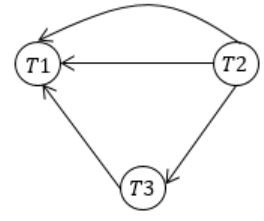
There is a cycle, so S2 is not conflict serializable.
No cycle, so schedule S1 is conflict serializable.
S2:
There is a cycle, so S2 is not conflict serializable.
Correct Answer: A
Question 39 Explanation:
S1:
No cycle, so schedule S1 is conflict serializable.
S2:
There is a cycle, so S2 is not conflict serializable.
No cycle, so schedule S1 is conflict serializable.
S2:
There is a cycle, so S2 is not conflict serializable.