
Co-ordinate-Geometry
Question 1 |
Let R be the radius of the circle. What is the angle subtended by an arc of length at the center of the circle?
1 degree | |
1 radian | |
90 degrees | |
π radians |
Question 1 Explanation:
A degree (in full, a degree of arc, arc degree, or arc degree), usually denoted by ° (the degree symbol), is a measurement of a plane angle, defined so that a full rotation is 360 degrees.
It is not an SI unit, as the SI unit of angular measure is the radian, but it is mentioned in the SI brochure as an accepted unit.Because a full rotation equals 2π radians.
The radian (SI symbol rad) is the SI unit for measuring angles, and is the standard unit of angular measure used in many areas of mathematics. The length of an arc of a unit circle is numerically equal to the measurement in radians of the angle that it subtends;
Question 2 |
What is the area bounded by the parabola 2y = x2 and the line x = y - 4?
18 | |
36 | |
72 | |
6 |
Question 2 Explanation:
Given parabola 2y = x2 --- (1)
and the line x = y – 4 ------ (2)
Then y = x+4
Now, Substitute Y value in Equation-(1)
x2 = 2 ( x + 4 ) ------ (3)
Solving equation-3 we get x = 4, - 2.
Place Values of x in equation (1) and (2) we will get y = 8, 2.
Then the points of intersection are (8, 4), (2, –2).
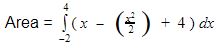
After solving the integration, we will get 18.
and the line x = y – 4 ------ (2)
Then y = x+4
Now, Substitute Y value in Equation-(1)
x2 = 2 ( x + 4 ) ------ (3)
Solving equation-3 we get x = 4, - 2.
Place Values of x in equation (1) and (2) we will get y = 8, 2.
Then the points of intersection are (8, 4), (2, –2).
After solving the integration, we will get 18.
Question 3 |
A straight line which cuts a curve on two points at an infinite distance from the origin and yet is not itself wholly at infinity is called:
Spiral
| |
Asymptote
| |
Parallel
| |
Polar
|
Question 3 Explanation:
A straight line which cuts a curve in two points at an infinite distance from the origin, but which is not itself wholly at infinity, is called an asymptote to a curve.
Question 4 |
On the parabola y = x 2 find the point N least distant from the straight line y = 2 x − 4
N (2, 4 ) | |
N (1, 1 ) | |
N (1, 2 ) | |
N (− 1 , 1 ) |
Question 5 |
Three lines 3 x + y − 2 = 0 , p x + 2 y − 3 = 0 and 2 x − y − 3 = 0 intersect at a point. Then, the value of p is
-7 | |
2 | |
5 | |
-11 |
Question 6 |
The equation of the plane through the point ( − 1 , 3 , 2 ) and perpendicular to each of the planes x + 2 y + 3 z = 5 and 3 x + 3 y + z = 0 is
7 x − 8 y + 3 z + 2 5 = 0 | |
7 x + 8 y + 3 z + 2 5 = 0 | |
7 x − 8 y + 3 z − 2 5 = 0 | |
7 x − 8 y − 3 z − 2 5 = 0 |
There are 6 questions to complete.