
Knowledge-Representation
Question 1 |
Opportunistic reasoning is addressed by which of the following knowledge representation
Script | |
Blackboard | |
Production Rules | |
Fuzzy Logic |
Question 1 Explanation:
→ Opportunistic reasoning:
It is a method of selecting a suitable logical inference strategy within artificial intelligence applications.
Opportunistic reasoning has been used in applications such as blackboard systems and medical applications.
→ Specific reasoning methods may be used to draw conclusions from a set of given facts in a knowledge base, e.g. forward chaining versus backward chaining.
→ However, in opportunistic reasoning, pieces of knowledge may be applied either forward or backward, at the "most opportune time".
→ An opportunistic reasoning system may combine elements of both forward and backward reasoning.
→ It is useful when the number of possible inferences is very large and the reasoning system must be responsive to new data that may become known.
Question 2 |
In Challenge-Response authentication the claimant
Proves that she knows the secret without revealing it | |
Proves that she doesn’t know the secret | |
Reveals the secret
| |
Gives a challenge |
Question 2 Explanation:
→ Challenge-Response authentication is a family of protocols in which one party presents a question ("challenge") and another party must provide a valid answer ("response") to be authenticated.
→ The simplest example of a challenge–response protocol is password authentication, where the challenge is asking for the password and the valid response is the correct password.
→ A more interesting challenge–response technique works as follows. Say, Bob is controlling access to some resource. Alice comes along seeking entry. Bob issues a challenge, perhaps "52w72y". Alice must respond with the one string of characters which "fits" the challenge Bob issued. The "fit" is determined by an algorithm "known" to Bob and Alice. (The correct response might be as simple as "63x83z" (each character of response one more than that of challenge), but in the real world, the "rules" would be much more complex.) Bob issues a different challenge each time, and thus knowing a previous correct response (even if it isn't "hidden" by the means of communication used between Alice and Bob) is of no use.
Question 3 |
In Artificial Intelligence (AI), an environment is uncertain if it is
Not fully observable and not deterministic | |
Not fully observable or not deterministic | |
Fully observable but not deterministic
| |
Not fully observable but deterministic
|
Question 3 Explanation:
→ Deterministic AI environments are those on which the outcome can be determined based on a specific state. In other words, deterministic environments ignore uncertainty.
→ Most real world AI environments are not deterministic. Instead, they can be classified as stochastic. Self-driving vehicles are a classic example of stochastic AI processes.
→ Most real world AI environments are not deterministic. Instead, they can be classified as stochastic. Self-driving vehicles are a classic example of stochastic AI processes.
Question 4 |
An agent can improve its performance by
Learning
| |
Responding
| |
Observing
| |
Perceiving
|
Question 4 Explanation:
→ An intelligent agent (IA) is an autonomous entity which observes through sensors and acts upon an environment using actuators (i.e. it is an agent) and directs its activity towards achieving goals (i.e. it is "rational", as defined in economics).
→ Intelligent agents may also learn or use knowledge to achieve their goals. They may be very simple or very complex. A reflex machine, such as a thermostat, is considered an example of an intelligent agent.
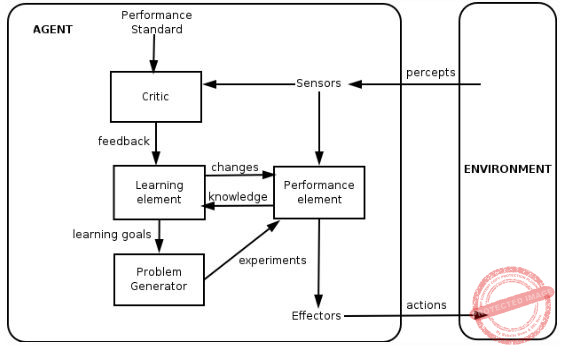
→ Intelligent agents may also learn or use knowledge to achieve their goals. They may be very simple or very complex. A reflex machine, such as a thermostat, is considered an example of an intelligent agent.
There are 4 questions to complete.