
Cache
Question 1 |
A certain processor uses a fully associative cache of size 16 kB. The cache block size is 16 bytes. Assume that the main memory is byte addressable and uses a 32-bit address. How many bits are required for the Tag and the Index fields respectively in the addresses generated by the processor?
28 bits and 0 bits | |
24 bits and 4 bits | |
24 bits and 0 bits | |
28 bits and 4 bits |
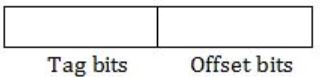
No index bits is there. So, now for tag bits,
Total bits - Offset bits = 32 - 4 = 28
So, tag bits = 28, Index bits = 0
Question 2 |
A certain processor deploys a single-level cache. The cache block size is 8 words and the word size is 4 bytes. The memory system uses a 60-MHz clock. To service a cache miss, the memory controller first takes 1 cycle to accept the starting address of the block, it then takes 3 cycles to fetch all the eight words of the block, and finally transmits the words of the requested block at the rate of 1 word per cycle. The maximum bandwidth for the memory system when the program running on the processor issues a series of read operations is ______ × 106 bytes/sec.
160 | |
145 | |
172 | |
124 |

Cache block = 8 words
Word size = 4 bytes
Cache block size = 32 bytes
Clock = 60 MHz
⇒ T = 1/clock = 1/60×106 seconds
Cache miss
= 1 cycle(Address) + 3 cycles (8 words) + 1word/cycle ×8 (transfer)
= 12 cycles
= 12/60×106
Total bandwidth = total data/total time = 32 bytes/(12/60×106) = 160 × 106 bytes/second
Answer: 160
Question 3 |
Assume that for a certain processor, a read request takes 50 nanoseconds on a cache miss and 5 nanoseconds on a cache hit. Suppose while running a program, it was observed that 80% of the processors read requests result in a cache hit. The average and access time in nanoseconds is _______.
14 | |
15 | |
16 | |
17 |
Question 4 |
Consider a machine with a byte addressable main memory of 220 bytes, block size of 16 bytes and a direct mapped cache having 212 cache lines. Let the addresses of two consecutive bytes in main memory be (E201F)16 and (E2020)16. What are the tag and cache line address (in hex) for main memory address (E201F)16?
E, 201 | |
F, 201 | |
E, E20 | |
2, 01F |
No. of cache lines in cache is 212 bytes which needs 12 bits. So next lower 12 bits are line indexing bits.
And the remaining top 4 bits are tag bits (out of 20). So answer is (A).
Question 5 |
The size of the physical address space of a processor is 2P bytes. The word length is 2W bytes. The capacity of cache memory is 2N bytes. The size of each cache block is 2M words. For a K-way set-associative cache memory, the length (in number of bits) of the tag field is
P - N - log2K | |
P - N + log2K | |
P - N - M - W - log2K | |
P - N - M - W + log2K |
Each word is of size 2W bytes.
Number of words in physical memory = 2(P-W)
So the physical address is P-W bits
Cache size is 2N bytes.
Number of words in the cache = 2(N-W)
Block size is 2M words
No. of blocks in the cache = 2(N-W-M)
Since it is k-way set associative cache, each set in the cache will have k blocks.
No. of sets = 2(N-W-M ) / k
SET bits = N-W-M-logk
Block offset = M
TAG bits = P-W-(N-M-W-logk)-M = P-W-N+M+W+logk-M = P - N + logk
Question 6 |
Consider a two-level cache hierarchy with L1 and L2 caches. An application incurs 1.4 memory accesses per instruction on average. For this application, the miss rate of L1 cache is 0.1; the L2 cache experiences, on average, 7 misses per 1000 instructions. The miss rate of L2 expressed correct to two decimal places is __________.
0.05 | |
0.06 | |
0.07 | |
0.08 |
For 1000 instructions total number of memory references = 1000 * 1.4 = 1400
These 1400 memory references are first accessed in the L1.
Since the miss rate of L1 is 0.1, for 1400 L1 references the number of misses = 0.1 * 1400 = 140
We know when there is a miss in L1 we next access the L2 cache.
So number of memory references to L2 = 140
It is given that there are 7 misses in L2 cache. Out of 140 memory references to L2 cache there are 7 misses.
Hence the miss rate in L2 cache = 7/140 = 0.05
Question 7 |
Consider a 2-way set associative cache with 256 blocks and uses LRU replacement. Initially the cache is empty. Conflict misses are those misses which occur due to contention of multiple blocks for the same cache set. Compulsory misses occur due to first time access to the block. The following sequence of accesses to memory blocks
(0, 128, 256, 128, 0, 128, 256, 128, 1, 129, 257, 129, 1, 129, 257, 129)is repeated 10 times. The number of conflict misses experienced by the cache is __________.
76 | |
79 | |
80 | |
81 |
If a block is accessed once and then before its second access if there are k-unique block accesses and the cache size is less than k, and in that case if the second access is amiss then it is capacity miss. In this case the cache doesn't have the size to hold all the k-unique blocks that came and so when the initial block came back again it is not in the cache because capacity of the cache is less than the unique block accesses k. Hence it is capacity miss.
If a block is accessed once and then before its second access if there are k-unique block accesses and the cache size is greater than k, and in that case if the second access is a miss then it is conflict miss. In this case the cache can hold all the k-unique blocks that came and even then when the initial block came back again it is not in the cache because it got replaced, then it is conflict miss.
LRU will use the function xmod128
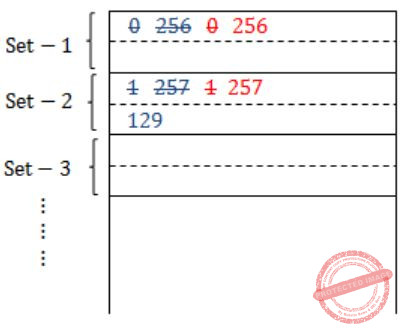
Cache size = 256 Bytes
2 way set associative cache
So, no. of cache sets = 256/2 = 128
Blue → Compulsory miss
Red → Conflict miss
At the end of first round we have 4, compulsory misses & 4 conflict misses.
Similarly, if we continue from Round-2 to last round, in every round we will get 8 conflict misses.
Total conflict misses = 4+9(8) = 4+72 = 76 (conflict misses)
Question 8 |
A cache memory unit with capacity of N words and block size of B words is to be designed. If it is designed as a direct mapped cache, the length of the TAG field is 10 bits. If the cache unit is now designed as a 16-way set-associative cache, the length of the TAG field is ___________ bits.
14 | |
15 | |
16 | |
17 |
(Tag bits + bits for block number + bits for block offset)
With block size being B words no. of bits for block offset = log (B)
Because the cache capacity is N words and each block is B words, number of blocks in cache = N / B
No. of bits for block number = log (N/B)
So, the physical address in direct mapping case
= 10 + log (N/B) + log (B)
= 10 + log (N) – log B + log B
= 10 + log (N)
If the same cache unit is designed as 16-way set associative, then the physical address becomes
(Tag bits + bits for set no. + Bits for block offset)
There are N/B blocks in the cache and in 16-way set associative cache each set contains 16 blocks.
So no. of sets = (N/B) / 16 = N / (16*B)
Then bits for set no = log (N/16B)
Bits for block offset remain the same in this case also. That is log (B).
So physical address in the set associative case
= tag bits + log (N/16*B) + log B
= tag bits + log (N) – log (16*B) + log B
= tag bits + log (N) – log 16 – log B + log B
= tag bits + log N – 4
The physical address is the same in both the cases.
So, 10 + log N = tag bits + log N – 4
Tag bits = 14
So, no. of tag bits in the case 16-way set associative mapping for the same cache = 14.
Question 9 |
In designing a computer’s cache system, the cache block (or cache line) size is an important parameter. Which one of the following statements is correct in this context?
A smaller block size implies better spatial locality | |
A smaller block size implies a smaller cache tag and hence lower cache tag overhead | |
A smaller block size implies a larger cache tag and hence lower cache hit time | |
A smaller block size incurs a lower cache miss penalty |
Question 10 |
A RAM chip has a capacity of 1024 words of 8 bits each (1K×8). The number of 2×4 decoders with enable line needed to construct a 16K×16 RAM from 1K×8 RAM is
4 | |
5 | |
6 | |
7 |
Capacity of the chips available = 1K
No. of address lines = 16K/1K = 16
Hence we can use 4 × 16 decoder for this. But we were only given 2 × 4 decoders.
So 4 decoders are required in inner level as from one 2×4 decoder we have only 4 output lines whereas we need 16 output lines.
Now to point to these 4 decoders, another 2×4 decoder is required in the outer level.
Hence no. of 2×4 decoders to realize the above implementation of RAM = 1 + 4 = 5
Question 11 |
In a two-level cache system, the access times of L1 and L2 caches are 1 and 8 clock cycles, respectively. The miss penalty from the L2 cache to main memory is 18 clock cycles. The miss rate of L1 cache is twice that of L2. The average memory access time (AMAT) of this cache system is 2 cycles. The miss rates of L1 and L2 respectively are:
0.111 and 0.056 | |
0.056 and 0.111 | |
0.0892 and 0.1784 | |
0.1784 and 0.0892 |
AMAT = (L1 hit rate)*(L1 access time) + (L1 miss rate)*(L1 access time + L1 miss penalty)
= L1 hit rate * L1 access time + L1 miss rate * L1 access time + L1 miss rate * L1 miss penalty
We can write,
L1 miss rate = 1 - L1 hit rate
AMAT = L1 hit rate * L1 access time + (1 - L1 hit rate) * L1 access time + L1 miss rate * L1 miss penalty
By taking L1 access time common,
= (L1 hit rate + 1 - L1 hit rate)* L1 access time + L1 miss rate * L1 miss penalty
AMAT = L1 access time + L1 miss rate * L1 miss penalty
We access L2 only when there is a miss in L1.
So, L1 miss penalty is nothing but the effective time taken to access L2.
L1_miss_penalty = Hit_rate_of_L2* Access time of L2 + MissRate of L2 *(Access time of L2+ miss penalty L2)
= Hit_rate_of_L2* Access time of L2 + MissRate of L2 *Access time of L2 + MissRate of L2 * miss penalty L2
By taking Access time of L2 common we get,
= Access time of L2 * (Hit_rate_of_L2 + MissRate of L2 ) + MissRate of L2 * miss penalty L2
We know, MissRate of L2 = 1 - Hit_rate_of_L2 → Hit_rate_of_L2 + MissRate of L2 = 1
So, the above formula becomes,
L1_miss_penalty = Access time of L2 + (MissRate of L2 * miss penalty L2)
It is given,
access time of L1 = 1,
access time of L2 = 8,
miss penalty of L2 = 18,
AMAT = 2.
Let, miss rate of L2 = x.
Since it is given that L1 miss rate is twice that of 12 miss rate, L1 miss rate = 2 * x.
Substituting the above values,
L1_miss_penalty = Access time of L2 + (MissRate of L2 * miss penalty L2)
L1_miss_penalty = 8 + (x*18)
AMAT = L1 access time + L1 miss rate * L1 miss penalty
2 = 1 + (2*x) (8+18*x)
36*x2+ 16*x -1 = 0
By solving the above quadratic equation we get,
x = Miss rate of L2 = 0.056
Miss rate of L1 = 2*x = 0.111
Question 12 |
The read access times and the hit ratios for different caches in a memory hierarchy are as given below.

The read access time of main memory is 90 nanoseconds. Assume that the caches use the referred-word-first read policy and the write back policy. Assume that all the caches are direct mapped caches. Assume that the dirty bit is always 0 for all the blocks in the caches. In execution of a program, 60% of memory reads are for instruction fetch and 40% are for memory operand fetch. The average read access time in nanoseconds (up to 2 decimal places) is ___________.
4.72 | |
4.73 | |
4.74 | |
4.75 |
Hierarchical memory (Default case):
For 2-level memory:
The formula for average memory access time = h1 t1 + (1-h1)(t1 + t2)
This can be simplified as
t1 + (1-h1)t2
For 3-level memory:
h1 t1 + (1-h1)(t1 + h2 t2 + (1-h2)(t2 + t3))
This can be simplified as
t1 + (1-h1)t2 + (1-h1)(1-h2)t3
Instruction fetch happens from I-cache whereas operand fetch happens from D-cache.
Using that we need to calculate the instruction fetch time (Using I-cache and L2-cache) and operand fetch time (Using D-cache and L2-cache) separately.
Then calculate 0.6 (instruction fetch time) + 0.4(operand fetch time) to find the average read access time.
The equation for instruction fetch time = t1 + (1-h1 ) t2 + (1-h1 )(1-h2 ) t3
= 2 + 0.2*8 + 0.2*0.1*90 = 5.4ns
Operand fetch time = t1 + (1-h1)t2 + (1-h1)(1-h2)t3 = 2 + 0.1*8 + 0.1*0.1*90 = 3.7ns
The average read access time = 0.6*5.4 + 0.4*3.7 = 4.72ns
Question 13 |
Consider a 4-way set associative cache consisting of 128 lines with a line size of 64 words. The CPU generates a 20-bit address of a word in main memory. The number of bits in the TAG, LINE and WORD fields are respectively:
9, 6, 5 | |
7, 7, 6 | |
7, 5, 8 | |
9, 5, 6 |
Each line size 64 words, so no. of bits for WORD = 6 bits
Because it is 4-way set associative cache, no. of sets in the cache = 128/4 = 32 = 25
No. of bits for the set number = 5
Because the address is 20-bits long, no. of TAG bits = 20-5-6 = 9
Question 14 |
Consider two cache organizations: The first one is 32 KB 2-way set associative with 32-byte block size. The second one is of the same size but direct mapped. The size of an address is 32 bits in both cases. A 2-to-1 multiplexer has a latency of 0.6 ns while a kbit comparator has a latency of k/10 ns. The hit latency of the set associative organization is h1 while that of the direct mapped one is h2.
The value of h2 is:
2.4 ns | |
2.3 ns | |
1.8 ns | |
1.7 ns |
For k,
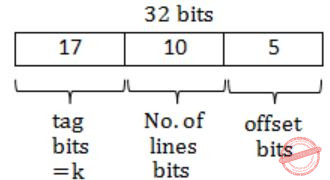
∴ Hit latency = 17/1 = 1.7 ns
Question 15 |
Consider a machine with a byte addressable main memory of 232 bytes divided into blocks of size 32 bytes. Assume that a direct mapped cache having 512 cache lines is used with this machine. The size of the tag field in bits is _____________.
18 | |
19 | |
20 | |
21 |
So the physical address is 32 bits long.
Each block is of size 32(=25) Bytes. So block offset 5.
Also given that there are 512(=29) cache lines, since it is a direct mapped cache we need 9 bits for the LINE number.
When it is directed mapped cache, the physical address can be divided as
(Tag bits + bits for block/LINE number + bits for block offset)
So, tag bits + 9 + 5 = 32
Tag bits = 32 - 14 = 18
Question 16 |
The width of the physical address on a machine is 40 bits. The width of the tag field in a 512 KB 8-way set associative cache is _________ bits.
24 | |
25 | |
26 | |
27 |
(Tag bits + bits for set no. + Bits for block offset)
In question block size has not been given, so we can assume block size 2x Bytes.
The cache is of size 512KB, so number of blocks in the cache = 219/2x = 219-x
It is 8-way set associative cache so there will be 8 blocks in each set.
So number of sets = (219 − x)/8 = 216 − x
So number of bits for sets = 16−x
Let number of bits for Tag = T
Since we assumed block size is 2x Bytes, number of bits for block offset is x.
So, T + (16−x) + x = 40
T + 16 = 40
T = 24
Question 17 |
A file system uses an in-memory cache to cache disk blocks. The miss rate of the cache is shown in the figure. The latency to read a block from the cache is 1 ms and to read a block from the disk is 10 ms. Assume that the cost of checking whether a block exists in the cache is negligible. Available cache sizes are in multiples of 10 MB.
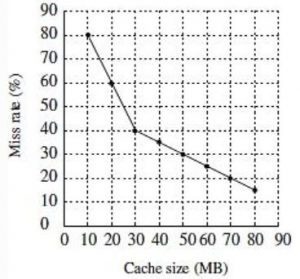
The smallest cache size required to ensure an average read latency of less than 6 ms is _______ MB.
30 | |
31 | |
32 | |
33 |
So we consider it as hierarchical memory.
But it is given that “assume that the cost of checking whether a block exists in the cache is negligible”, which means don't consider the checking time in the cache when there is a miss.
So formula for average access time becomes h1t1 + (1-h1)(t2) which is same as for simultaneous access.
Though the memory is hierarchical because of the statement given in the question we ignored the cache access time when there is a miss and effectively the calculation became like simultaneous access.
The average access time or read latency = h1t1 + (1-h1)t2.
It is given that the average read latency has to be less than 6ms.
So, h1t1 + (1-h1)t2 < 6
From the given information t1 = 1ms, t2 = 10ms
h1*1+(1-h1)10 < 6
10-9h1 < 6
-9h1 < - 4
-h1 < - 4/9
-h1 < -0.444
Since in the given graph we have miss rate information and 1-h1 gives the miss rate, so we add 1 on both sides of the above inequality.
1-h1 < 1-0.444
1-h1 < 0.555
So for the average read latency to be less than 6 ms the miss rate hsa to be less than 55.5%.
From the given graph the closest value of miss rate less than 55.5 is 40%.
For 40% miss rate the corresponding cache size is 30MB.
Hence the answer is 30MB.
Question 18 |
An access sequence of cache block addresses is of length N and contains n unique block addresses. The number of unique block addresses between two consecutive accesses to the same block address is bounded above by k. What is the miss ratio if the access sequence is passed through a cache of associativity A≥k exercising least-recently-used replacement policy?
n/N | |
1/N | |
1/A | |
k/n |
As the set associativity size keeps increasing then we don't have to replace any block, so LRU is not of any significance here.
Question 19 |
Consider a direct mapped cache of size 32 KB with block size 32 bytes. The CPU generates 32 bit addresses. The number of bits needed for cache indexing and the number of tag bits are respectively.
10, 17 | |
10, 22 | |
15, 17 | |
5, 17 |
So indexing requires 10 bits.
No. of offset bit required to access 32 byte block = 5
So, No. of TAG bits = 32 - 10 - 5 = 17
Question 20 |
Consider a small two-way set-associative cache memory, consisting of four blocks. For choosing the block to be replaced, use the least recently used (LRU) scheme. The number of cache misses for the following sequence of block addresses is 8, 12, 0, 12, 8
2 | |
3 | |
4 | |
5 |
The given sequence is 8, 12, 0, 12, 8.
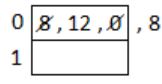
So in total 4 misses is there.
Question 21 |
More than one word is put in one cache block to
exploit the temporal locality of reference in a program | |
exploit the spatial locality of reference in a program | |
reduce the miss penalty | |
none of the above |
The temporal locality refers to reuse of data elements with a smaller regular intervals.
Question 22 |
A CPU has 32-bit memory address and a 256 KB cache memory. The cache is organized as a 4-way set associative cache with cache block size of 16 bytes.
- (a) What is the number of sets in the cache?
(b) What is the size (in bits) of the tag field per cache block?
(c) What is the number and size of comparators required for tag matching?
(d) How many address bits are required to find the byte offset within a cache block?
(e) What is the total amount of extra memory (in bytes) required for the tag bits?
Theory Explanation is given below. |
Question 23 |
A 4-way set-associative cache memory unit with a capacity of 16 KB is built using a block size of 8 words. The word length is 32 bits. The size of the physical address space is 4 GB. The number of bits for the TAG field is __________.
20 | |
21 | |
22 | |
23 |
Cache size = 16K bytes = 214 Bytes
block size = 8 words = 8⨯4 Byte = 32 Bytes = 25 Bytes
(where each word = 4 Bytes)
No. of blocks =214/25=29
block offset =9bits
Because it is 4-way set associative cache, no. of sets =29/4=27
Set of set = 7 bits
TAG = 32 – (7 + 5) = 20 bits

Question 24 |
Suppose a stack implementation supports an instruction REVERSE, which reverses the order of elements on the stack, in addition to the PUSH and POP instructions. Which one of the following statements is TRUE with respect to this modified stack?
A queue cannot be implemented using this stack. | |
A queue can be implemented where ENQUEUE takes a single instruction and DEQUEUE takes a sequence of two instructions. | |
A queue can be implemented where ENQUEUE takes a sequence of three instructions and DEQUEUE takes a single instruction. | |
A queue can be implemented where both ENQUEUE and DEQUEUE take a single instruction each. |
Suppose:
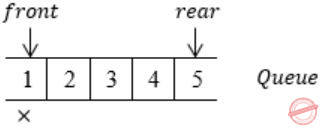
Dequeue:
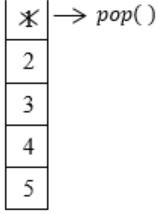
If we want to delete an element, that first we need to delete 1.
Enqueue:
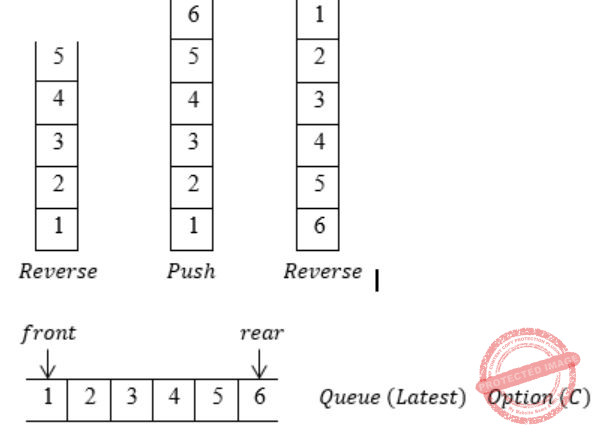
Question 25 |
If the associativity of a processor cache is doubled while keeping the capacity and block size unchanged, which one of the following is guaranteed to be NOT affected?
Width of tag comparator | |
Width of set index decoder | |
Width of way selection multiplexor | |
Width of processor to main memory data bus |
Width of set index decoder also will be affected when set offset is changed.
A k-way set associative cache needs k-to-1 way selection multiplexer. If the associativity is doubled the width of way selection multiplexer will also be doubled.
With of processor to main memory data bus is guaranteed to be NOT affected as this is not dependent on the cache associativity.
Question 26 |
In a k-way set associative cache, the cache is divided into v sets, each of which consists of k lines. The lines of a set are placed in sequence one after another. The lines in set s are sequenced before the lines in set (s+1). The main memory blocks are numbered 0 onwards. The main memory block numbered j must be mapped to any one of the cache lines from
(j mod v) * k to (j mod v) * k + (k-1) | |
(j mod v) to (j mod v) + (k-1) | |
(j mod k) to (j mod k) + (v-1) | |
(j mod k) * v to (j mod k) * v + (v-1) |
A block numbered j will be mapped to set number (j mod v). Since it is k-way set associative cache, there are k blocks in each set. It is given in the question that the blocks in consecutive sets are sequenced. It means for set-0 the cache lines are numbered 0, 1, .., k-1 and for set-1, the cache lines are numbered k, k+1,... k+k-1 and so on. As the main memory block j will be mapped to set (j mod v), it will be any one of the cache lines from (j mod v) * k to (j mod v) * k + (k-1).