
Artificial-Intelligence
December 23, 2023Artificial-Intelligence
December 23, 2023Artificial-Intelligence
|
Question 30
|
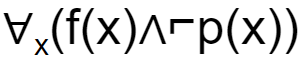
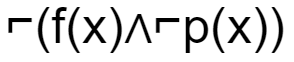
If f(x)=x is my friend, and p(x) = x is perfect, then the correct logical translation of the statement “some of my friends are not perfect” is _____.
 |
|
 |
|
 |
|
 |
Question 30 Explanation:
Input:
f(x)=x is my friend
p(x) = x is perfect
So, they are asking about SOME. Finally, outer most parentheses will get SOME.
So, based on this we will eliminate 2 options.
They are given conditions like NOT perfect. So, we get ⌐p(x).
The final condition is ∃x(f(x)∧⌐p(x))
f(x)=x is my friend
p(x) = x is perfect
So, they are asking about SOME. Finally, outer most parentheses will get SOME.
So, based on this we will eliminate 2 options.
They are given conditions like NOT perfect. So, we get ⌐p(x).
The final condition is ∃x(f(x)∧⌐p(x))
Correct Answer: B
Question 30 Explanation:
Input:
f(x)=x is my friend
p(x) = x is perfect
So, they are asking about SOME. Finally, outer most parentheses will get SOME.
So, based on this we will eliminate 2 options.
They are given conditions like NOT perfect. So, we get ⌐p(x).
The final condition is ∃x(f(x)∧⌐p(x))
f(x)=x is my friend
p(x) = x is perfect
So, they are asking about SOME. Finally, outer most parentheses will get SOME.
So, based on this we will eliminate 2 options.
They are given conditions like NOT perfect. So, we get ⌐p(x).
The final condition is ∃x(f(x)∧⌐p(x))