![GATE 2014 [Set-1]](https://solutionsadda.in/wp-content/uploads/2019/05/green-new-logo.png)
Question 11052 – Algorithms
January 15, 2024Question 11091 – Algorithms
January 16, 2024GATE 2014 [Set-1]
|
Question 16
|
Let the function
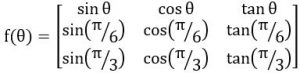
where  and f(θ) denote the derivative of f with respect to θ. Which of the following is/are TRUE?
-
(I) There exists such that
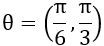 such that f(θ)=0.
 (II) There exists such that
such that f(θ)≠0.
|
I only
|
|
|
II only
|
|
|
Both I and II
|
|
|
Neither I nor II
|
Question 16 Explanation:
Rolle’s theorem:
Rolle’s theorem states that for any continuous, differentiable function that has two equal values at two distinct points, the function must have a point on the function where the first derivative is zero. The technical way to state this is: if f is continuous and differentiable on a closed interval [a,b] and if f(a) = f(b), then f has a minimum of one value c in the open interval [a, b] so that f'(c) = 0.
We can observe that, sin, cos are continuous, but, Tan is not continuous at π/2. As the mentioned interval does not contain π/2, we can conclude that it is continuous.
As per Rolls theorem both statement 1 and statement 2 are true.
Rolle’s theorem states that for any continuous, differentiable function that has two equal values at two distinct points, the function must have a point on the function where the first derivative is zero. The technical way to state this is: if f is continuous and differentiable on a closed interval [a,b] and if f(a) = f(b), then f has a minimum of one value c in the open interval [a, b] so that f'(c) = 0.
We can observe that, sin, cos are continuous, but, Tan is not continuous at π/2. As the mentioned interval does not contain π/2, we can conclude that it is continuous.
As per Rolls theorem both statement 1 and statement 2 are true.
Correct Answer: C
Question 16 Explanation:
Rolle’s theorem:
Rolle’s theorem states that for any continuous, differentiable function that has two equal values at two distinct points, the function must have a point on the function where the first derivative is zero. The technical way to state this is: if f is continuous and differentiable on a closed interval [a,b] and if f(a) = f(b), then f has a minimum of one value c in the open interval [a, b] so that f'(c) = 0.
We can observe that, sin, cos are continuous, but, Tan is not continuous at π/2. As the mentioned interval does not contain π/2, we can conclude that it is continuous.
As per Rolls theorem both statement 1 and statement 2 are true.
Rolle’s theorem states that for any continuous, differentiable function that has two equal values at two distinct points, the function must have a point on the function where the first derivative is zero. The technical way to state this is: if f is continuous and differentiable on a closed interval [a,b] and if f(a) = f(b), then f has a minimum of one value c in the open interval [a, b] so that f'(c) = 0.
We can observe that, sin, cos are continuous, but, Tan is not continuous at π/2. As the mentioned interval does not contain π/2, we can conclude that it is continuous.
As per Rolls theorem both statement 1 and statement 2 are true.