
Problem-Solving
October 17, 2024Programming
October 18, 2024Functions
|
Question 9
|
Let A and B be sets with cardinalities m and n respectively. The number of one-one mappings (injections) from A to B, when m < n, is:
|
mn
|
|
|
nPm
|
|
|
mCn
|
|
|
nCm
|
|
|
mPn
|
Question 9 Explanation:
Let,
A = {a1, a2, … am} and
B = {b1, b2, … bn}
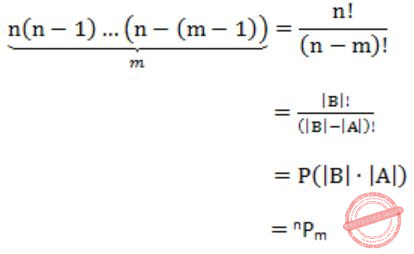
A one-one function ‘f’ assigns each element ai of A a distinct element, bj=f(ai) of Bi for a, there are n choices, for a2 there are n-1 choices, for am there are (n-(m-1)) choices.
i.e.,
A = {a1, a2, … am} and
B = {b1, b2, … bn}
A one-one function ‘f’ assigns each element ai of A a distinct element, bj=f(ai) of Bi for a, there are n choices, for a2 there are n-1 choices, for am there are (n-(m-1)) choices.
i.e.,
Correct Answer: B
Question 9 Explanation:
Let,
A = {a1, a2, … am} and
B = {b1, b2, … bn}
A one-one function ‘f’ assigns each element ai of A a distinct element, bj=f(ai) of Bi for a, there are n choices, for a2 there are n-1 choices, for am there are (n-(m-1)) choices.
i.e.,
A = {a1, a2, … am} and
B = {b1, b2, … bn}
A one-one function ‘f’ assigns each element ai of A a distinct element, bj=f(ai) of Bi for a, there are n choices, for a2 there are n-1 choices, for am there are (n-(m-1)) choices.
i.e.,