
GATE 2009
March 14, 2025GATE 2009
March 14, 2025GATE 2009
|
Question 36
|
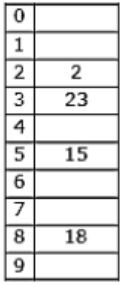
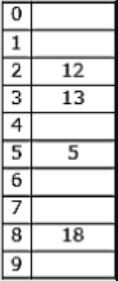
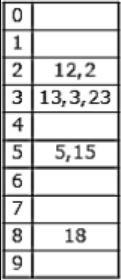
The keys 12, 18, 13, 2, 3, 23, 5 and 15 are inserted into an initially empty hash table of length 10 using open addressing with hash function h(k) = k mod 10 and linear probing. What is the resultant hash table?
 |
|
 |
|
 |
|
 |
Question 36 Explanation:
Given keys: 12, 18, 13, 2, 3, 23, 5 & 15
They are inserted into an initially empty hash table of length 10 using open addressing with hash function h(k)=k mod 10 & linear probing is used.
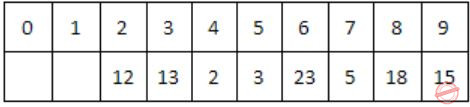
12 % 10 = 2
18 % 10 = 8
13 % 10 = 3
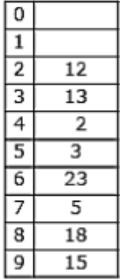
2 % 10 = 2 (Index 4 is empty)
3 % 10 = 3 (Index 5 is empty)
23 % 10 = 3 (Index 6 is empty)
5 % 10 = 5 (Index 7 is empty)
15 % 10 = 5 (Index 9 is empty)
Hence Option C is correct.
A & B doesn’t include all the keys & option D is similar to chaining. So, will go with C.
They are inserted into an initially empty hash table of length 10 using open addressing with hash function h(k)=k mod 10 & linear probing is used.
12 % 10 = 2
18 % 10 = 8
13 % 10 = 3
2 % 10 = 2 (Index 4 is empty)
3 % 10 = 3 (Index 5 is empty)
23 % 10 = 3 (Index 6 is empty)
5 % 10 = 5 (Index 7 is empty)
15 % 10 = 5 (Index 9 is empty)
Hence Option C is correct.
A & B doesn’t include all the keys & option D is similar to chaining. So, will go with C.
Correct Answer: C
Question 36 Explanation:
Given keys: 12, 18, 13, 2, 3, 23, 5 & 15
They are inserted into an initially empty hash table of length 10 using open addressing with hash function h(k)=k mod 10 & linear probing is used.
12 % 10 = 2
18 % 10 = 8
13 % 10 = 3
2 % 10 = 2 (Index 4 is empty)
3 % 10 = 3 (Index 5 is empty)
23 % 10 = 3 (Index 6 is empty)
5 % 10 = 5 (Index 7 is empty)
15 % 10 = 5 (Index 9 is empty)
Hence Option C is correct.
A & B doesn’t include all the keys & option D is similar to chaining. So, will go with C.
They are inserted into an initially empty hash table of length 10 using open addressing with hash function h(k)=k mod 10 & linear probing is used.
12 % 10 = 2
18 % 10 = 8
13 % 10 = 3
2 % 10 = 2 (Index 4 is empty)
3 % 10 = 3 (Index 5 is empty)
23 % 10 = 3 (Index 6 is empty)
5 % 10 = 5 (Index 7 is empty)
15 % 10 = 5 (Index 9 is empty)
Hence Option C is correct.
A & B doesn’t include all the keys & option D is similar to chaining. So, will go with C.