
Registers
Question 1 |
Consider the following data path diagram.
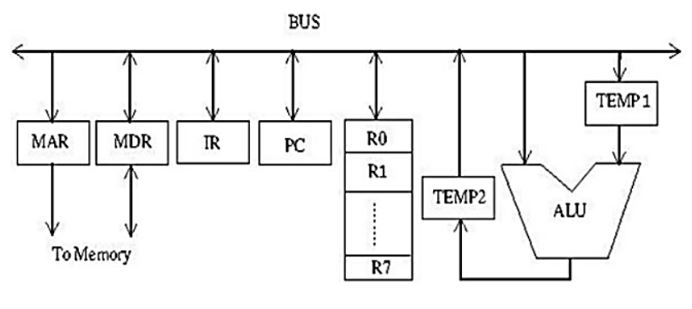
Consider an instruction: R0 ← R1 + R2. The following steps are used to execute it over the given data path. Assume that PC is incremented appropriately. The subscripts r and w indicate read and write operations, respectively.
1. R2r, TEMP1r, ALUadd, TEMP2w
2. R1r, TEMP1w
3. PCr, MARw, MEMr
4. TEMP2r, ROw
5. MDRr, IRw
Which one of the following is the correct order of execution of the above steps?
3, 5, 1, 2, 4
| |
3, 5, 2, 1, 4
| |
1, 2, 4, 3, 5 | |
2, 1, 4, 5, 3
|
Question 1 Explanation:
To execute the given instruction R0 ← R1 + R2.
First the PC value has to be moved into MAR (step-3 from the given sequence), then the instruction has to be fetched(step-5 from the given sequence). Then Temp1 is loaded with the value of R1 (step-2 from the given sequence), then the addition operation is performed by accessing the R2 value directly and adding it to Temp1 value and storing the result in Temp2 (step-1 from the given sequence).
Finally the result from Temp2 is stored in R0 (step-4 from the given sequence).
Hence the correct sequence is (3, 5, 2, 1, 4).
Question 2 |
A processor has 64 registers and uses 16-bit instruction format. It has two types of instructions: I-type and R-type. Each I-type instruction contains an opcode, a register name, and a 4-bit immediate value. Each R-type instruction contains an opcode and two register names. If there are 8 distinct I-type opcodes, then the maximum number of distinct R-type opcodes is _____.
14 |
Question 2 Explanation:
Instruction is of size 16-bits.
All possible binary combinations = 216
There are 64 registers, so no. of bits needed to identify a register = 6
I-type instruction has (Opcode+Register+4-bit immediate value). There are 8 distinct I-type instructions.
All the binary combinations possible with the I-type instructions are = 8*26*24 = 213
R-type instructions have 2 register operands.
Let x be the number of R-type instructions.
All the possible binary combinations of R-type instructions = x*26*26 = x*212
The sum of I-type and R-type binary combinations should be equal to 216.
x*212 + 213 = 216
212 (x+2) = 216
x+2 = 24
x = 16 - 2 = 14
Question 3 |
The Memory Address Register
is a hardware memory device which denotes the location of the current instruction being executed. | |
is a group of electrical circuit, that performs the intent of instructions fetched from memory | |
contains the address of the memory location that is to be read from or stored into | |
contains a copy of the designated memory location specified by the MAR after a “read” or the new contents of the memory prior to a “write” |
Question 3 Explanation:
In a computer, the Memory Address Register (MAR) is the CPU register that either stores the memory address from which data will be fetched from the CPU, or the address to which data will be sent and stored.
Question 4 |
The ALU uses ____ to store intermediate result.
Cache | |
Registers | |
Accumulators | |
Stack |
Question 4 Explanation:
→ An accumulator is a register for short-term, intermediate storage of arithmetic and logic data in a computer's CPU (central processing unit).
→ A processor register (CPU register) is one of a small set of data holding places that are part of the computer processor.
→ Cache memory is a small-sized type of volatile computer memory that provides high-speed data access to a processor and stores frequently used computer programs, applications and data.
There are 4 questions to complete.