
BFS-and-DFS
Question 1 |
The Breadth First Search (BFS) algorithm has been implemented using the queue data structure. Which one of the following is a possible order of visiting the nodes in the graph below?
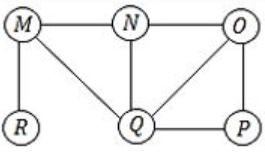
MNOPQR | |
NQMPOR | |
QMNROP | |
POQNMR |
(Do it by option Elimination)
(a) MNOPQR – MNO is not the proper order R must come in between.
(b) NQMPOR – QMP is not the order O is the child of N.
(C) QMNROP – M is not the child of Q, so QMN is false.
(D) POQNMR – P → OQ → NMR is the correct sequence. Hence Option (D).
Question 2 |
Breadth First Search (BFS) is started on a binary tree beginning from the root vertex. There is a vertex t at a distance four from the root. If t is the n-th vertex in this BFS traversal, then the maximum possible value of n is _________.
31 | |
32 | |
33 | |
34 |

For distance 1, max possible value is (3).
Similarly, for distance 2, max value is (7).
So, maximum number of nodes = 2(h+1) - 1
For distance 4, 2(4+1) - 1 ⇒ 25 - 1 ⇒ 32 - 1 = 31
31 is the last node.

So for distance 4, the maximum possible node will be 31 & minimum will be 16.
Question 3 |

For any vertex A in G, the set of all possible orderings in which the vertices of G can be visited in a Breadth First Search (BFS) starting from A is denoted by B(A). If ∅ denotes the empty set, then the cardinality of B(∅) is ______?
5040 |
Question 4 |
Let G = (V, E) be a simple undirected graph, and s be a particular vertex in it called the source. For x ∈ V, let d(x)denote the shortest distance in G from s to x. A breadth first search (BFS) is performed starting at s. Let T be the resultant BFS tree. If (u, v) is an edge of G that is not in T, then which one of the following CANNOT be the value of d(u) - d(v) ?
-1 | |
0 | |
1 | |
2 |
Then the difference between the d(u) and d(v) is not more than '1'.
In the option 'D' the difference is given as '2' it is not possible in the undirected graph.