
Graph-theory
Question 1 |
Let G be an undirected complete graph on n vertices, where n > 2. Then, the number of different Hamiltonian cycles in G is equal to
n! | |
1 | |
(n-1)! | |
 |
The total number of hamiltonian cycles in a complete graph are
(n-1)!/2, where n is number of vertices.
Question 2 |
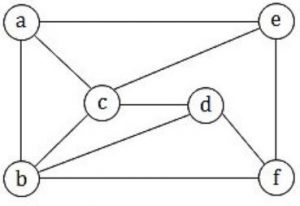
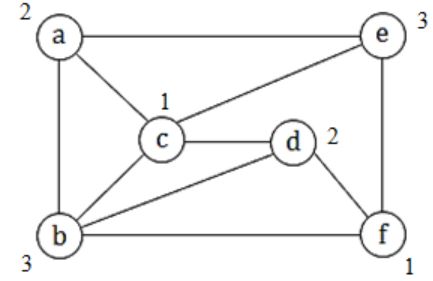
The chromatic number of the following graph is _______.
1 | |
2 | |
3 | |
4 |
Question 3 |
G is an undirected graph with n vertices and 25 edges such that each vertex of G has degree at least 3. Then the maximum possible value of n is ___________.
16 | |
17 | |
18 | |
19 |
Degree of each vertex ≥ 3

|v| = 2|E|
The relation between max and min degree of graph are
m ≤ 2|E| / |v| ≤ M
Given minimum degree = 3
So, 3 ≤2 |E| / |v|
3|v| ≤ 2|E|
3(n) ≤ 2(25)
n ≤ 50/3
n ≤ 16.6
(n = 16)
Question 4 |
The minimum number of colours that is sufficient to vertex-colour any planar graph is ________.
4 | |
5 | |
6 | |
7 |
Here it is asked about the sufficient number of colors, so with the worst case of 4 colors we can color any planar graph.
Question 5 |
Let G be a connected planar graph with 10 vertices. If the number of edges on each face is three, then the number of edges in G is _______________.
24 | |
25 | |
26 | |
27 |
|V| + |R| = |E| + 2 ------(1) where |V|, |E|, |R| are respectively number of vertices, edges and faces (regions)
Given |V| = 10 ------(2) and number of edges on each face is three
∴3|R| = 2|E| ⇒ |R| = 2/3|E| ------(3)
Substituting (2), (3) in (1), we get
10 + 2/3|E| = |E| + 2 ⇒ |E|/3 = 8 ⇒ |E| = 24
Question 6 |
Let G be a graph with 100! vertices, with each vertex labeled by a distinct permutation of the numbers 1, 2, …, 100. There is an edge between vertices u and v if and only if the label of u can be obtained by swapping two adjacent numbers in the label of v. Let y denote the degree of a vertex in G, and z denote the number of connected components in G.
Then, y + 10z = ___________.
109 | |
110 | |
111 | |
112 |
There exists edge between two vertices iff label of ‘u’ is obtained by swapping two adjacent numbers in label of ‘v’.
Example:
12 & 21, 23 & 34
The sets of the swapping numbers be (1, 2) (2, 3) (3, 4) … (99).
The no. of such sets are 99 i.e., no. of edges = 99.
As this is regular, each vertex has ‘99’ edges correspond to it.
So degree of each vertex = 99 = y.
As the vertices are connected together, the number of components formed = 1 = z
y + 102 = 99 + 10(1) = 109
Question 7 |
In a connected graph, a bridge is an edge whose removal disconnects a graph. Which one of the following statements is true?
A tree has no bridges | |
A bridge cannot be part of a simple cycle | |
Every edge of a clique with size 3 is a bridge (A clique is any complete sub graph of a graph) | |
A graph with bridges cannot have a cycle |
∴ (A) is false
Since, every edge in a complete graph kn(n≥3) is not a bridge ⇒
(C) is false
Let us consider the following graph G:
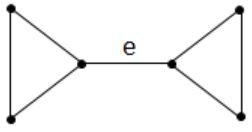
This graph has a bridge i.e., edge ‘e’ and a cycle of length ‘3’
∴ (D) is false
Since, in a cycle every edge is not a bridge
∴ (B) is true
Question 8 |
A graph is self-complementary if it is isomorphic to its complement for all self-complementary graphs on n vertices, n is
A multiple of 4 | |
Even | |
Odd | |
Congruent to 0 mod 4, or, 1 mod 4
|
Question 9 |
Let G = (V,E) be a directed graph where V is the set of vertices and E the set of edges. Then which one of the following graphs has the same strongly connected components as G?
G1=(V,E1) where E1={(u,v)|(u,v)∉E} | |
G2=(V,E2 )where E2={(u,v)│(u,v)∈E} | |
G3=(V,E3) where E3={(u,v)|there is a path of length≤2 from u to v in E} | |
G4=(V4,E) where V4 is the set of vertices in G which are not isolated |
→ It strongly connected.
(A) G1=(V,E1) where E1={(u,v)|(u,v)∉E}
If (u, v) does not belong to the edge set ‘E’, then it indicates there are no edges. So, it is not connected.
(B) G2=(V,E2 )where E2={(u,v)│(u,v)∈E}
Given that ‘G’ is directed graph, i.e., it has path from each vertex to every other vertex.
Though direction is changed from (u, v) to (v, u), it is still connected component same as ‘G’.
(C) G3=(V,E3) where E3={(u,v)|there is a path of length≤2 from u to v in E}
This can also be true.
eg:

Both from each vertex to other vertex is also exists. So it is also strongly connected graph.
(D) G4=(V4,E) where V4 is the set of vertices in G which are not isolated.
If ‘G’ has same ‘x’ no. of isolated vertices, one strongly connected component
then no. of SCC = x + 1
G4 contain only ‘1’ component, which is not same as G.
Question 10 |
An ordered -tuple (d1, d2, ..., dn) with d1 ≥ d2 ≥ ... dn is called graphic if there exists a simple undirected graph with n vertices having degrees d1, d2, ..., dn respectively. Which of the following 6-tuples is NOT graphic?
(1, 1, 1, 1, 1, 1) | |
(2, 2, 2, 2, 2, 2) | |
(3, 3, 3, 1, 0, 0) | |
(3, 2, 1, 1, 1, 0) |
A) (1, 1, 1, 1, 1, 1)

Yes, it is a graph.
We will see that option (C) is not graphic.
Question 11 |
The maximum number of edges in a bipartite graph on 12 vertices is ______.
36 | |
37 | |
38 | |
39 |
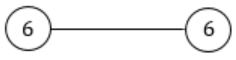
Total no. of edges = 6×6 = 36
Question 12 |
If G is a forest with n vertices and k connected components, how many edges does G have?
⌊n/k⌋ | |
⌈n/k⌉ | |
n–k | |
n-k+1 |
Option 1, 2 will give answer 1. (i.e. one edge among them),
Option 3: n-k = 0 edges.
Option 4: n-k+1 = 1 edge, which is false.
Question 13 |
Let δ denote the minimum degree of a vertex in a graph. For all planar graphs on n vertices with δ ≥ 3, which one of the following is TRUE?
In any planar embedding, the number of faces is at least n/2 + 2 | |
In any planar embedding, the number of faces is less than n/2 + 2 | |
There is a planar embedding in which the number of faces is less than n/2 + 2 | |
There is a planar embedding in which the number of faces is at most n/(δ+1) |
v – e + f = 2 →①
Point ① degree of each vertex is minimum ‘3’.

3×n ≥ 2e
e ≤ 3n/2
From ① :
n-3n/2+f = 2 ⇒

Question 14 |
Consider an undirected graph where self-loops are not allowed. The vertex set of G is {(i,j): 1 ≤ i ≤ 12, 1 ≤ j ≤ 12}. There is an edge between (a,b) and (c,d) if |a - c| ≤ 1 and |b - d| ≤ 1. The number of edges in this graph is __________.
506 | |
507 | |
508 | |
509 |
If we observe the graph, it looks like a 12 by 12 grid. Each corner vertex has a degree of 3 and we have 4 corner vertices. 40 external vertices of degree 5 and remaining 100 vertices of degree 8.
From Handshaking theorem, sum of the degrees of the vertices is equal to the 2*number of edges in the graph.
⇒ (4*3) + (40*5) + (100*8) = 2*E
⇒ 1012 = 2*E
⇒ E = 506
Question 15 |
A cycle on n vertices is isomorphic to its complement. The value of n is _____.
5 | |
6 | |
7 | |
8 |
In a cycle of n vertices, each vertex is connected to other two vertices. So each vertex degree is 2.
When we complement it, each vertex will be connected to remaining n-3 vertices ( one is self and two other vertices in actual graph).
As per given question,
n-3 =2
n=5
Cycle of 5 vertices is

Complement of the above graph1 is

Graph1 and Graph2 are complement each other.
So, the value of n is 5.
Question 16 |
There are two elements x, y in a group (G,∗) such that every element in the group can be written as a product of some number of x's and y's in some order. It is known that
x * x = y * y = x * y * x = y * x * y * x = e
where e is the identity element. The maximum number of elements in such a group is ________.
4 | |
5 | |
6 | |
7 |
a*a-1 = e

1. x*x = e So x-1 is x ⇒ x is element of Group
2. y*y = e So y-1 = y ⇒ y is element of Group

4. (y*x)*(y*x) = x*y*y*x = x*x*e = e So (y*x)-1 = (y*x)
In ③, ④
x*y, y*x has same inverse, there should be unique inverse for each element.
x*y = y*x (even with cumulative law, we can conclude)
So {x, y, e, x*y} are element of Group.
Question 17 |
Consider an undirected random graph of eight vertices. The probability that there is an edge between a pair of vertices is 1/2. What is the expected number of unordered cycles of length three?
1/8 | |
1 | |
7 | |
8 |

The probability that there exists one edge between two vertices = 1/2

So, the total probability that all three edges of the above exists
= 1/2 × 1/2 × 1/2 (as they are independent events)
= 1/8
Total number of ways in which we can select ‘3’ such vertices among ‘8’ vertices = 8C3 = 56
Total number of cycles of length ‘3’ out of 8 vertices = 56 × 1/8 = 7
Question 18 |
Which of the following statements is/are TRUE for undirected graphs?
- P: Number of odd degree vertices is even.
Q: Sum of degrees of all vertices is even.
P only | |
Q only | |
Both P and Q | |
Neither P nor Q |
The sum of the degrees of all the vertices of a graph is an even number (exactly twice the number of edges).
In every graph, the number of vertices of odd degree must be even.
Question 19 |
The line graph L(G) of a simple graph G is defined as follows: · There is exactly one vertex v(e) in L(G) for each edge e in G. · For any two edges e and e' in G, L(G) has an edge between v(e) and v(e'), if and only if e and e'are incident with the same vertex in G. Which of the following statements is/are TRUE?
- (P) The line graph of a cycle is a cycle.
(Q) The line graph of a clique is a clique.
(R) The line graph of a planar graph is planar.
(S) The line graph of a tree is a tree.
P only | |
P and R only | |
R only | |
P, Q and S only |
R) False. We can give counter example. Let G has 5 vertices and 9 edges which is planar graph. Assume degree of one vertex is 2 and of all others are 4. Now, L(G) has 9 vertices (because G has 9 edges) and 25 edges. But for a graph to be planar,
|E| ≤ 3|v| - 6
For 9 vertices |E| ≤ 3 × 9 - 6
⇒ |E| ≤ 27 - 6
⇒ |E| ≤ 21. But L(G) has 25 edges and so is not planar.
As (R) is false, option (B) & (C) are eliminated.
Question 20 |
Let G be a simple undirected planar graph on 10 vertices with 15 edges. If G is a connected graph, then the number of bounded faces in any embedding of G on the plane is equal to
3 | |
4 | |
5 | |
6 |
v-e+f = 2
Given 10 vertices & 15 edges
10-15+f = 2
f = 2+15-10
f = 7
There will be an unbounded face always. So, number of faces = 6.
Question 21 |
K4 and Q3 are graphs with the following structures.
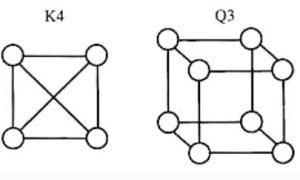
Which one of the following statement is TRUE in relation to these graphs?
K4 is planar while Q3 is not | |
Both K4 and Q3 are planar | |
Q3 is planar while K4 is not | |
Neither K4 not Q3 is planar |
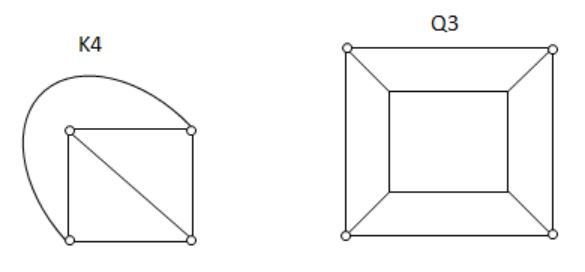
Both the above graphs are planar.
Question 22 |
What is the chromatic number of an n-vertex simple connected graph which does not contain any odd length cycle? Assume n ≥ 2.
2 | |
3 | |
n-1 | |
n |
Eg: Consider a square, which has 4 edges. It can be represented as bipartite ,with chromatic number 2.
Question 23 |
Which of the following statements is true for every planar graph on n vertices?
The graph is connected | |
The graph is Eulerian
| |
The graph has a vertex-cover of size at most 3n/4 | |
The graph has an independent set of size at least n/3
|
(A) Consider the following disconnected graph which is planar.

So false.
(B) A graph is Eulerian if all vertices have even degree but a planar graph can have vertices with odd degree.

So false.
(D) Consider K4 graph. It has independent set size 1 which is less than 4/3.

So false.
Hence, option (C) is correct.
Question 24 |
Which of the following graphs is isomorphic to

 | |
 | |
 | |
 |

(A) 3 cycle graph not in original one.

(B) Correct 5 cycles & max degree is 4.
(C) Original graph doesn’t have a degree of 3.

(D) 4 cycles not in original one.

Question 25 |
Let G be a complete undirected graph on 6 vertices. If vertices of G are labeled, then the number of distinct cycles of length 4 in G is equal to
15 | |
30 | |
45 | |
360 |
It is asked to find the distinct cycle of length 4. As it is complete graph, if we chose any two vertices, there will be an edge.
So, to get a cycle of length 4 (means selecting the 4 edges which can form a cycle) we can select any four vertices.
The number of such selection of 4 vertices from 6 vertices is 6C4 => 15.
From each set of 4 vertices, suppose a set {a, b, c, d} we can have cycles like
a-b-c-d
a-b-d-c
a-c-b-d
a-c-d-b
a-d-b-c
a-d-c-b (Total 6, which is equal to number of cyclic permutations (n-1)! )
As they are labelled you can observe, a-b-c-d and a-d-c-b are same, in different directions.
So, we get only three combinations from the above 6.
So, total number of distinct cycles of length 4 will be 15*3 = 45.
If it is asked about just number of cycles then 15*6 = 90
Question 26 |
Let G = (V,E) be a graph. Define ξ(G) = Σd id x d, where id is the number of vertices of degree d in G. If S and T are two different trees with ξ(S) = ξ(T),then
|S| = 2|T| | |
|S| = |T| - 1 | |
|S| = |T| | |
|S| = |T| + 1 |
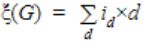
id= no. of vertices of degree ‘d’ in ‘G’
Eg:
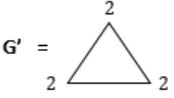
No. of vertices with degree ‘2’ = 3
ξ(G') = 3 × 2 = '6' i.e., sum of degrees
By Handshaking Theorem,
The sum of degrees would be equal to twice the no. of edges
|V| = 2|E|
It is given that ξ(G) = ξ(S) then
Sum of degrees of vertices in G is equal to sum of degrees of vertices in S
i.e., 2*(no. of edges in G) = 2*no. of edges in S no. of edges in G = no. of edges in S
Eg:
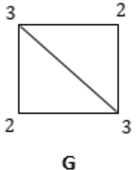
ξ(G) = (2 × 2) + (2 × 3) = 4 + 6 = 10
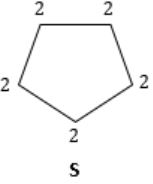
ξ(S) = 2 × 5 = 10
You can observe that, though no. of vertices are different, but still no. of edges are same.
Question 27 |
The degree sequence of a simple graph is the sequence of the degrees of the nodes in the graph in decreasing order. Which of the following sequences can not be the degree sequence of any graph?
- (I) 7, 6, 5, 4, 4, 3, 2, 1
(II) 6, 6, 6, 6, 3, 3, 2, 2
(III) 7, 6, 6, 4, 4, 3, 2, 2
(IV) 8, 7, 7, 6, 4, 2, 1, 1
I and II | |
III and IV | |
IV only | |
II and IV |
⇾ Arrange the degree of vertices in descending order
eg. d1, d2, d3... dn
⇾ Discard d1, subtrack ‘1’ from the next 'd1' degrees
eg:

⇒ 1 1 0 1
⇾ We should not get any negative value if its negative, this is not valid sequence
⇾ Repeat it till we get ‘0’ sequence
I. 7, 6, 5, 4, 4, 3, 2, 1
➡️5, 4, 3, 3, 2, 1, 0
➡️3, 2, 2, 1, 0, 0
➡️1, 1, 0, 0, 0
➡️0, 0, 0, 0
[valid]
II. 6, 6, 6, 6, 3, 3, 2, 2
➡️5, 5, 5, 2, 2, 1, 2
put them in descending order
➡️5, 5, 5, 2, 2, 2, 1
➡️4, 4, 1, 1, 1, 1
➡️3, 0, 0, 0, 1 (descending order)
➡️3, 1, 0, 0, 0
➡️0, -1, -1, 0
[This is not valid]
III. 7, 6, 6, 4, 4, 3, 2, 2
➡️5, 5, 3, 3, 2, 1, 1
➡️4, 2, 2, 1, 0, 1
➡️4, 2, 2, 1, 1, 0 (descending order)
➡️1, 1, 0, 0, 0
➡️0, 0, 0, 0
[valid]
IV. 8, 7, 7, 6, 4, 2, 1, 1
There is a degree ‘8’, but there are only ‘8’ vertices.
A vertex cannot have edge to itself in a simple graph. This is not valid sequence.
Question 28 |
Let G be the non-planar graph with the minimum possible number of edges. Then G has
9 edges and 5 vertices | |
9 edges and 6 vertices | |
10 edges and 5 vertices | |
10 edges and 6 vertices |
if n ≥ 3 then e ≤ 3n-6 (for planarity)
where n = no. of vertices
e = no. of edges
Now lets check the options.
A) e=9, n=5
9 ≤ 3(5) - 6
9 ≤ 15 - 6
9 ≤ 9
Yes, it is planar.
B) e=9, n=6
9 ≤ 3(6) - 6
9 ≤ 18 - 6 9 ≤ 12 Yes, it is planar.
iii) e=10, n=5
10 ≤ 3(5) - 6
10 ≤ 15 - 6
10 ≤ 9 No, it is not planar.
So, option C is non-planar graph.
iv) e=10, n=6
10 ≤ 3(6) - 6
10 ≤ 18 - 6
10 ≤ 12
Yes, it is planar.
Question 29 |
The 2n vertices of a graph G corresponds to all subsets of a set of size n, for n ≥ 6. Two vertices of G are adjacent if and only if the corresponding sets intersect in exactly two elements.
The number of vertices of degree zero in G is:
1 | |
n | |
n+1 | |
2n |
= no. of subsets with size less than or equal to 1
= n+1, because in question it is given that the two vertices are connected if and only if the corresponding sets intersect in exactly two elements.
Question 30 |
The 2n vertices of a graph G corresponds to all subsets of a set of size n, for n ≥ 6. Two vertices of G are adjacent if and only if the corresponding sets intersect in exactly two elements.
The number of connected components in G is:
n | |
n+2 | |
2n/2 | |
2n / n |
While other nodes are connected so that total number of connected components is (n+1)+1
(here we are adding 1 because it is connected corresponding remaining vertices)
= n+2
Question 31 |
Let G be a simple connected planar graph with 13 vertices and 19 edges. Then, the number of faces in the planar embedding of the graph is:
6 | |
8 | |
9 | |
13 |
F = E - V + 2 [From Euler's formula i.e., F + V - E = 2]
F = 19 - 13 +2
F = 8
Question 32 |
Which one of the following is TRUE for any simple connected undirected graph with more than 2 vertices?
No two vertices have the same degree. | |
At least two vertices have the same degree. | |
At least three vertices have the same degree. | |
All vertices have the same degree.
|
If all vertices have different degrees, then the degree sequence will be {1,2,3,....n-1}, it will not have ‘n’( A simple graph will not have edge to itself, so it can have edges with all other (n-1) vertices). Degree sequence has only (n-1) numbers, but we have ‘n’ vertices. So, by Pigeonhole principle there are two vertices which has same degree.
Method 2:
A) Consider a triangle, all vertices has same degree, so it is false
C) Consider a square with one diagonal, there are less than three vertices with same degree, so it is false
D) Consider a square with one diagonal, vertices have different degrees. So, it is false.
We can conclude that option B is correct.
Question 33 |
Which of the following graphs has an Eulerian circuit?
Any k-regular graph where k is an even number. | |
A complete graph on 90 vertices. | |
The complement of a cycle on 25 vertices.
| |
None of the above. |
→ all vertices in the graph have an "even degree".
→ And the graph must be corrected.
Now in option (C) it is saying that the complement of a cycle on 25 vertices without complement the degree of each vertex is 2.
Now since there are 25 vertices, so maximum degree of each vertex will be 24 and so in complement of cycle each vertex degree will be 24 - 2 = 22.
There is a theorem which says "G be a graph with n vertices and if every vertex has a degree of atleast n-1/2 then G is connected."
So we can say that complement of cycle with 25 vertices fulfills both the conditions, and hence is Eulerian circuit.
Question 34 |
The 2n vertices of a graph G corresponds to all subsets of a set of size n, for n ≥ 6. Two vertices of G are adjacent if and only if the corresponding sets intersect in exactly two elements.
The maximum degree of a vertex in G is:
 | |
2n-2 | |
2n-3 × 3 | |
2n-1 |
(k(c))2 2n-k
∴ We need to find 'k' value such that, the value will be maximum.[k should be an integer].
If you differentiate (k(c))2 2n-k w.r.t. k and equal to 0.
You will get k = 2/(loge)2 which is not an integer.
So you can see it like

∴ The maximum degree 3⋅2n-3 at k=3 or k=4.
Question 35 |
Let G be a simple graph with 20 vertices and 100 edges. The size of the minimum vertex cover of G is 8. Then, the size of the maximum independent set of G is
12 | |
8 | |
Less than 8 | |
More than 12
|
Edges = 100
Minimum cover of vertex G is = 8
Maximum Independent set of G = No. of vertices - Minimum cover of vertex G
= 20 - 8
= 12
Question 36 |
Which one of the following graphs is NOT planar?
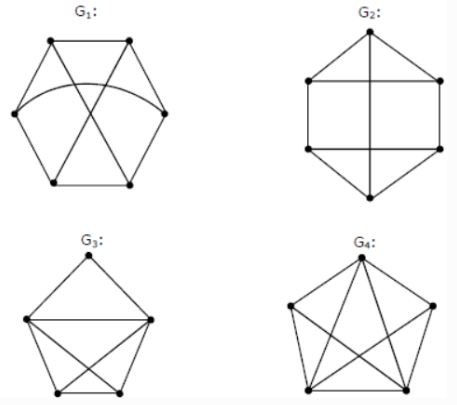
G1 | |
G2 | |
G3 | |
G4 |
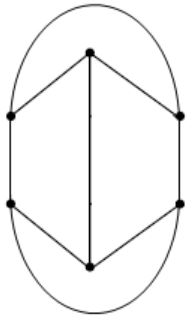
which is planar
G3 can also be drawn as
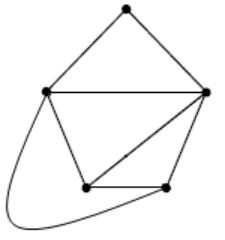
which is planar
G4 can also be drawn as

which is planar
But G1 cannot be drawn as planar graph.
Hence, option (A) is the answer.
Question 37 |
The minimum number of colours required to colour the following graph, such that no two adjacent vertices are assigned the same colour, is
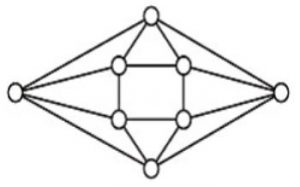
2 | |
3 | |
4 | |
5 |
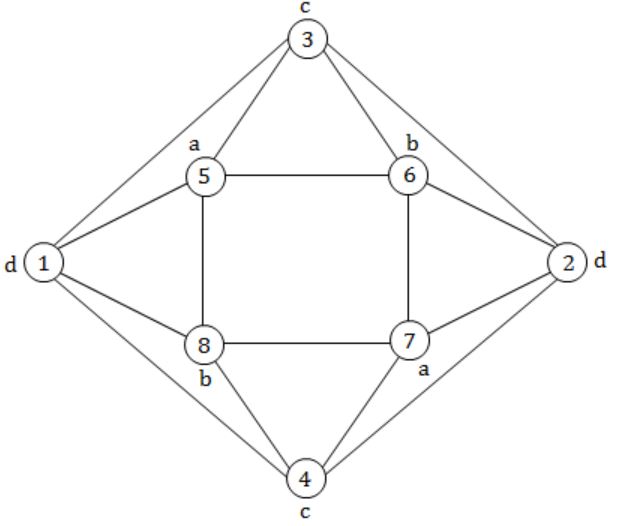
→ a, b, c, d = 4
→ The minimum no. of colours required to colour a graph = 4 (no two adjacent vertices have same colours)
Question 38 |
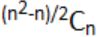
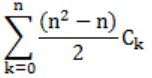
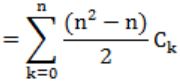
How many graphs on n labeled vertices exist which have at least (n2 - 3n)/2 edges?
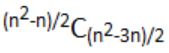 | |
 | |
 | |
 |
Maximum no. of vertices = n(n-1)/2 = v
No. of graphs with minimum b edges is
= C(v,e) + C(v,e+1) + C(v,e+2) + ... + C(v,v)
= C((v,v-e) + C(v,v-(e+1)) + C(v,v-(e+2)) + ... + C(v,0)
= C(a,n) + C(a,n-1) + C(a,n-2) + ... + C(a,0) (since a-b=n)
= C(n(n-1)/2,n) + C(n(n-1)/2,n-1) + ... + C(n(n-1)/2,0)
Question 39 |
Let G be an arbitrary graph with n nodes and k components. If a vertex is removed from G, the number of components in the resultant graph must necessarily lie between
k and n | |
k – 1 and k + 1 | |
k – 1 and n – 1 | |
k + 1 and n – k |
If a vertex is removed then it results that all the components are also be disconnected. So removal can create (n-1) components.
Question 40 |
How many perfect matching are there in a complete graph of 6 vertices ?
15 | |
24 | |
30 | |
60 |
(2n)!/n!×2n
Given, 2n = 6 ⇒ n = 3
So, finally, 6!/3!×23 = 15
Question 41 |
A graph G = (V,E) satisfies |E|≤ 3|V|-6. The min-degree of G is defined as  . Therefore, min-degree of G cannot be
3 | |
4 | |
5 | |
6 |
|E| ≤ 3|v| - 6
Based on handshaking lemma, the minimum degree is (min×|v|)/2
⇒ (min×|v|)/2 ≤ 3|v| - 6
Checking the options lets take min=6
(6×|v|)/2 ≤ 3|v| - 6
0 ≤ -6 (Not satisfied)
And which is inconsistent.
Question 42 |
The minimum number of colours required to colour the vertices of a cycle with η nodes in such a way that no two adjacent nodes have the same colour is
2 | |
3 | |
4 | |
n - 2[n/2] + 2 |
Question 43 |
Maximum number of edges in a n-node undirected graph without self loops is
n2 | |
n(n-1)/2 | |
n-1 | |
(n+1)(n)/2 |
Question 44 |
Let G1 = (V,E1) and G2 = (V,E2) be connected graphs on the same vertex set V with more than two vertices. If G1 ∩ G2 = (V, E1 ∩ E2) is not a connected graph, then the graph G1 U G2 = (V, E1 U E2)
cannot have a cut vertex
| |
must have a cycle | |
must have a cut-edge (bridge)
| |
has chromatic number strictly greater than those of G1 and G2
|
(A)
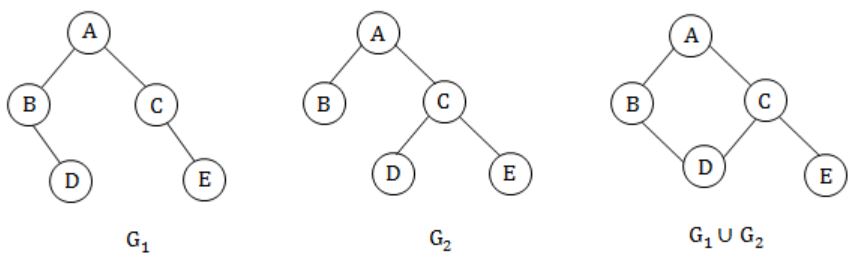
False, since in G1∪G2 'C' is a cut vertex.
(B) True, for all conditions.
(C)

False. G1∪G2 has no bridge.
D)

False. G1∪G2, G1, G2 all the three graphs have chromatic number of 2.
Question 45 |
How many undirected graphs (not necessarily connected) can be constructed out of a given set V = {v1, v2, ...,vn} of n vertices?
n(n-1)/2 | |
2n | |
n! | |
2n(n-1)/2 |
Each subset of these edges will be form a graph.
No. of possible undirected graphs is 2(n C 2)
⇒ 2(n(n-1)/2)
Question 46 |
Let S be a set of n elements {1, 2, …., n} and G a graph with 2n vertices, each vertex corresponding to a distinct subset of S. Two vertices are adjacent iff the symmetric difference of the corresponding sets has exactly 2 elements. Note: The symmetric difference of two sets R1 and R2 is defined as (R1/R2)∪(R2/R1)
(a) Every vertex in G has the same degree. What is the degree of a vertex in G?
(b) How many connected components does G have?
Theory Explanation is given below. |
Question 47 |
Let G be a connected, undirected graph. A cut in G is a set of edges whose removal results in 0 being broken into two or more components which are not connected with each other. The size of a cut is called its cardinality. A men-cut of G is a cut in G of minimum cardinality. Consider the following graph.

(a) Which of the following sets of edges is a cut?
(i) {(A,B), (E,F), (B,D), (A,E), (A,D)}
(ii) {(B,D), (C,F), (A,B)}
(b) What is the cardinality of a min-cut in the graph?
(c) Prove that if a connected undirected graph G with n vertices has a min-cut of cardinality K, then G has atleast (nk/2) edges.
Theory Explanation. |
Question 48 |
(a) Prove by induction that the expression for the number of diagonals in a polygon of n sides is n(n-3)/2.
(b) Let R be a binary relation on A = {a, b, c, d, e, f, g, h} represented by following two component digraph. Find the smallest integers m and n such that mm = Rn.
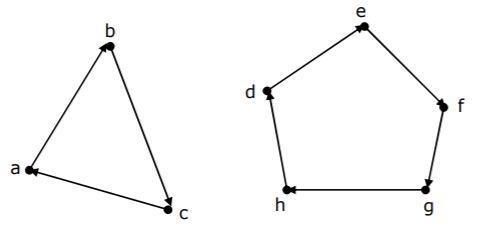
Theory Explanation. |
Question 49 |
Let (A, *) be a semi group. Furthermore, for every a and b in A, if a ≠ b, then a*b ≠ b*a.
(a) Show that for every a in A
a*a = a
(b) Show that for every a, b in A
a*b*a = a
(c) Show that for every a, b, c in A
a*b*c = a*c
Theory Explanation. |
Question 50 |
Let G be a graph with 100 vertices numbered 1 to 100. Two vertices i and j are adjacent if |i - j| = 8 or |i - j| = 12. The number of connected components in G is
8 | |
4 | |
12 | |
25 |
1 — 9 — 17 — ......... — 97
2 — 10 — 18 — ......... — 98
3 — 11 — 19 — ......... — 99
4 — 12 — 20 — ......... — 100
5 — 13 — 21 — ......... — 93
6 — 14 — 22 — ......... — 94
7 — 15 — 23 — ......... — 95
8 — 16 — 24 — ......... — 96
We have covered all vertices using 8 vertex sets considering only |i - j| = 8. Using |i - j| = 12 we can see the vertex 1 is connected to 13, 2 to 14, 3 to 15 and 4 to 16. So the top 4 vertex sets are infact connected to the bottom 4 sets, thus reducing the connected components to 4.
Question 51 |
The minimum number of edges in a connected cyclic graph on n vertices is:
n - 1 | |
n | |
n + 1 | |
None of the above |
In cyclic graph:
No. of edges = No. of vertices
⇒ n = n
Question 52 |
Prove that in finite graph, the number of vertices of odd degree is always even.
Theory Explanation. |
Question 53 |
The number of distinct simple graphs with upto three nodes is
15 | |
10 | |
7 | |
9 |
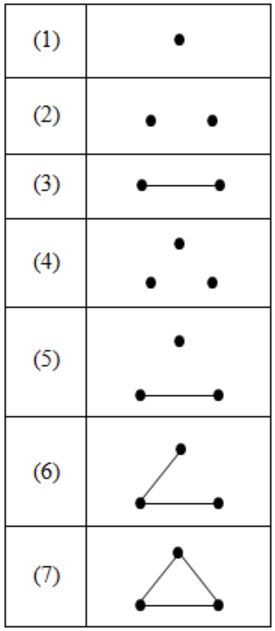
Question 54 |
The number of edges in a regular graph of degree d and n vertices is _________.
d*n/2 |
d * n = 2 * |E|
∴ |E| = d*n/2
Question 55 |
Maximum number of edges in a planar graph with n vertices is ________
3n - 6 |
⇒ (3n - 2) = 3n - 6
Question 56 |
A non-planar graph with minimum number of vertices has
9 edges, 6 vertices | |
6 edges, 4 vertices | |
10 edges, 5 vertices | |
9 edges, 5 vertices |

The above graph with 5 vertices and 10 edges is non-planar.
Question 57 |
Let T be a Depth First Tree of a undirected graph G. An array P indexed by vertices of G is given. P[V] is the parent of vertex V, in T. Parent of the root is the root itself.
Give a method for finding and printing the cycle formed if the edge (u,v) of G not in T (i.e., e ∈ G − T) is now added to T.
Time taken by your method must be proportional to the length of the cycle.
Describe the algorithm in a PASCAL – like language. Assume that the variables have been suitably declared.
Theory Explanation. |
Question 58 |
Graph G is obtained by adding vertex s to K3,4 and making s adjacent to every vertex of K3,4. The minimum number of colours required to edge-colour G is _____.
7 |
The vertex in the set of size 3 has 4 edges connected to 4 vertices on other set. So, edge color of G is max(3,4) i.e. 4.
When a vertex is added to the graph with 7 vertices ( K3x4 has 7 vertices), there would be 7 edges associated to that new vertex. As per the edge coloring “no two adjacent edges have same color).
As the new vertex with 7 edges need to be colored with 7 colors, the edge color of graph G is 7.
Question 59 |
(a) If G is a group of even order, then show that there exists an element a ≠ e, the identity in g, such that a2 = e
(b) Consider the set of integers {1,2,3, 4,6,8,12,24} together with the two binary operations LCM (lowest common multiple) and GCD (greatest common divisor). Which of the following algebraic structures does this represent?
 (i) group            (ii) ring
 (iii) field          (iv) lattice
Theory Explanation. |
Question 60 |
The maximum number of possible edges in an undirected graph with a vertices and k components is ________.
(n-k)(n-k+1)/2 |
To get maximum, take one vertex each for each component, except last component.
Now, k-1 components have 1 vertex each and so on edges.
The last component has (n-(k-1)) vertices. So make the last component complete, i.e., it has n-(n-1)C2
= (n-k)(n-k+1)/2
= maximum no. of edges
Question 61 |
Choose the correct alternatives (More than one may be correct).
A graph is planar if and only if,It does not contain subgraphs homeomorphic to k5 and k3,3. | |
It does not contain subgraphs isomorphic to k5 or k3,3. | |
It does not contain a subgraph isomorphic to k5 or k3,3. | |
It does not contain a subgraph homeomorphic to k5 or k3,3. |
Question 62 |
Which of the following graphs is/are planner?
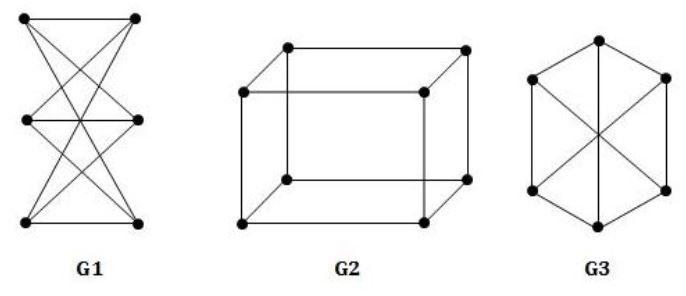
Theory Explanation is given below. |
→ Let us assume K33is a planar graph. Then it satisfy the useful corollary. As there is no triangle in K33.
Let G be a connected planar graph with n vertices and m edges, and no triangles. Then m≤2n-4.
Where m=9, n=6
⇒ 9 ≤ 12 - 4
⇒ 9 ≤ 8, which is to be false, then K33 is non-planar graph.
(ii) G2 is a planar graph. Because it can be redrawn like as below.
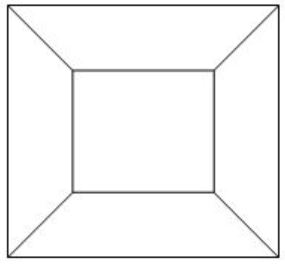
(iii) Let us assume G3 be a planar graph then it also be satisfy useful corollary.
Where m=9, n=6
then 9 ≤ 12-4
9 ≤ 8 is False
So, G3 is non-planar graph.
Answer: Only G2 is planar graph.