
Page-Replacement-Algorithm
Question 1 |
Consider a main memory with five page frames and the following sequence of page references: 3, 8, 2, 3, 9, 1, 6, 3, 8, 9, 3, 6, 2, 1, 3. Which one of the following is true with respect to page replacement policies First-In-First Out (FIFO) and Least Recently Used (LRU)?
Both incur the same number of page faults
| |
FIFO incurs 2 more page faults than LRU | |
LRU incurs 2 more page faults than FIFO | |
FIFO incurs 1 more page faults than LRU |
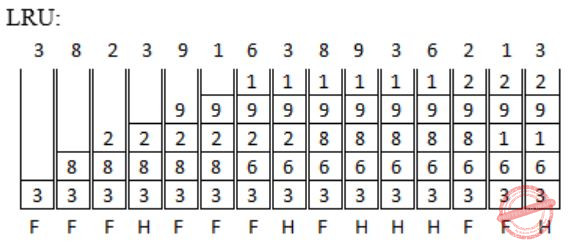
∴ Number of page faults = 9
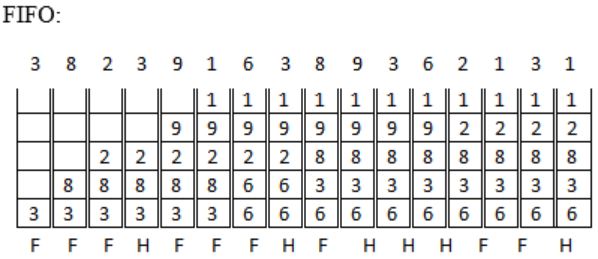
∴ Number of page faults = 9
Question 2 |
Assume that there are 3 page frames which are initially empty. If the page reference string is 1, 2, 3, 4, 2, 1, 5, 3, 2, 4, 6, the number of page faults using the optimal replacement policy is__________.
7 | |
8 | |
9 | |
10 |
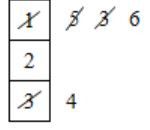
Total 7 faults are there.
Question 3 |
A system uses 3 page frames for storing process pages in main memory. It uses the Least Recently Used (LRU) page replacement policy. Assume that all the page frames are initially empty. What is the total number of page faults that will occur while processing the page reference string given below?
4, 7, 6, 1, 7, 6, 1, 2, 7, 2
6 | |
7 | |
8 | |
9 |
Question 4 |
S1: Random page replacement algorithm (where a page chosen at random is replaced) suffers from Belady’s anomaly
S2: LRU page replacement algorithm suffers from Belady’s anomaly
Which of the following is CORRECT?
S1 is true, S2 is true | |
S1 is true, S2 is false | |
S1 is false, S2 is true | |
S1 is false, S2 is false |
Page replacement algorithm suffers from Belady's anomaly when it is not a stack algorithm.
S1: Random page replacement algorithm is not a stack algorithm. So, S1 is true.
S2: LRU is a stack algorithm. Therefore, it doesn't suffer from Belady's anomaly. S2 is false.
Question 5 |
Consider a computer system with ten physical page frames. The system is provided with an access sequence (a1,a2,…,a20,a1,a2,…,a20), where each ai is a distinct virtual page number. The difference in the number of page faults between the last-in-first-out page replacement policy and the optimal page replacement policy is ___________.
1 | |
2 | |
3 | |
4 |
First we can consider LIFO (Last In First Out) →
a1 to a10 will result in page faults = 10 page faults,
Then a11 will replace a10 (last in is a10), a12 replace a11 and ...till a20 = 10 page faults and a20 will be top of stack and a9…a1 are remained as such.
Then a1 to a9 are already there.
So, 0 page faults from a1 to a9.
a10 will replace a20, a11 will replace a10 and so on = So 11 page faults.
So total faults will be 10+10+11 = 31.
Second Optimal Page Replacement Policy →
a1 to a10 = 10 page faults,
a11 will replace a10 because among a1 to a10, a10 will be used later, a12 will replace a11 and so on = 10 page faults.
a20 will be top of stack and a9…a1 are remained as such.
a1 to a9 = 0 page fault. a10 will replace a1 because it will not be used afterwards and so on, a10 to a19 will have 10 page faults.
So no page fault for a20.
Total = 10+ 10 +10 = 30.
So the difference between LIFO - Optimal = 1
Question 6 |
In which one of the following page replacement algorithms it is possible for the page fault rate to increase even when the number of allocated frames increases?
LRU (Least Recently Used) | |
OPT (Optimal Page Replacement) | |
MRU (Most Recently Used) | |
FIFO (First In First Out) |
In Belady’s anomaly is the phenomenon in which increasing the number of page frames results in an increase in the number of page faults for certain memory access patterns proves that it is possible to have more page faults when increasing the number of page frames while using the First in First Out (FIFO) page replacement algorithm.
In some situations, FIFO page replacement gives more page faults when increasing the number of page frames.
Question 7 |
A computer has twenty physical page frames which contain pages numbered 101 through 120. Now a program accesses the pages numbered 1, 2, …, 100 in that order, and repeats the access sequence THRICE. Which one of the following page replacement policies experiences the same number of page faults as the optimal page replacement policy for this program?
Least-recently-used | |
First-in-first-out | |
Last-in-first-out | |
Most-recently-used |
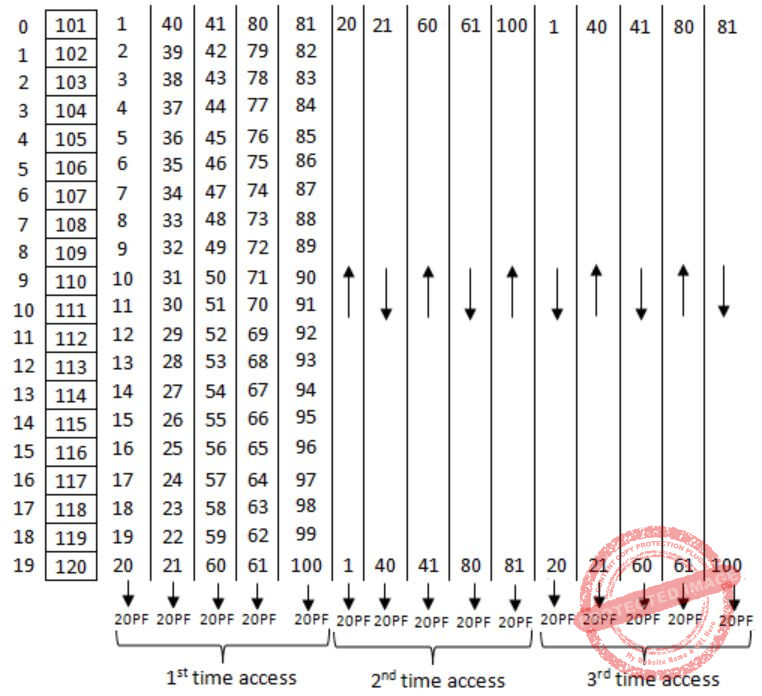
So, there would be 300 page faults in total (each access 100 page faults). Also it is visible that every time a replacement is done for the page which is most recently referred as it will be least recently referred in future. So, for the given page reference string optimal page replacement policy is working same as most recently used policy and thus number of page faults will be same in both of them.
Question 8 |
A system uses FIFO policy for page replacement. It has 4 page frames with no pages loaded to begin with. The system first accesses 100 distinct pages in some order and then accesses the same 100 pages but now in the reverse order. How many page faults will occur?
196 | |
192 | |
197 | |
195 |
Page 1 …….. Page 100 causes 100 faults.
Now, when they are accesses in reverse order page 100, 99, 98, 97 are already present. So we get 96 page faults. So, total of 196 page faults.
Question 9 |
In which one of the following page replacement policies, Belady’s anomaly may occur?
FIFO | |
Optimal | |
LRU | |
MRU |
Question 10 |
The essential content(s) in each entry of a page table is/are
Virtual page number | |
Page frame number | |
Both virtual page number and page frame number | |
Access right information |
Virtual page number can represents index in the page table to get the page frame number.
Question 11 |
A process has been allocated 3 page frames. Assume that none of the pages of the process are available in the memory initially. The process makes the following sequence of page references (reference string): 1, 2, 1, 3, 7, 4, 5, 6, 3, 1
If optimal page replacement policy is used, how many page faults occur for the above reference string?
7 | |
8 | |
9 | |
10 |
1, 2, 1, 3, 7, 4, 5, 6, 3, 1
No. of frames = 3
Using Optimal page replacement,
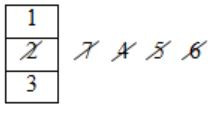
Total 7 page faults.
Question 12 |
Consider the virtual page reference string
1, 2, 3, 2, 4, 1, 3, 2, 4, 1
On a demand paged virtual memory system running on a computer system that main memory size of 3 pages frames which are initially empty. Let LRU, FIFO and OPTIMAL denote the number of page faults under the corresponding page replacements policy. Then
OPTIMAL < LRU < FIFO | |
OPTIMAL < FIFO < LRU | |
OPTIMAL = LRU | |
OPTIMAL = FIFO |

No. of page faults with FIFO = 6
LRU:

No. of page faults with LRU = 9
Optimal:

No. of page faults with optimal = 5
∴ Optimal < FIFO < LRU
Question 13 |
A virtual memory system uses First In First Out (FIFO) page replacement policy and allocates a fixed number of frames to a process. Consider the following statements:
P: Increasing the number of page frames allocated to a
   process sometimes increases the page fault rate.
Q: Some programs do not exhibit locality of reference.
Which one of the following is TRUE?
Both P and Q are true, and Q is the reason for P
| |
Both P and Q are true, but Q is not the reason for P | |
P is false, but Q is true | |
Both P and Q are false |
FIFO suffers from Belady anomaly. Belady anomaly states that when number of page frames increases no. of page fault increases.
Statement Q,
Locality of reference also known as the principle of locality, is the tendency of a processor to accesses the same set of memory locations respectively over a short period of time.
And yes some programs do not exhibit locality of reference.
Hence, both P and Q are true. But Q is not the reason for P.
Question 14 |
A process has been allocated 3 page frames. Assume that none of the pages of the process are available in the memory initially. The process makes the following sequence of page references (reference string): 1, 2, 1, 3, 7, 4, 5, 6, 3, 1
Least Recently Used (LRU) page replacement policy is a practical approximation to optimal page replacement. For the above reference string, how many more page faults occur with LRU than with the optimal page replacement policy?
0 | |
1 | |
2 | |
3 |
1, 2, 1, 3, 7, 4, 5, 6, 3, 1 br> No. of frames = 3 (Using LRU)
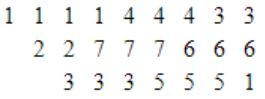
No. of page faults with LRU = 9
⟶ In the LRU we replace the page with least recently used page.
Using optimal page replacement
⟶ 1,2,1,3,7,4,5,6,3,1
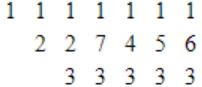
No. of page faults with optimal = 7
Difference between optimal and LRU = 9 - 7 = 2
In optimal we replace the page which will occur last in the future.
Question 15 |
The optimal page replacement algorithm will select the page that
Has not been used for the longest time in the past. | |
Will not be used for the longest time in the future. | |
Has been used least number of times. | |
Has been used most number of times. |
Question 16 |
Consider a virtual memory system with FIFO page replacement policy. For an arbitrary page access pattern, increasing the number of page frames in main memory will
always decrease the number of page faults | |
always increase the number of page faults | |
sometimes increase the number of page faults | |
never affect the number of page faults |
See Belady’s anomaly is the name given to the phenomenon where increasing the number of page frames results in an increase in the number of page faults for a given memory access pattern.
This phenomenon is commonly experienced in following page replacement algorithms:
First in first out (FIFO), Second chance algorithm, Random page replacement algorithm.
Question 17 |
Which of the following page replacement algorithms suffers from Belady’s anamoly?
Optimal replacement | |
LRU | |
FIFO | |
Both (A) and (C) |