
Relations-and-Functions
Question 1 |
The number of onto function (surjective function) from set X = {1, 2, 3, 4} to set Y = {a, b, c} is ______.
36 | |
37 | |
38 | |
39 |

m = 4, n = 3 ⇒ number of onto function is

Question 2 |
Let X and Y denote the sets containing 2 and 20 distinct objects respectively and F denote the set of all possible functions defined from X to Y. Let f be randomly chosen from F. The probability of f being one-to-one is ______.
0.95 | |
0.96 | |
0.97 | |
0.98 |
Number of functions from X to Y is 202 i.e., 400 and number of one-one functions from X to Y is 20P2 i.e., 20×19 = 380
∴ Probability of a function f being one-one is 380/400 i.e., 0.95
Question 3 |
Let S denote the set of all functions f:{0,1}4 → {0,1}. Denote by N the number of functions from S to the set {0,1}. The value of log2log2N is ______.
16 | |
17 | |
18 | |
19 |
{0,1}4 = {0,1}×{0,1}×{0,1}×{0,1} = 16
|S| = 216
N = 2|S|
loglogN=loglog2|S| = log |S| = log216 = 16
Question 4 |
(a) Mr. X claims the following:
If a relation R is both symmetric and transitive, then R is reflexive. For this, Mr. X offers the following proof:
"From xRy, using symmetry we get yRy. Now because R is transitive, xRy and yRy together imply xRx. Therefore, R is reflexive."
Briefly point out the flaw in Mr. X's proof.
(b) Give an example of relation R which is symmetric and transitive but not reflexive.
Theory Explanation |
Question 5 |
Let f be a function defined by
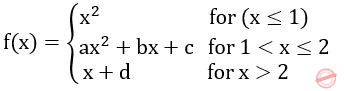
Find the values for the constants a, b, c and d so that f is continuous and differentiable every where on the real line.
Theory Explanation. |
Question 6 |
Let F be the collection of all functions f: {1,2,3} → {1,2,3}. If f and g ∈ F, define an equivalence relation ~ by f ~ g if and only if f(3) = g(3).
a) Find the number of equivalence classes defined by ~.
b) Find the number of elements in each equivalence class.
Theory Explanation. |
Question 7 |
Every element a of some ring (R,+,0) satisfies the equation aoa = a.
Decide whether or not the ring is commutative.
Theory Explanation. |