
Tree-traversal
Question 1 |
Consider the following rooted tree with the vertex labeled P as t he root:

The order in which the nodes are visited during in-order traversal is
SQPTRWUV | |
SQPTUWRV | |
SQPTWUVR | |
SQPTRUWV |
Question 1 Explanation:
The tree can be redrawn as
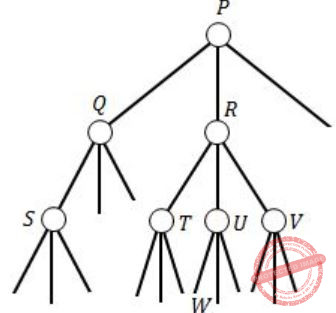
Inorder Traversal: Left, Root, Middle, Right.
So, during inorder traversal whenever we visit the node second time then print it.
So, output will be,
S Q P T R W U V
Inorder Traversal: Left, Root, Middle, Right.
So, during inorder traversal whenever we visit the node second time then print it.
So, output will be,
S Q P T R W U V
Question 2 |
Consider the pseudocode given below. The function DoSomething() takes as argument a pointer to the root of an arbitrary tree represented by the leftMostChild-rightSibling representation. Each node of the tree is of type treeNode.
typedef struct treeNode* treeptr;
struct treeNode
{
    treeptr leftMostChild, rightSibling;
};
int DoSomething (treeptr tree)
{
    int value=0;
    if (tree != NULL)
    {
        if (tree->leftMostChild == NULL)
            value = 1;
        else
            value = DoSomething(tree->leftMostChild);
        value = value + DoSomething(tree->rightSibling);
    }
    return(value);
}
When the pointer to the root of a tree is passed as the argument to DoSomething, the value returned by the function corresponds to the
number of internal nodes in the tree. | |
height of the tree. | |
number of nodes without a right sibling in the tree. | |
number of leaf nodes in the tree. |
Question 2 Explanation:
The key to solving such questions is to understand or detect where/by what condition the value (or the counter) is getting incremented each time.
Here, that condition is if (tree → leftMostchild = = Null)
⇒ Which means if there is no left most child of the tree (or the sub-tree or the current node as called in recursion)
⇒ Which means there is no child to that particular node (since if there is no left most child, there is no child at all).
⇒ Which means the node under consideration is a leaf node.
⇒ The function recursively counts, and adds to value, whenever a leaf node is encountered.
⇒ The function returns the number of leaf nodes in the tree.
Question 3 |
The preorder traversal sequence of a binary search tree is 30, 20, 10, 15, 25, 23, 39, 35, 42. Which one of the following is the postorder traversal sequence of the same tree?
10, 20, 15, 23, 25, 35, 42, 39, 30 | |
15, 10, 25, 23, 20, 42, 35, 39, 30 | |
15, 20, 10, 23, 25, 42, 35, 39, 30 | |
15, 10, 23, 25, 20, 35, 42, 39, 30 |
Question 3 Explanation:
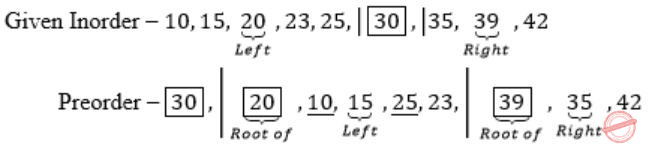
From the data,
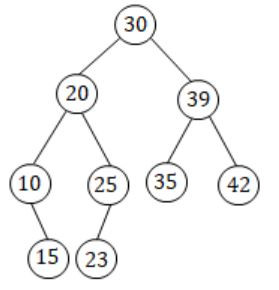
The Postorder traversal sequence is:
→ 15, 10, 23, 25, 20, 35, 42, 39, 30.
There are 3 questions to complete.