
K-Map
Question 1 |
Given f(w,x,y,z) = Σm(0,1,2,3,7,8,10) + Σd(5,6,11,15), where d represents the don’t-care condition in Karnaugh maps. Which of the following is a minimum product-of-sums (POS) form of f(w,x,y,z)?
 | |
 | |
 | |
 |
K-Map for the function f is

Consider maxterms in K-map to represent function in product-of-sums (POS) form
f(w,x,y,z) = (w' + z')(x' + z)
Question 2 |
The total number of prime implicants of the function f(w,x,y,z) = Σ(0, 2, 4, 5, 6, 10) is ______.
3 | |
4 | |
2 | |
1 |

Total 3 prime implicants are there.
Question 3 |
Consider the minterm list form of a Boolean function F given below.
- F(P, Q, R, S) = Σm(0, 2, 5, 7, 9, 11) + d(3, 8, 10, 12, 14)
Here, m denotes a minterm and d denotes a don’t care term. The number of essential prime implicants of the function F is _______.
3 | |
4 | |
5 |
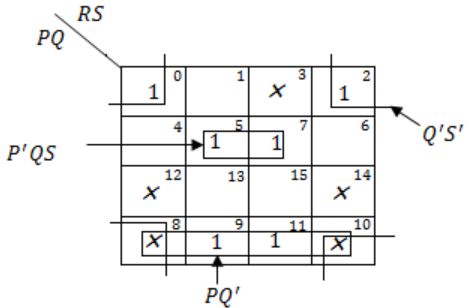
There are 3 prime implicant i.e., P’QS, Q’S’ and PQ’ and all are essential.
Because 0 and 2 are correct by only Q’S’, 5 and 7 are covered by only P’QS and 8 and 9 are covered by only PQ’.
Question 4 |
Consider the Karnaugh map given below, where X represents “don’t care” and blank represents 0.
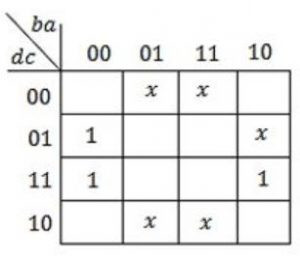
Assume for all inputs 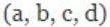 , the respective complements
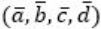 are also available. The above logic is implemented using 2-input NOR gates only. The minimum number of gates required is _________.
1 | |
2 | |
3 | |
4 |
As all variables and their complements are available we can implement the function with only one NOR Gate.
Question 5 |
S1: F = Σ (4, 5, 6)
S2: F = Σ (0, 1, 2, 3, 7)
S3: F = Π (4, 5, 6)
S4: F = Π (0, 1, 2, 3, 7)
Which of the following is true?
S1-False, S2-True, S3-True, S4-False | |
S1-True, S2-False, S3-False, S4-True | |
S1-False, S2-False, S3-True, S4-True | |
S1-True, S2-True, S3-False, S4-False |
Question 6 |
What is the minimal form of the karnaugh map shown below? Assume that X denotes a don't care term

 | |
 | |
 | |
 |

Question 7 |
In the Karnaugh map shown below, X denotes a don’t care term. What is the minimal form of the function represented by the Karnaugh map?
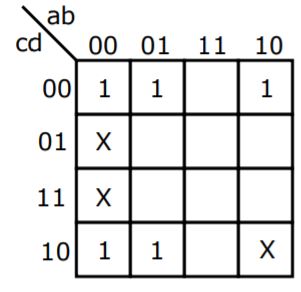
 | |
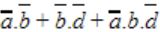 | |
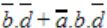 | |
 |
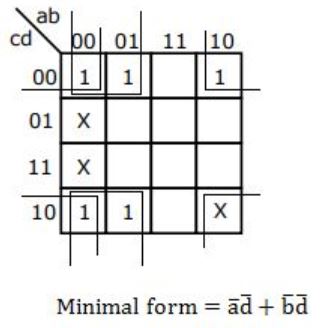
Question 8 |
Consider a Boolean function f(w,x,y,z). Suppose that exactly one of its inputs is allowed to change at a time. If the function happens to be true for two input vectors i1 = 〈w1, x1, y1, z1〉 and i2 = 〈w2, x2, y2, z2〉, we would like the function to remain true as the input changes from vectors i1 to i2 (i1 and i2 differ in exactly one bit position), without becoming false momentarily. Let f(w,x,y,z) = ∑(5,7,11,12,13,15). Which of the following cube covers of f will ensure that the required property is satisfied?
 | |
 | |
 | |
 |
f = X1 * X2 + X1' * X3
If (X1, X2, X3) = (1,1,1) then f=1 because X1 * X2 =1 X1' * X3 = 0.
Let the input is changed from 111 to 011 , then f = 1 because X1 * X2 = 0 X1' * X3 =1.
The output f will be momentarily 0 if AND gate X1 * X2 is faster than the AND gate X1' * X3.
This Hazard can be avoided by adding the term X2 * X3 (because X1 is in true form in first term and in complement form in the second term . So pick the fixed terms X2 and X3 from both terms) to f i.e f = X1 * X2 + X1' * X3 + X2 * X3
Option D is equivalent to f(w, x, y, z) = ∑(5,7,11,12,13,15)
Question 9 |
Which are the essential prime implicants of the following Boolean function?
f(a,b,c) = aȼc + acȼ + bȼc
aȼc and acȼ | |
aȼc and bȼc | |
aȼc only | |
acȼ and bcȼ |

There are two EPI,
A'C and AC'.
Question 10 |
Minimum sum of product expression for f(w,x,y,z) shown in Karnaugh-map below is

xz+y'z | |
xz'+zx' | |
x'y+zx' | |
None of the above |
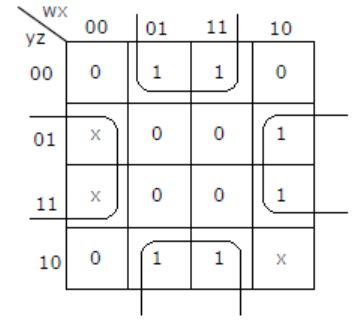
⇒ xz' + zx'