
Software-Reliability
Question 1 |
The following table shoes the time between failures for a software system
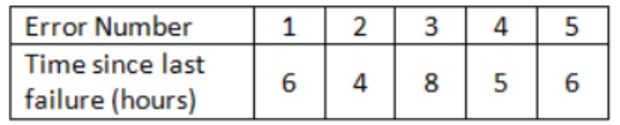
The reliability of the system for one hour of operation assuming an exponential model is
0.45 | |
0.63 | |
0.84 | |
0.95 |
Question 1 Explanation:
MIBF = ∑(Start of downtime - Start of uptime)/No. of failures
MIBF = (6+4+8+5+6)/5 = 29/5
The probability or reliability that the product will work for a defined period of time without failure is given by
R(T) = exp(-T/MTBF); T = 1 hour
R(1) = e(-1/(29/5)) = e(-5/29) = 0.84
MIBF = (6+4+8+5+6)/5 = 29/5
The probability or reliability that the product will work for a defined period of time without failure is given by
R(T) = exp(-T/MTBF); T = 1 hour
R(1) = e(-1/(29/5)) = e(-5/29) = 0.84
Question 2 |
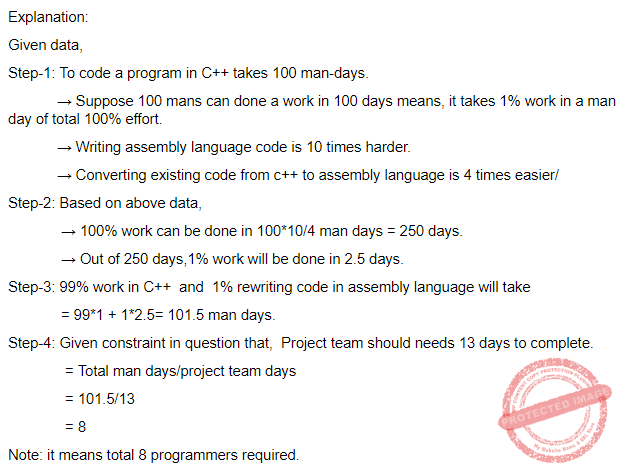
In a particular program, it is found that 1% of the code accounts for 50% of the execution time. To code a program in C++, it takes 100 man-days. Coding in assembly language is 10 times harder than coding in C++ but runs 5 times faster. Converting an existing C++ program into an assembly language program is 4 times faster.
To completely write the program in C++ and rewrite the 1% code in assembly language, if a project team needs 13 days, the team consists
To completely write the program in C++ and rewrite the 1% code in assembly language, if a project team needs 13 days, the team consists
13 programmers | |
10 programmers | |
8 programmers | |
100/13 programmers |
Question 2 Explanation:
Question 3 |
A program p calls two subprograms P1 and P2. P1 can fail 50% time and P2 can fail 40% times. The program P can fail
50% | |
10% | |
60% | |
70% |
Question 3 Explanation:
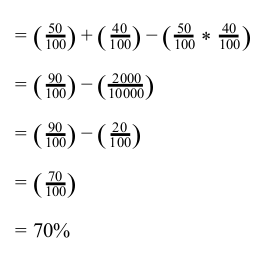
Program P fails when either P1 fails or P2 fails, i.e., failure of P1 + failure of P2 .
But this will also contain the case when both P1 and P2 fails at the same time, i.e., failure of P1 ∩ failure of P2 , since this case will be already be counted on ( P1+P2 ).
Therefore, our final answer will be failure of P1 + failure of P2 - (failure of P1 ∩ failure of P2)
But this will also contain the case when both P1 and P2 fails at the same time, i.e., failure of P1 ∩ failure of P2 , since this case will be already be counted on ( P1+P2 ).
Therefore, our final answer will be failure of P1 + failure of P2 - (failure of P1 ∩ failure of P2)
There are 3 questions to complete.