
Circuits-Output
Question 1 |
The control signal functions of a 4-bit binary counter are given below (where X is “don’t care”) The counter is connected as follows:
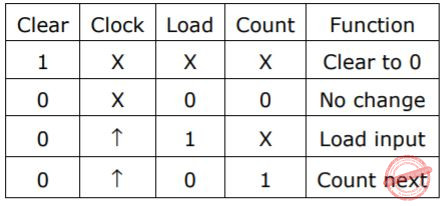
The counter is connected as follows:
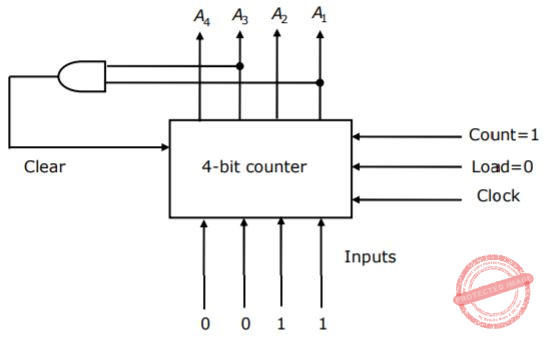
Assume that the counter and gate delays are negligible. If the counter starts at 0, then it cycles through the following sequence:
0, 3, 4 | |
0, 3, 4, 5 | |
0, 1, 2, 3, 4 | |
0, 1, 2, 3, 4, 5 |
Question 1 Explanation:
A counter goes through a sequence of states. Given counter resets when A1 = A3 = 1.
Here, initial state is 0000. It goes through 0001,0010,0011,0100 and 0101. When the state is 5(0101) it immediately resets to initial state 0. Here, state 5 is not considered as valid state.
So valid states are 0,1,2,3, and 4 and hence it is a Mod5 counter.
Here, initial state is 0000. It goes through 0001,0010,0011,0100 and 0101. When the state is 5(0101) it immediately resets to initial state 0. Here, state 5 is not considered as valid state.
So valid states are 0,1,2,3, and 4 and hence it is a Mod5 counter.
Question 2 |
Consider the following circuit.
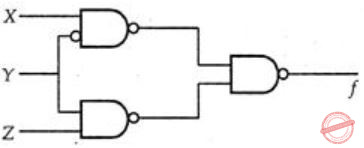
Which one of the following is TRUE?
f is independent of X
| |
f is independent of Y | |
f is independent of Z | |
None of X, Y, Z is redundant |
Question 2 Explanation:
f(X,Y,Z) = ((XY’)’ (YZ))’
= ((X’+Y) YZ)’
= (X’YZ + YZ)’
= ((X’+1) YZ)’
= (YZ)’
= ((X’+Y) YZ)’
= (X’YZ + YZ)’
= ((X’+1) YZ)’
= (YZ)’
There are 2 questions to complete.