
Context-Free-Grammar
Question 1 |
Let G be a context-free grammar where G = ({S, A, B, C},{a,b,d},P,S) with the productions in P given below.
   S → ABAC
   A → aA ∣ ε
   B → bB ∣ ε
   C → d
(ε denotes null string). Transform the grammar G to an equivalent context-free grammar G' that has no ε productions and no unit productions. (A unit production is of the form x → y, and x and y are non terminals.)
Theory Explanation. |
Question 2 |
(a) Let G1 = (N, T, P, S1) be a CFG where,
N = {S1, A, B}, T = {a,b} and
P is given by
         S1 → aS1b             S1 → aBb
         S1 → aAb              B → Bb
         A → aA                B → b
         A → a
What is L(G1)?
(b) Use the grammar in part(a) to give a CFG
for L2 = {ai bj ak bl | i, j, k, l ≥ 1, i=j or k=l} by adding not more than 5 production rule.
(c) Is L2 inherently ambiguous?
Theory Explanation. |
Question 3 |
A simple Pascal like language has only three statements.
(i) assignment statement e.g. x:=expression
(ii) loop construct e.g. for i:=expression to expression do statement.
(iii) sequencing e.g. begin statement ;…; statement end
(a) Write a context-free grammar (CFG) for statements in the above language. Assume that expression has already been defined. Do not use optional
parentheses and * operator in CFG.
(b) Show the parse tree for the following statement:
     for j:=2 to 10 do
         begin x:=expr1;
               y:=expr2
end Theory Explanation. |
Question 4 |
S → aSb | X
X → aX | Xb | a | b ,
where S and X are non-terminals, and a and b are terminal symbols. The starting non-terminal is S. Which one of the following statements is CORRECT?
The language generated by G is (a + b)* | |
The language generated by G is a*(a + b)b* | |
The language generated by G is a*b*(a + b) | |
The language generated by G is not a regular language |
Question 5 |
two | |
three | |
four | |
five |
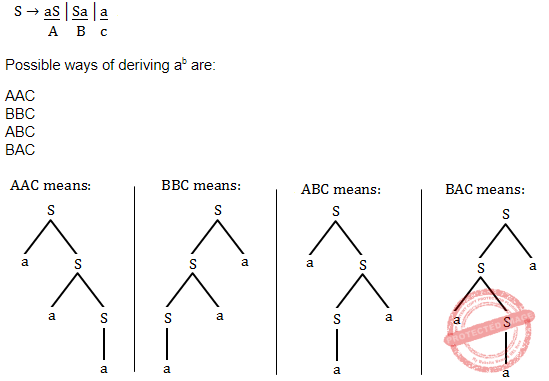
Question 6 |
S → XYX
X → aX|bX|λ
Y → bbb
generates the language which is defined by regular expression:
(a + b)*bbb | |
abbb(a + b)* | |
(a + b)*(bbb)(a + b)* | |
(a + b)(bbb)(a + b)* |
Option(B) is incorrect because "bbbb(a+b)* can also be generated by given grammar.
Option (C) is correct because S → XYX X → aX|bX|λ Y → bbb , here "bbb" will be in middle and X → aX|bX|λ can generate (a+b)* and since S → XYX is having "X" before and after "Y" so it is correct.
Option (D) is not correct because X → aX|bX|λ can generate (a+b)^* and since S → XYX is having "X" before and after "Y" so we can have (a+b)* before and after "bbb"
Question 7 |
Context free but not linear
| |
Not context free
| |
Context free and linear
| |
Linear |
Question 8 |
S -- < Sa | b | |
S -- > aSb | ab | |
S -- < abX, X --> cY, Y -- > d | aX | |
None of the given options |