
DFA
Question 1 |
Design a deterministic finite state automaton (using minimum number of states) that recognizes the following language:
L = {w ∈ {0,1}* | w interpreted as a binary number (ignoring the leading zeros) is divisible by 5}
Theory Explanation. |
Question 2 |
Draw the state transition of a deterministic finite state automaton which accepts all strings from the alphabet {a,b}, such that no string has 3 consecutive occurrences of the letter b.
Theory Explanation. |
Question 3 |
L U {01} | |
L.L | |
{0,1}*-L | |
L-{01} |
Question 4 |
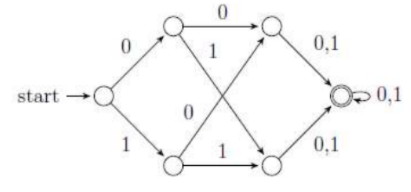
The number of strings of length 8 accepted by the above automaton is __________.
256 |
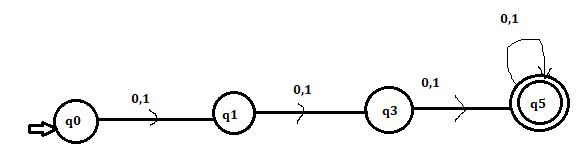
So the DFA accepts all strings of length greater than equal to 3.
For 8 length strings we have 8 positions
_ _ _ _ _ _ _ _
For each position there are two possibilities 0 or 1.
So for 8 positions we have 28 possibilities = 256
Question 5 |
Consider the regular grammar:
S → Xa | Ya
X → Za Z → Sa | ϵ
Y → Wa W → Sa
where S is the starting symbol, the set of terminals is {a} and the set of non-terminals is {S, W, X, Y, Z}. We wish to construct a deterministic finite automaton (DFA) to recognize the same language. What is the minimum number of states required for the DFA?
2 | |
3 | |
4 | |
5 |
The minimum string length is 2 [aa], so we require 3 states to construct DFA.