
Data-Interpretation
Question 1 |
The total electricity generation in a country is 97 GW. The contribution of various energy sources is indicated in percentage terms in the Pie Chart given below ;

What is the contribution of wind and solar power in absolute terms in the electricity generation ?
What is the contribution of wind and solar power in absolute terms in the electricity generation ?
6.79 GW | |
19.4 GW | |
9.7 GW | |
29.1 GW |
Question 2 |
The total electricity generation in a country is 97 GW. The contribution of various energy sources is indicated in percentage terms in the Pie Chart given below ;
What is the contribution of renewable energy sources in absolute terms in the electricity generation ?
What is the contribution of renewable energy sources in absolute terms in the electricity generation ?
29.1 GW | |
26.19 GW | |
67.9 GW | |
97 GW |
Question 3 |
Read the table below and based on this table answer questions from 6 to 11:
Area under Major Horticulture Crops (in lakh hectares)

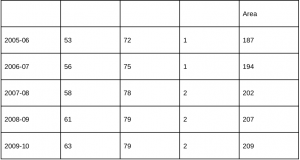
Which of the following two years have recorded the highest rate of increase in area under the total horticulture?
Area under Major Horticulture Crops (in lakh hectares)
Which of the following two years have recorded the highest rate of increase in area under the total horticulture?
2005-06 & 2006-07 | |
2006-07 & 2008-09 | |
2007-08 & 2008-09 | |
2006-07 & 2007-08 |
Question 4 |
Read the table below and based on this table answer questions from 6 to 11:
Area under Major Horticulture Crops (in lakh hectares)
Shares of the area under flowers, vegetables and fruits in the area under total horticulture are respectively:
Area under Major Horticulture Crops (in lakh hectares)
Shares of the area under flowers, vegetables and fruits in the area under total horticulture are respectively:
1, 38 and 30 percent | |
30, 38 and 1 perctent | |
38, 30 and 1 percent | |
35, 36 and 2 percent |
Question 5 |
Read the table below and based on this table answer questions from 6 to 11:
Area under Major Horticulture Crops (in lakh hectares)
Which of the following has recorded the highest rate of increase in area during 2005-06 to 2009-10?
Area under Major Horticulture Crops (in lakh hectares)
Which of the following has recorded the highest rate of increase in area during 2005-06 to 2009-10?
Fruits | |
Vegetables | |
Flowers | |
Total horticulture |
Question 6 |
Read the table below and based on this table answer questions from 6 to 11:
Area under Major Horticulture Crops (in lakh hectares)
Find out the horticultural crops that have recorded an increase of area by around 10 percent from 2005-06 to 2009-10.
Area under Major Horticulture Crops (in lakh hectares)
Find out the horticultural crops that have recorded an increase of area by around 10 percent from 2005-06 to 2009-10.
Fruits | |
Vegetables | |
Flower | |
Total horticulture |
Question 7 |
Read the table below and based on this table answer questions from 6 to 11:
Area under Major Horticulture Crops (in lakh hectares)
What has been the share of area under fruits, vegetables and flowers in the area under total horticulture in 2007-08?
Area under Major Horticulture Crops (in lakh hectares)
What has been the share of area under fruits, vegetables and flowers in the area under total horticulture in 2007-08?
53 percent | |
68 percent | |
79 percent | |
100 percent |
Question 8 |
Read the table below and based on this table answer questions from 6 to 11:
Area under Major Horticulture Crops (in lakh hectares)
In which year, area under fruits has recorded the highest rate of increase?
Area under Major Horticulture Crops (in lakh hectares)
In which year, area under fruits has recorded the highest rate of increase?
2006-07 | |
2007-08 | |
2008-09 | |
2009-10 |
Question 9 |
For a country CO2 emissions (million metric tons) from various sectors are given in the following table. Answer the questions (55 to 60) based on the data given :
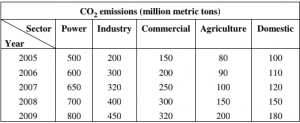
What is the percentage (%) growth of CO2 emissions from power sector during 2005 to 2009 ?
What is the percentage (%) growth of CO2 emissions from power sector during 2005 to 2009 ?
60 | |
50 | |
40 | |
80 |
Question 10 |
For a country CO2 emissions (million metric tons) from various sectors are given in the following table. Answer the questions (55 to 60) based on the data given :
By what percentage (%), the total emissions of CO 2 have increased from 2005 to 2009?
By what percentage (%), the total emissions of CO 2 have increased from 2005 to 2009?
~89.32% | |
~57.62% | |
~40.32% | |
~113.12% |
Question 11 |
For a country CO2 emissions (million metric tons) from various sectors are given in the following table. Answer the questions (55 to 60) based on the data given :
What is the average annual growth rate of CO 2 emission in power sector?
What is the average annual growth rate of CO 2 emission in power sector?
~12.57% | |
~16.87% | |
~30.81% | |
~50.25% |
Question 12 |
For a country CO2 emissions (million metric tons) from various sectors are given in the following table. Answer the questions (55 to 60) based on the data given :
What is the percentage contribution of power sector to total CO 2 emission in the year 2008?
What is the percentage contribution of power sector to total CO 2 emission in the year 2008?
~30.82% | |
~41.18% | |
~51.38% | |
~60.25% |
Question 13 |
For a country CO2 emissions (million metric tons) from various sectors are given in the following table. Answer the questions (55 to 60) based on the data given :
In which year, the contribution (%) of industry to total sectoral CO 2 emission was minimum?
In which year, the contribution (%) of industry to total sectoral CO 2 emission was minimum?
2005 | |
2006 | |
2007 | |
2008 |
Question 14 |
For a country CO2 emissions (million metric tons) from various sectors are given in the following table. Answer the questions (55 to 60) based on the data given :
Which sector has recorded maximum growth in CO 2 emission during 2005 to 2009?
Which sector has recorded maximum growth in CO 2 emission during 2005 to 2009?
Power | |
Industry | |
Commercial | |
Agriculture |
Question 15 |
Following table provides details about the Foreign Tourist Arrivals (FTAs) in India from different regions of the’ world in different years. Study the table carefully and answer questions from 57 to 60 based on this table.
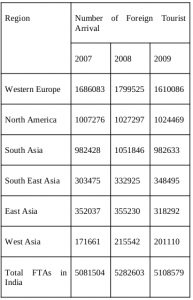
Find out the region that contributed around 20 percent of the total foreign tourist arrivals in India in 2009.
Find out the region that contributed around 20 percent of the total foreign tourist arrivals in India in 2009.
Western Europe | |
North America | |
South Asia | |
South East Asia |
Question 16 |
Following table provides details about the Foreign Tourist Arrivals (FTAs) in India from different regions of the’ world in different years. Study the table carefully and answer questions from 57 to 60 based on this table.
Which of the following regions has recorded the highest negative growth rate of foreign tourist arrivals in India in 2009?
Which of the following regions has recorded the highest negative growth rate of foreign tourist arrivals in India in 2009?
Western Europe | |
North America | |
South Asia | |
West Asia |
Question 17 |
Following table provides details about the Foreign Tourist Arrivals (FTAs) in India from different regions of the’ world in different years. Study the table carefully and answer questions from 57 to 60 based on this table.
Find out the region that has been showing declining trend in terms of share of foreign tourist arrivals in India in 2008 and 2009.
Find out the region that has been showing declining trend in terms of share of foreign tourist arrivals in India in 2008 and 2009.
Western Europe | |
South East Asia | |
East Asia | |
West Asia |
Question 18 |
Following table provides details about the Foreign Tourist Arrivals (FTAs) in India from different regions of the’ world in different years. Study the table carefully and answer questions from 57 to 60 based on this table.
Identify the region that has shown hyper growth rate of foreign tourist arrivals than the growth rate of the total FTAs in India in 2008.
Identify the region that has shown hyper growth rate of foreign tourist arrivals than the growth rate of the total FTAs in India in 2008.
Western Europe | |
North America | |
South Asia | |
East Asia |
Question 19 |
In the following table, trends in production of energy in India by primary sources are given. Study the table and answer Question Nos. 20 to 23 : (Production in peta Joules)
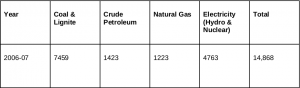
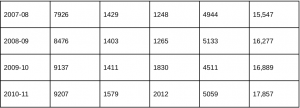
In which year primary sources recorded the lowest growth in total production of energy ?
In which year primary sources recorded the lowest growth in total production of energy ?
2007–08 | |
2008–09 | |
2009–10 | |
2010–11 |
Question 20 |
In the following table, trends in production of energy in India by primary sources are given. Study the table and answer Question Nos. 20 to 23 : (Production in peta Joules)
Which source of energy has shown the highest growth rate in production during 2006-07 to 2010-11 ?
Which source of energy has shown the highest growth rate in production during 2006-07 to 2010-11 ?
Coal & lignite | |
Crude petroleum | |
Hydro & nuclear electricity | |
Total production of energy |
Question 21 |
In the following table, trends in production of energy in India by primary sources are given. Study the table and answer Question Nos. 20 to 23 : (Production in peta Joules)
Which one of the following primary sources of energy has recorded the highest growth in production in 2008–09 ?
Which one of the following primary sources of energy has recorded the highest growth in production in 2008–09 ?
Coal & lignite | |
Crude petroleum | |
Natural gas | |
Hydro & nuclear electricity |
Question 22 |
Read the following table and answer question no 18-22 based on table

Which of the following sources of Irrigation has registered the largest percentage of decline in Net area under irrigation during 1997-98 and 2005-06 ?
Which of the following sources of Irrigation has registered the largest percentage of decline in Net area under irrigation during 1997-98 and 2005-06 ?
Government Canals | |
Private Canals | |
Tanks | |
Other Sources |
Question 23 |
Read the following table and answer question no 18-22 based on table
Find out the source of irrigation that has registered the maximum improvement in terms of percentage of Net irrigated area during 2002-03 and 2003-04.
Find out the source of irrigation that has registered the maximum improvement in terms of percentage of Net irrigated area during 2002-03 and 2003-04.
Government Canals | |
Tanks | |
Tube Wells and other wells | |
Other Sources |
Question 24 |
Read the following table and answer question no 18-22 based on table
In which of the following years, Net irrigation by tanks increased at the highest rate?
In which of the following years, Net irrigation by tanks increased at the highest rate?
1998-99 | |
2000-01 | |
2003-04 | |
2005-06 |
Question 25 |
In the following table, trends in production of energy in India by primary sources are given. Study the table and answer Question Nos. 20 to 23 : (Production in peta Joules)
In which year, production of hydro and nuclear electricity was almost double the production of crude petroleum and natural gas taken together ?
In which year, production of hydro and nuclear electricity was almost double the production of crude petroleum and natural gas taken together ?
2006–07 | |
2007–08 | |
2008–09 | |
2009–10 |
Question 26 |
Read the following table and answer question no 18-22 based on table
Identify the source of irrigation that has recorded the maximum incidence of negative growth in terms of Net irrigated area during the years given in the table.
Identify the source of irrigation that has recorded the maximum incidence of negative growth in terms of Net irrigated area during the years given in the table.
Government Canals | |
Private Canals | |
Tube Wells and other wells | |
Other sources |
Question 27 |
Read the following table and answer question no 18-22 based on table
In which of the following years, share of the tube wells and other wells in the total net irrigated area was the highest?
In which of the following years, share of the tube wells and other wells in the total net irrigated area was the highest?
1998-99 | |
2000-01 | |
2002-03 | |
2004-05 |
Question 28 |
Consider the following two tables (I and II) that show the percentage of students in each faculty at University and the number of foreign students in the Science faculty. These percentages have been rounded to the nearest whole number. There are a total of 1049 students in the science faculty. Study these tables I and II and answer the questions that follow (Questions 9 – 31):
I: Students Faculty wise
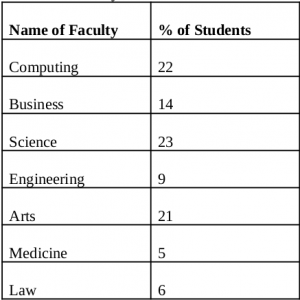
II : Foreign Students in Science Faculty
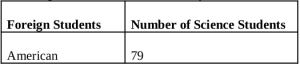
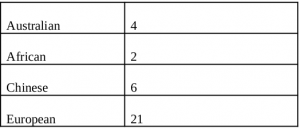
Approximately, what percentage of students in the Science faculty is that of foreign students?
I: Students Faculty wise
II : Foreign Students in Science Faculty
Approximately, what percentage of students in the Science faculty is that of foreign students?
14% | |
9% | |
30% | |
11% |
Question 29 |
Consider the following two tables (I and II) that show the percentage of students in each faculty at University and the number of foreign students in the Science faculty. These percentages have been rounded to the nearest whole number. There are a total of 1049 students in the science faculty. Study these tables I and II and answer the questions that follow (Questions 9 – 31):
I: Students Faculty wise
II : Foreign Students in Science Faculty
Approximately, how many students belong to the Engineering faculty?
I: Students Faculty wise
II : Foreign Students in Science Faculty
Approximately, how many students belong to the Engineering faculty?
420 | |
410 | |
390 | |
400 |
Question 30 |
Consider the following two tables (I and II) that show the percentage of students in each faculty at University and the number of foreign students in the Science faculty. These percentages have been rounded to the nearest whole number. There are a total of 1049 students in the science faculty. Study these tables I and II and answer the questions that follow (Questions 9 – 31):
I: Students Faculty wise
II : Foreign Students in Science Faculty
In case, there are 34 European medical students, then approximately, what is their percentage in the medicine faculty?
I: Students Faculty wise
II : Foreign Students in Science Faculty
In case, there are 34 European medical students, then approximately, what is their percentage in the medicine faculty?
13% | |
18% | |
12% | |
15% |
Question 31 |
The following table shows the percentage profit (%) earned by two companies A and B during the years 2011 - 15. Answer questions 51 - 53 based on the data contained in the table:
Profit earned by the companies
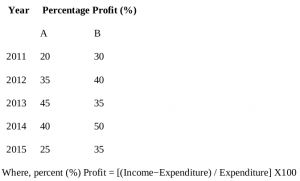
If the total expenditure of the two companies was Rs. 9 lakh in the year 2012 and the expenditure of A and B were in the ratio 2:1, then what was the income of the company A in that year?
Profit earned by the companies
If the total expenditure of the two companies was Rs. 9 lakh in the year 2012 and the expenditure of A and B were in the ratio 2:1, then what was the income of the company A in that year?
Rs. 9.2 lakh | |
Rs. 8.1 lakh | |
Rs. 7.2 lakh | |
Rs. 6.0 lakh |
Question 32 |
The following table shows the percentage profit (%) earned by two companies A and B during the years 2011 - 15. Answer questions 51 - 53 based on the data contained in the table:
Profit earned by the companies
What is the average percentage profit earned by the company B?
Profit earned by the companies
What is the average percentage profit earned by the company B?
35% | |
42% | |
38% | |
40% |
Question 33 |
The following table shows the percentage profit (%) earned by two companies A and B during the years 2011 - 15. Answer questions 51 - 53 based on the data contained in the table:
Profit earned by the companies
In which year, the percentage profit earned by the company B is less than that of company A?
Profit earned by the companies
In which year, the percentage profit earned by the company B is less than that of company A?
2012 | |
2013 | |
2014 | |
2015 |
Question 34 |
A college has a total of 800 MCA students, 80% of whom are in class MCA-III and remaining are equally divided between class MCA-I and class MCA-II. The proportion of female students and the proportion of vegetarian students in the college are indicated as under through the table.
Answer questions 32 to 34 based on this information.
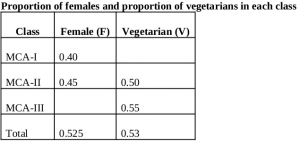
For example, in the table above, 0.525 is the total proportion of female students and 0.53 is the total proportion of vegetarian students in the college.
What is the percentage of female students in class MCA-III?
Answer questions 32 to 34 based on this information.
For example, in the table above, 0.525 is the total proportion of female students and 0.53 is the total proportion of vegetarian students in the college.
What is the percentage of female students in class MCA-III?
40 | |
45 | |
50 | |
55 |
Question 35 |
A college has a total of 800 MCA students, 80% of whom are in class MCA-III and remaining are equally divided between class MCA-I and class MCA-II. The proportion of female students and the proportion of vegetarian students in the college are indicated as under through the table.
Answer questions 32 to 34 based on this information.
For example, in the table above, 0.525 is the total proportion of female students and 0.53 is the total proportion of vegetarian students in the college.
What is the percentage of vegetarian students in class MCA-I?
Answer questions 32 to 34 based on this information.
For example, in the table above, 0.525 is the total proportion of female students and 0.53 is the total proportion of vegetarian students in the college.
What is the percentage of vegetarian students in class MCA-I?
40 | |
45 | |
50 | |
55 |
Question 36 |
A college has a total of 800 MCA students, 80% of whom are in class MCA-III and remaining are equally divided between class MCA-I and class MCA-II. The proportion of female students and the proportion of vegetarian students in the college are indicated as under through the table.
Answer questions 32 to 34 based on this information.
For example, in the table above, 0.525 is the total proportion of female students and 0.53 is the total proportion of vegetarian students in the college.
How many total non-vegetarian students are there in class MCA-I and class MCA-II?
Answer questions 32 to 34 based on this information.
For example, in the table above, 0.525 is the total proportion of female students and 0.53 is the total proportion of vegetarian students in the college.
How many total non-vegetarian students are there in class MCA-I and class MCA-II?
72 | |
88 | |
78 | |
92 |
Question 37 |
Question numbers 55 to 60 are based on the tabulated data given below:
A company has 20 employees with their age (in years) and salary (in thousand rupees per month) mentioned against each of them:
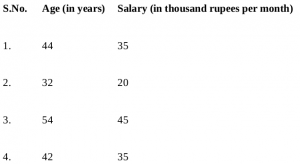
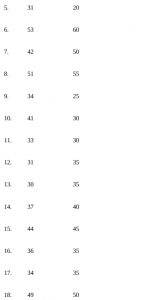
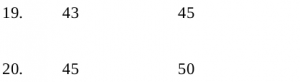
What is the average salary (in thousand per month) in the age group 40-50 years?
A company has 20 employees with their age (in years) and salary (in thousand rupees per month) mentioned against each of them:
What is the average salary (in thousand per month) in the age group 40-50 years?
36.5 | |
35 | |
42.5 | |
40.5 |
There are 37 questions to complete.