
Recursive-and-Recursively-Enumerable-Language
Question 1 |
Which of the following statements is false?
Every NFA can be converted to an equivalent DFA | |
Every non-deterministic Turing machine can be converted to an equivalent deterministic Turing machine
| |
Every regular language is also a context-free language
| |
Every subset of a recursively enumerable set is recursive |
Question 1 Explanation:
Every NFA can be converted into DFA (as there exist a standard procedure to convert NFA into DFA). Also, every non-deterministic Turing machine can be converted to an equivalent deterministic Turing machine. Every regular language is also a CFL , since if a language can be recognized by Finite automata, then it must also be recognize by PDA (as PDA is more powerful than FA). But every subset of recursively enumerable need not be recursive.
Question 2 |
Let L1 be a recursive language, and let L2 be a recursively enumerable but not a recursive language. Which one of the following is TRUE?
 | |
 | |
 | |
 |
Question 2 Explanation:
Recursive languages are closed under complementation.
But, recursive enumerable languages are not closed under complementation.
If L1 is recursive, then L1', is also recursive.
If L2 is recursive enumerable, then L2', is not recursive enumerable language.
Question 3 |
Nobody knows yet if P = NP. Consider the language L defined as follows:
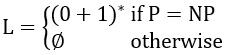
Which of the following statements is true?
L is recursive | |
L is recursively enumerable but not recursive | |
L is not recursively enumerable | |
Whether L is recursive or not will be known after we find out if P = NP |
Question 3 Explanation:
Here, we have two possibilities, whether
P = NP (or) P != NP
→ If P=NP then L=(0+1)* which is regular, then it is recursive.
→ If P!=NP then L becomes ɸ which is also regular, then it is recursive.
So, finally L is recursive.
Question 4 |
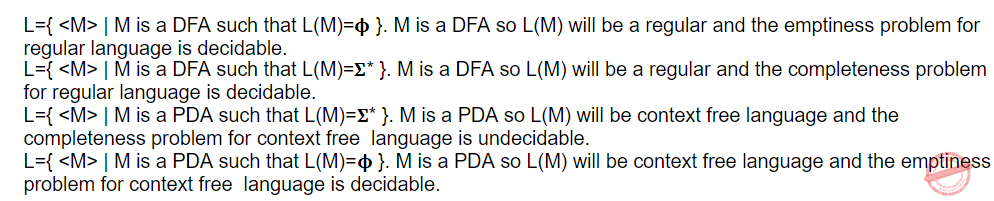
Let <M> denote an encoding of an automaton M. Suppose that Σ = {0,1}. Which of the following languages is/are NOT recursive?
L = { | |
L = { | |
L = { | |
L = { |
Question 4 Explanation:
There are 4 questions to complete.