
computer-networks
Question 1 |
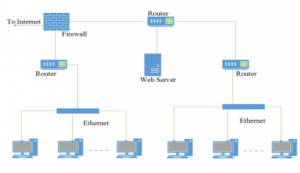
What is the number of subnets inside the enterprise network?
3 | |
12 | |
6 | |
8 |
Where router 2 (via Firewall) has the half of the addresses.
Router 1 (via web server) has other half which is further divided into two subnets which is web server and router 3. So total of 3 subnets possible.
Question 2 |
3 |
1.root server, 2. TLD DNS server, 3. authoritative server.
So there will be three pairs of request and response here.
Question 3 |
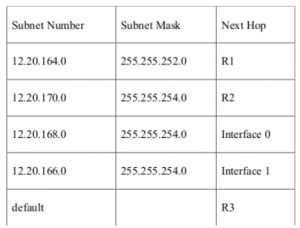
Which of the following prefixes in CIDR notation can be collectively used to correctly aggregate all of the subnets in the routing table?
12.20.164.0/20 | |
12.20.164.0/22 | |
12.20.164.0/21 | |
12.20.168.0/22 |
Question 4 |
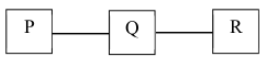
The routers exchange distance vector routing information and have converged on the routing tables, after which the link Q−R fails. Assume that P and Q send out routing updates at random times, each at the same average rate. The probability of a routing loop formation (rounded off to one decimal place) between P and Q, leading to count-to-infinity problem, is___________.
1 |
If asked for R, from among P, Q, R
Probability = 1 /3
Question 5 |
7.08 ms |
Tt = L / B => 1000 x 8 bits / 10^8 bps = 0.08 ms
Tp = D / V => 2100 x 1000 m / 3 x10^8 ms = 7 ms
Therefore, Total time = 7.08 ms
Question 6 |
33 |
1 sec = 20^30 / 8 bytes
=> 1 sec = 20^30 / 8 sequence number
=> 60 sec =20^30 x 60 / 8 bytes
Number of sequence bits required = log (20^30 x 60 / 8) => 33
Question 7 |
Assume that you have made a request for a web page through your web browser to a web server. Initially the browser cache is empty. Further, the browser is configured to send HTTP requests in non-persistent mode. The web page contains text and five very small images. The minimum number of TCP connections required to display the web page completely in your browser is ______.
6 |
Hence, 1 Text + 5 Image = 6 Objects
Question 8 |
Consider the following statements about the functionality of an IP based router.
- I. A router does not modify the IP packets during forwarding.
II. It is not necessary for a router to implement any routing protocol.
III. A router should reassemble IP fragments if the MTU of the outgoing link is larger than the size of the incoming IP packet.
Which of the above statements is/are TRUE?
I and II only | |
II only | |
I only | |
II and III only
|
II: Is True.
III: Reassemble is not necessary at the router.
Question 9 |
An organization requires a range of IP addresses to assign one to each of its 1500 computers. The organization has approached an Internet Service Provider (ISP) for this task. The ISP uses CIDR and serves the requests from the available IP address space 202.61.0.0/17. The ISP wants to assign an address space to the organization which will minimize the number of routing entries in the ISP’s router using route aggregation. Which of the following address spaces are potential candidates from which the ISP can allot any one to the organization?
I. 202.61.84.0/21
II. 202.61.104.0/21
III. 202.61.64.0/21
IV. 202.61.144.0/21
I and II only
| |
III and IV only
| |
II and III only
| |
I and IV only
|
And to Assign an IP address for 1500 computer, we require 11 bit from HID part.
So NID + SID = 17 + 4 = 21 bits and HID = 11 bits
NID HID
202.61.0 0000 000.00000000
So, from the given option, possible IP Address is
I. 84 -> 0 1010 100 (Because in HID bit 1 is not possible)
II. 104 -> 0 1101 000
III. 64 -> 0 1000 000
IV. 144 -> 1 0010 000 (Because in NID bit 1 is not possible )
Question 10 |
Consider a TCP connection between a client and a server with the following specifications: the round trip time is 6 ms, the size of the receiver advertised window is 50 KB, slow start threshold at the client is 32 KB, and the maximum segment size is 2 KB. The connection is established at time t=0. Assume that there are no timeouts and errors during transmission. Then the size of the congestion window (in KB) at time t+60 ms after all acknowledgements are processed is ______.
44 |
Here, t + 60 is nothing but at the 10 RTT (60/6 = 10), but here it’s asking after all acknowledgement are processed it means after the 10th RTT, i.e., at the 11RTT.
1st transmission: 2 KB
2nd transmission: 4 KB
3rd transmission: 8 KB
4th transmission: 16 KB
5th transmission: 32 KB (Threshold reached)
6th transmission: 34 KB
7th transmission: 36 KB
8th transmission: 38 KB
9th transmission: 40 KB
10th transmission: 42 KB
At the completion of 10th transmission RTT = 10*6 = 60 ms
For the 11th transmission, The congestion window size is 44 KB.
Question 11 |
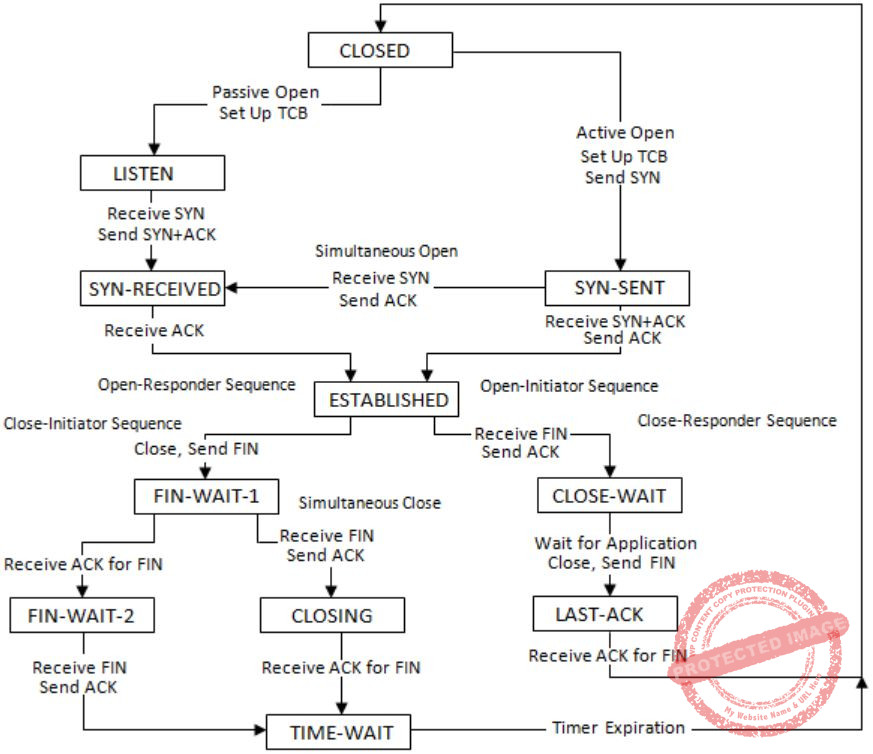
Consider a TCP client and a TCP server running on two different machines. After completing data transfer, the TCP client calls close to terminate the connection and a FIN segment is sent to the TCP server. Server-side TCP responds by sending an ACK, which is received by the client-side TCP. As per the TCP connection state diagram (RFC 793), in which state does the client-side TCP connection wait for the FIN from the server-side TCP?
LAST-ACK | |
TIME-WAIT | |
FIN-WAIT-1 | |
FIN-WAIT-2 |
i.e. waiting for the ACK for own FIN segment.
There are two possibilities here:
I. If Client receives ACK for its FIN then client will move to FIN-WAIT-2 and will wait for matching FIN from server side.
After receiving the FIN from server, client will send ACK and move to TIME-WAIT state.
II. Client has sent FIN segment but didn’t get ACK till the time.
Instead of ACK, client received FIN from server side.
Client will acknowledge this FIN and move to CLOSE state.
Here Client will wait for the ACK for its own FIN.
After receiving ACK, client will move to TIME-WAIT state.
Here we encounter First Case.
So, the solution is (D).
Refer this TCP state transition diagram:
Question 12 |
(I) S can launch a birthday attack to replace m with a fraudulent message.
(II) A third party attacker can launch a birthday attack to replace m with a fraudulent message.
(III) R can launch a birthday attack to replace m with a fraudulent message.
Which of the following are possible security violations?
(I) and (II) only | |
(I) only | |
(II) only | |
(II) and (III) only |
(I) Can the sender replace the message with a fraudulent message?
Yes, definitely because the sender will encrypt the message with its private key.
It can encrypt another message also with its private key.
(II) Can the third party send a fraudulent message?
No, because the third party doesn't know about the private key of the sender.
(III) Can receiver send the fraudulent message?
No, the receiver also doesn't know about the Private key of the sender.
So receiver also cannot send the fraudulent message.
Question 13 |
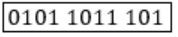
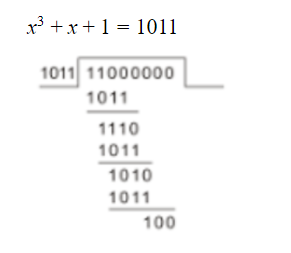
A computer network uses polynomials over GF(2) for error checking with 8 bits as information bits and uses x3 + x + 1 as the generator polynomial to generate the check bits. In this network, the message 01011011 is transmitted as
01011011010 | |
01011011011 | |
01011011101 | |
01011011100 |
= 1∙x3+0∙x2+1∙x1+1∙x0
= 1011
Message = 01011011
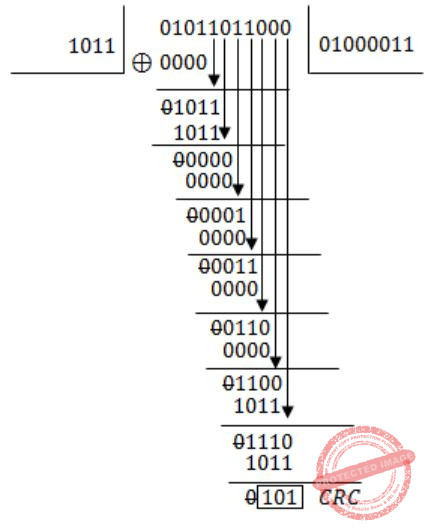
So, the message 01011011 is transmitted as
Question 14 |
In a RSA cryptosystem, a participant A uses two prime numbers p = 13 and q = 17 to generate her public and private keys. If the public key of A is 35, then the private key of A is _________.
11 | |
12 | |
13 | |
14 |
Given, p=13, q=17, e=35 (Public key), d=? (Private key)
As per RSA Algorithm; following steps:
Step 1: Find n = p×q = 13×17 = 221
Step 2: Find ∅(n) = (p-1)×(q-1) = 12×16 = 192
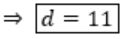
Step 3: d×e mod ∅(n) = 1 ⇒ (d = e(-1) mod ∅(n))
or
d×e = 1 mod ∅(n)
⇒ d×35 mod 192 = 1
Question 15 |
The value of parameters for the Stop-and-Wait ARQ protocol are as given below:
          Bit rate of the transmission channel = 1 Mbps.
          Propagation delay from sender to receiver = 0.75 ms.
          Time to process a frame = 0.25 ms.
          Number of bytes in the information frame = 1980.
          Number of bytes in the acknowledge frame = 20.
          Number of overhead bytes in the information frame = 20.
Assume that there are no transmission errors. Then, the transmission efficiency (expressed in percentage) of the Stop-and-Wait ARQ protocol for the above parameters is _________ (correct to 2 decimal places).
89.33% | |
89.34% | |
89.35% | |
89.36% |
B = 1Mbps, L = 1980Bytes, Overhead = 20Bytes
TProc = 0.25ms, LAck = 20Bytes
Tp=0.75ms
Total Data size(L) = (L + overhead) = 1980+20 = 2000Bytes
Efficiency of Stop & Wait ARQ?
Tt = L/B = 2000Bytes/1Mbps = (2000×8bits)/(106 b/s) = 16msec
TAck = LAck/B = (20×8bits)/(106 bits/sec) = 0.16msec
∴ In Stop and Wait ARQ, efficiency
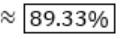
ƞ = Tt/(Tt+TAck+2Tp+TProc) = 16ms/(16+0.16+2×0.75+0.25ms) = 16ms/17.91ms = 0.8933
Question 16 |
Which of the following assertions is FALSE about the Internet Protocol (IP)?
It is possible for a computer to have multiple IP addresses
| |
IP packets from the same source to the same destination can take different routes in the network
| |
IP ensures that a packet is discarded if it is unable to reach its destination within a given number of hops
| |
The packet source cannot set the route of an outgoing packets; the route is determined only by the routing tables in the routers on the way
|
Question 17 |
Which of the following functionalities must be implemented by a transport protocol over and above the network protocol?
Recovery from packet losses | |
Detection of duplicate packets | |
Packet delivery in the correct order | |
End to end connectivity |
Question 18 |
The subnet mask for a particular network is 255.255.31.0. Which of the following pairs of IP addresses could belong to this network?
172.57.88.62 and 172.56.87.233
| |
10.35.28.2 and 10.35.29.4 | |
191.203.31.87 and 191.234.31.88 | |
128.8.129.43 and 128.8.161.55 |
128.8.129.43 (Bitwise AND) 255.255.31.0 = 128.8.1.0
128.8.161.55 (Bitwise AND) 255.255.31.0 = 128.8.1.0
Question 19 |
A 2 km long broadcast LAN has 107 bps bandwidth and uses CSMA/CD. The signal travels along the wire at 2×10⁸ m/s. What is the minimum packet size that can be used on this network?
50 bytes | |
100 bytes | |
200 bytes | |
None of the above |
d= 2 km = 2 x 10³ m, v = 2 x 10⁸ m/s, B= 107
Tp = d / v = 2 x 10³ /(2 x 108 ) seconds = 10-5 seconds
Let L bits be minimum size of frame, then Tt = t L / B = L / 107 seconds
Now, Tt = 2Tp
L/107 = 2 x 10-5 = 200 bits = (200 / 8) bytes = 25 bytes
Question 20 |
Host A is sending data to host B over a full duplex link. A and B are using the sliding window protocol for flow control. The send and receive window sizes are 5 packets each. Data packets (sent only from A to B) are all 1000 bytes long and the transmission time for such a packet is 50 µs. Acknowledgement packets (sent only from B to A) are very small and require negligible transmission time. The propagation delay over the link is 200 µs. What is the maximum achievable throughput in this communication?
7.69 × 10⁶ bps
| |
11.11 × 10⁶ bps | |
12.33 × 10⁶ bps | |
15.00 × 10⁶ bps |
Transmission rate , Tt = L / B.W
Therefore, B.W. = L / Tt = 1000 bytes/ 50 μs = 8000 bits / 50 μs=160 Mbps
Efficiency = N / 1 + 2a, where a = Tp / Tt
Efficiency = 5 * 50 / (50+400) = 250/450 = 5/9
Maximum achievable throughput = Efficiency * B.W = (5/9)*160 Mbps = 88.88 Mbps = = 11.11 x 106 bytes per second
*Actual option should be in bytes per second.
Question 21 |
Choose the best matching between Group 1 and Group 2.
   Group-1   	  	  Group-2
 P. Data link          1. Ensures reliable transport of data
                          over a physical point-to-point link
 Q. Network layer      2. Encoder/decodes data for physical
                          transmission
 R. Transport layer    3. Allows end-to-end communication
                          between two processes
                       4. Routes data from one network
node to the nextP - 1, Q - 4, R - 3 | |
P - 2, Q - 4, R - 1
| |
P - 2, Q - 3, R - 1 | |
P - 1, Q - 3, R - 2 |
Transport Layer :: Fourth layer of the OSI Model, Responsible for Service point addressing/Socket to socket connection or end to end connection with full reliability.
Network Layer :: Third layer of the OSI Model, Responsible for Host to Host.
Question 22 |
Which of the following is NOT true with respect to a transparent bridge and a router?
Both bridge and router selectively forward data packets
| |
A bridge uses IP addresses while a router uses MAC addresses
| |
A bridge builds up its routing table by inspecting incoming packets | |
A router can connect between a LAN and a WAN |
Question 23 |
How many 8-bit characters can be transmitted per second over a 9600 baud serial communication link using asynchronous mode of transmission with one start bit, eight data bits, two stop bits, and one parity bit?
600 | |
800 | |
876 | |
1200 |
So bit rate is 9600 bps.
To send one char we need to send (1 + 8 + 2 +1) = 12
So total char send = 9600 / 12 = 800
Question 24 |
A and B are the only two stations on an Ethernet. Each has a steady queue of frames to send. Both A and B attempt to transmit a frame, collide, and A wins the first backoff race. At the end of this successful transmission by A, both A and B attempt to transmit and collide. The probability that A wins the second backoff race is:
0.5 | |
0.625 | |
0.75 | |
1.0 |
The probability that A wins the second back-off race = 5/8 = 0.625
More explanation in the video.
Question 25 |
The routing table of a router is shown below:
 Destination     Sub net mask 	     Interface
 128.75.43.0 	 255.255.255.0 	        Eth0
 128.75.43.0 	 255.255.255.128 	Eth1
 192.12.17.5 	 255.255.255.255 	Eth3
 Default 	  	                Eth2
On which interfaces will the router forward packets addressed to destinations 128.75.43.16 and 192.12.17.10 respectively?
Eth1 and Eth2 | |
Eth0 and Eth2 | |
Eth0 and Eth3 | |
Eth1 and Eth3 |
If results of ANDing subnet masks and IP address are same then subnet mask with higher number of 1s is preferred.
IP address 128.75.43.16 is AND with 255.255.255.0 results 128.75.43.0 Net ID which is similar to destination of this mask, but ANDing 128.75.43.16 with 255.255.255.128 also results same destination. So, here, mask with higher number of one is considered and router will forward packet to Eth1.
ANDing 192.12.17.10 with three subnet mask in table does not result in destination Net ID so router will forward this packet to default network via Eth2.
Question 26 |
Consider three IP networks A, B and C. Host HA in network A sends messages each containing 180 bytes of application data to a host HC in network C. The TCP layer prefixes a 20 byte header to the message. This passes through an intermediate network B. The maximum packet size, including 20 byte IP header, in each network is:
     A : 1000 bytes
     B : 100 bytes
     C : 1000 bytes
The network A and B are connected through a 1 Mbps link, while B and C are connected by a 512 Kbps link (bps = bits per second).

Assuming that the packets are correctly delivered, how many bytes, including headers, are delivered to the IP layer at the destination for one application message, in the best case? Consider only data packets.
200 | |
220 | |
240 | |
260 |
Data will be divided in three packets as:
First packet: 80 bytes + 20 byte of header
Second packet: 80 bytes + 20 byte of header
Third packet: 40 bytes + 20 byte of header
Note: Defragmentation (grouping of fragments) is done only at destination.
HC will receive total 260 bytes including header.
Question 27 |
Consider three IP networks A, B and C. Host HA in network A sends messages each containing 180 bytes of application data to a host HC in network C. The TCP layer prefixes a 20 byte header to the message. This passes through an intermediate network B. The maximum packet size, including 20 byte IP header, in each network is:
     A : 1000 bytes
     B : 100 bytes
     C : 1000 bytes
The network A and B are connected through a 1 Mbps link, while B and C are connected by a 512 Kbps link (bps = bits per second).
What is the rate at which application data is transferred to host HC? Ignore errors, acknowledgements, and other overheads.
325.5 Kbps
| |
354.5 Kbps | |
409.6 Kbps | |
512.0 Kbps |
Application data is transferred at rate of (180/260) x 512 Kbps = 354.46 Kbps
Question 28 |
A simple and reliable data transfer can be accomplished by using the ‘handshake protocol’. It accomplishes reliable data transfer because for every data item sent by the transmitter __________.
in this case receiver has to respond that receiver can be able to receive the data item. |
Question 29 |
Start and stop bits do not contain an ‘information’ but are used in serial communication for
Error detection | |
Error correction | |
Synchronization | |
Slowing down the communications |
Question 30 |
SYN bit = 1, SEQ number = X+1, ACK bit = 0, ACK number = Y, FIN bit = 0 | |
SYN bit = 0, SEQ number = X+1, ACK bit = 0, ACK number = Y, FIN bit = 1 | |
SYN bit = 1, SEQ number = Y, ACK bit = 1, ACK number = X+1, FIN bit = 0 | |
SYN bit = 1, SEQ number = Y, ACK bit = 1, ACK number = X, FIN bit = 0 |
Q will send the SYN bit = 1 to the connection establishment.
Q Seq number will be Y different from X
ACK bit = 1 because sending the ACK
ACK number = X+1 (Next seq number id)
FIN bit = 0 (Because establishing the connection)
Question 31 |
111 | |
100 | |
101 | |
110 |
Question 32 |
The next hop router for a packet from R to P is Y. | |
The distance from R to Q will be stored as 7. | |
The next hop router for a packet from R to Q is Z. | |
The distance from R to P will be stored as 10. |
Given R gets the distance vector (3,2,5)
After the one iteration distance vector from X to P, Y to P, and Z to P is (7, 6, 5) respectively
The distance vector from R to P via X Y Z is (3+7, 2+6, 5+5) =(10, 8, 10)
So Take minimum distance from R to P which is 8 via Y
After the iteration distance vector from X to Q, Y to Q, Z to Q is ( 4, 6, 8) respectively
The distance vector from R to Q via X Y Z is (3+4, 2+6, 5+8) = (7, 8 13)
So Take minimum distance from R to Q which is 7 via X.
Question 33 |
135 |
1 frames takes = Tt = L / B.w. => 1000 / 10^6 = 1 millisec
1000 frame Tt = 1000 x 1 millisec = 1 sec
In 1 sec, 1000 frames sends, which is 1 millisec per frame.
So, G = 1
Efficiency of Pure Aloha (η) = G x e-2G
where G = Number of requests per time slot willing to transmit.
e = Mathematical constant approximately equal to 2.718
So, η = 1 x 2.718(-2 x 1) = 0.1353
Therefore, In 1 sec1000 frames = 0.1353 x 1000 = 135.3(closest integer) =>135
Throughput => 135
Question 34 |
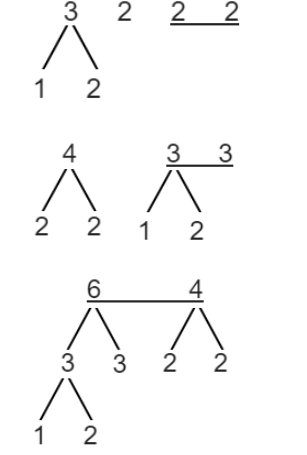
- For any two letters, the code assigned to one letter must not be a prefix of the code assigned to the other letter.
- For any two letters of the same frequency, the letter which occurs earlier in the dictionary order is assigned a code whose length is at most the length of the code assigned to the other letter.
21 | |
30 | |
23 | |
25 |
Input String : abbccddeee
The character frequencies are
|
Character |
a |
b |
c |
d |
e |
|
Frequency |
1 |
2 |
2 |
2 |
3 |
|
Binary Code |
? |
? |
? |
? |
? |

Question 35 |
Which one of the following statements is FALSE?
Packet switching leads to better utilization of bandwidth resources than circuit switching. | |
Packet switching results in less variation in delay than circuit switching. | |
Packet switching requires more per packet processing than circuit switching. | |
Packet switching can lead to reordering unlike in circuit switching. |
Question 36 |
Which one of the following statements is FALSE?
TCP guarantees a minimum communication rate | |
TCP ensures in-order delivery | |
TCP reacts to congestion by reducing sender window size | |
TCP employs retransmission to compensate for packet loss
|
Sequence numbers can allow receivers to discard duplicate packets and properly sequence reordered packets.
Option C:
If the congestion is deleted, the transmitter decreases the transmission rate by a multiplicative factor.
Option D:
Acknowledgement allows the sender to determine when to retransmit lost packets.
Question 37 |
Which one of the following statements is FALSE?
HTTP runs over TCP | |
HTTP describes the structure of web pages | |
HTTP allows information to be stored in a URL | |
HTTP can be used to test the validity of a hypertext link |
Question 38 |
A sender is employing public key cryptography to send a secret message to a receiver. Which one of the following statements is TRUE?
Sender encrypts using receiver’s public key | |
Sender encrypts using his own public key | |
Receiver decrypts using sender’s public key | |
Receiver decrypts using his own public key |
Question 39 |
A subnet has been assigned a subnet mask of 255.255.255.192. What is the maximum number of hosts that can belong to this subnet?
14 | |
30 | |
62 | |
126 |
= 26- 2
= 64 - 2
= 62
Question 40 |
A host is connected to a Department network which is part of a University network. The University network, in turn, is part of the Internet. The largest network in which the Ethernet address of the host is unique is:
the subnet to which the host belongs | |
the Department network | |
the University network | |
the Internet |
Question 41 |
In TCP, a unique sequence number is assigned to each
byte | |
word | |
segment | |
message |
Question 42 |
Which of the following objects can be used in expressions and scriplets in JSP (Java Server Pages) without explicitly declaring them?
session and request only | |
request and response only | |
response and session only | |
session, request and response |
Question 43 |
Consider the following statements:
I. telnet, ftp and http are application layer protocols.
II.l EJB (Enterprise Java Beans) components can be deployed in a J2EE (Java2 Enterprise Edition) application server.
III. If two languages conform to the Common Language Specification (CLS) of the Microsoft.NET framework, then a class defined in any one of them may be inherited in the other.
Which statements are true?
l and II only | |
II and III only | |
l and III only | |
I, II and III |
Then there are certain compliance rules which may be used for inheritance. So other statement (I) and (II) are True.
Question 44 |
A serial transmission T1 uses 8 information bits, 2 start bits, 1 stop bit and 1 parity bit for each character. A synchronous transmission T2 uses 3 eight bit sync characters followed by 30 eight bit information characters. If the bit rate is 1200 bits/second in both cases, what are the transfer rates of T1 and T2?
100 characters/sec, 153 characters/sec | |
80 characters/sec, 136 characters/sec | |
100 characters/sec, 136 characters/sec | |
80 characters/sec, 153 characters/sec |
Transfer rate = 1200/12 = 100 char/sec
T2: Transfer character in bits = 24 + 240 = 264 bits
In 264 = 30 characters
Then in 1200 = ? 264/30 = 1200/x
x = 136.3 char/sec
So, correct option is (C).
Question 45 |
In a data link protocol, the frame delimiter flag is given by 0111. Assuming that bit stuffing is employed, the transmitter sends the data sequence 01110110 as
01101011 | |
011010110 | |
011101100 | |
0110101100 |
Thus using the above logic,
Delimiter flag: 0111
Data sequence: 01110110
So, for a flag of 4 bits we will compare data sequence with a pattern of 3 bits, i.e., 011.
0 1 1 0 1 0 1 1 0 0
In the above pattern the underlined bits are found matched. Hence, 0 in italics is stuffed. Thus resulting in the data sequence as 0110101100 which is option (D).
Question 46 |
In a sliding window ARQ scheme, the transmitter's window size is N and the receiver's window size is M. The minimum number of distinct sequence numbers required to ensure correct operation of the ARQ scheme is
min (M,N) | |
max (M,N) | |
M + N | |
MN |
Question 47 |
Consider a 10 Mbps token ring LAN with a ring latency of 400 µs. A host that needs to transmit seizes the token. Then it sends a frame of 1000 bytes, removes the frame after it has circulated all around the ring, and finally releases the token. This process is repeated for every frame. Assuming that only a single host wishes to transmit, the effective data rate is
1Mbps | |
2Mbps | |
5Mbps | |
6Mbps |
Question 48 |
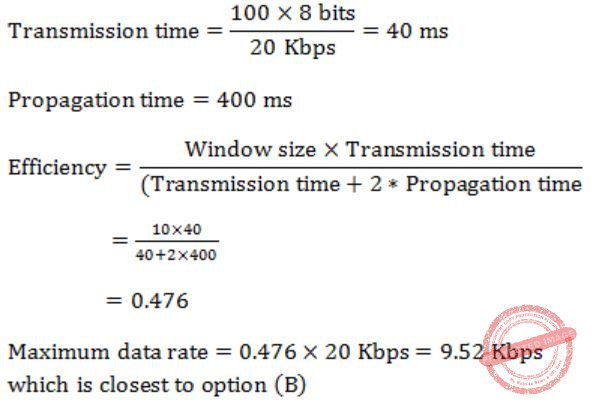
A 20 Kbps satellite link has a propagation delay of 400 ms. The transmitter employs the "go back n ARQ" scheme with n set to 10. Assuming that each frame is 100 bytes long, what is the maximum data rate possible?
5 Kbps | |
10 Kbps | |
15 Kbps | |
20 Kbps |
Question 49 |
Consider a simplified time slotted MAC protocol, where each host always has data to send and transmits with probability p = 0.2 in every slot. There is no backoff and one frame can be transmitted in one slot. If more than one host transmits in the same slot, then the transmissions are unsuccessful due to collision. What is the maximum number of hosts which this protocol can support, if each host has to be provided a minimum through put of 0.16 frames per time slot?
1 | |
2 | |
3 | |
4 |
0.16 = 0.2 × 0.8N-1
⇒ 0.8 = 0.8N-1
⇒ N = 2
Question 50 |
In the TCP/IP protocol suite, which one of the following is NOT part of the IP header?
Fragment Offset | |
Source IP address | |
Destination IP address | |
Destination port number |