
database-management-system
Question 1 |
A relation with only two attributes is always in BCNF. | |
If all attributes of a relation are prime attributes, then the relation is in BCNF. | |
Every relation has at least one non-prime attribute. | |
BCNF decompositions preserve functional dependencies. |
Example:
R(A, B).
Two functional dependencies possible for the relation: (1) A->B and (2) B->A
If there is no functional dependency, we can assume trivial functional dependencies like AB->A and AB->B.
In all cases, functional dependencies like A->B, A must be a key.
So they all will be in BCNF irrespective of the functional depencies set.
Question 2 |
Employee ( eId , Name ), Brand ( bId , bName ), Own ( eId , bId )
Which of the following relational algebra expressions return the set of elds who own all the brands?
 | |
| |
| |
|
In relational algebra, divide (/) is not a basic operator and it can be derived from the basic operators. In option (B), the divide operator is derived using basic operators and which is equivalent to option (A)
Question 3 |
AB → C; BC → D; C → E;
The number of superkeys in the relation R is _____________.
8 |
AB → C
BC → D
C → E
¯ The attributes A, B are not there in the right hand side of any of the given FDs.
¯ So, AB can be a candidate key.
(AB)^+ = ABCDE
¯ (AB)^+ is deriving all the attributes of R Hence, AB is a candidate key.
¯ The number of super keys possible for R with “AB” candidate kay is:
2^5 – 2 = 2^3
= 8
Question 4 |
S: R4(x) R2(x) R3(x) R1(y) W1(y) W2(x) W3(y) R4(y)
Which one of the following serial schedules is conflict equivalent to S
 | |
| |
| |
|
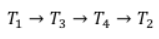
Precedence Graph
T1 → T3 → T4 → T2
Question 5 |
Student(sNo, sName, dNo) Dept(dNo, dName)
Course(cNo, cName, dNo)
Register(sNo, cNo)
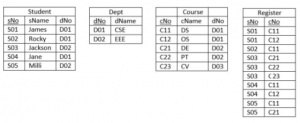
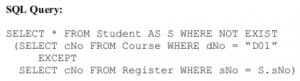
The number of rows returned by the above SQL query is___________.
2 |
-----+---------+------+
| sNo | sName | dNo |
+-----+---------+------+
| S01 | James | D01 |
| S04 | Jane | D01 |
+-----+---------+------+
Question 6 |
State True or False with reason
There is always a decomposition into Boyce-Codd normal form (BCNF) that is
lossless and dependency preserving.
True | |
False |
Question 7 |
An instance of a relational scheme R(A, B, C) has distinct values for attribute A.
Can you conclude that A is a candidate key for R?
Yes | |
No |
Question 8 |
Give a relational algebra expression using only the minimum number of operators from (∪, −) which is equivalent to R ∩ S.
Out of syllabus (For explanation see below) |
→ No need of using Union operation here. → In question they gave (∪, −) but we don't use both.
→ And also they are saying that only the minimum number of operators from (∪, −) which is equivalent to R ∩ S.
So, the expression is minimal.
Question 9 |
State True or False with reason
Logical data independence is easier to achieve than physical data independence
True | |
False |
Question 10 |
Consider the following relational schema:
 COURSES (cno, cname)
 STUDENTS (rollno, sname, age, year)
 REGISTERED FOR (cno, rollno)
(a) Write a relational algebra query to
Print the roll number of students who have registered for cno 322.
(b) Write a SQL query to
Print the age and year of the youngest student in each year.
Theory Explanation. |
Question 11 |
Consider B+ − tree of order d shown in figure? (A) B+ − tree of order d contains between d and 2d keys in each node. (a) Draw the resulting B+ − tree after inserted in the figure.

(b) For a B+ − tree of order d with n leaf nodes, the number of nodes accessed during a search is 0(-).
Theory Explanation. |
Question 12 |
Consider a relational database containing the following schemas.
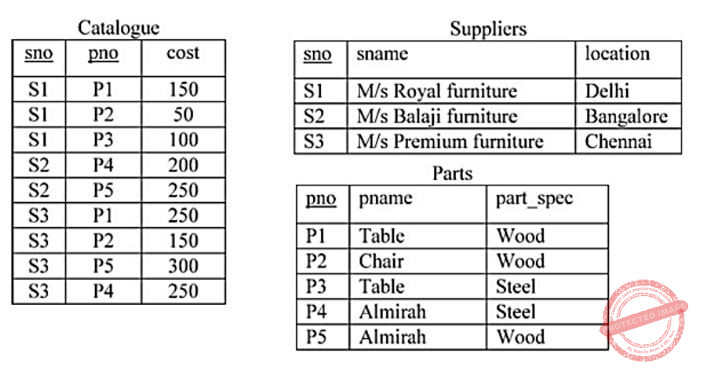
The primary key of each table is indicated by underlying the constituent fields.
SELECT s.sno, s.sname
FROM Suppliers s, Catalogue c
WHERE s.sno = c.sno AND
              Cost > (SELECT AVG (cost)
                      FROM Catalogue
                      WHERE pno = ‘P4’
                      GROUP BY pno);
The number of rows returned by the above SQL query is
0 | |
5 | |
4 | |
2 |
AVG(COST)
------------
225
The outer query “select s.sno, s.sname from suppliers s, catalogue c where s.sno=c.sno” returns:
SNO SNAME
----------------------------------------
S1 M/s Royal furniture
S1 M/s Royal furniture
S1 M/s Royal furniture
S2 M/s Balaji furniture
S2 M/s Balaji furniture
S3 M/s Premium furniture
S3 M/s Premium furniture
S3 M/s Premium furniture
S3 M/s Premium furniture
So, the final result of the query is:
SN SNAME
----------------------------------------
S2 M/s Balaji furniture
S3 M/s Premium furniture
S3 M/s Premium furniture
S3 M/s Premium furniture
Therefore, 4 rows will be returned by the query.
Question 13 |
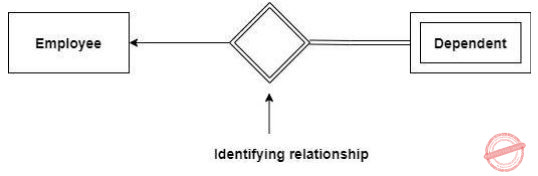
Which one of the following is used to represent the supporting many-one relationships of a weak entity set in an entity-relationship diagram?
Ovals that contain underlined identifiers
| |
Rectangles with double/bold border | |
Diamonds with double/bold border
| |
Ovals with double/bold border
|
Question 14 |
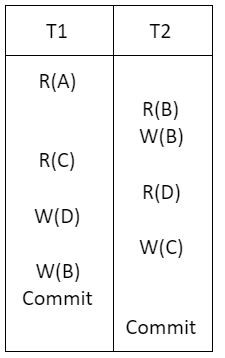
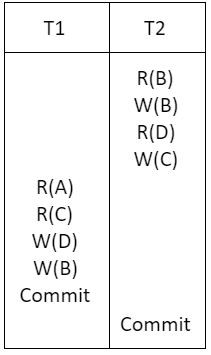
Consider a schedule of transactions T1 and T2:

Here, RX stands for “Read(X)” and WX stands for “Write(X)”. Which one of the following schedules is conflict equivalent to the above schedule?
 | |
 | |
 | |
 |
• First, let’s list the conflict operations of each of the schedule given in the options and compare with the conflict operations of schedule which is given in the question.
Given schedule:
Conflict operations:
R2(B) → W1(B)
W2(B) → W1(B)
R1(C) → W2(C)
R2(D) → W1(D)
Option(1):
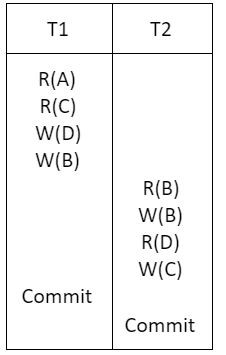
Conflict operations:
R1(C) → W2(C)
W1(D) → R2(D)
W1(B) → R2(B)
W1(B) → W2(B)
Option(2):
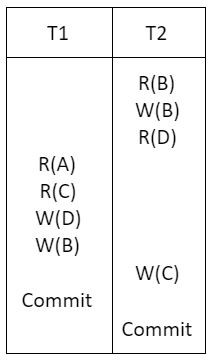
Conflict operations:
R2(B) → W1(B)
W2(B) → W1(B)
R2(D) → W1(D)
R1(C) → W2(C)
Option(3):
Conflict operations:
R2(B) → W1(B)
W2(B) → W1(B)
R2(D) → W1(D)
W2(C) → R1(C)
Option(4):

Conflict operations:
R1(C) → W2(C)
W1(D) → R2(D)
R2(B) → W1(B)
W2(B) → W1(B)
The conflict operations in the option (2) and given schedule are appearing in the same sequence order, so option (2) is the answer.
Question 15 |
Consider a relational table R that is in 3NF, but not in BCNF. Which one of the following statements is TRUE?
A cell in R holds a set instead of an atomic value. | |
R has a nontrivial functional dependency X→A, where X is not a superkey and A is a non-prime attribute and X is not a proper subset of any key.
| |
R has a nontrivial functional dependency X→A, where X is not a superkey and A is a non-prime attribute and X is a proper subset of some key. | |
R has a nontrivial functional dependency X→A, where X is not a superkey and A is a prime attribute. |
FDs:
AB → C
BC → A
(BD)+ = BD ✖
(ABD)+ = ABDC ✔
(CBD)+ = CBDA ✔
Candidate keys = {ABD, CBD}
• The relation R is in 3NF, as there are no transitive dependencies.
• The relation R is not in BCNF, because the left side of both the FD’s are not Super keys.
• In R, BC → A is a non-trivial FD and in which BC is not a Super key and A is a prime attribute.
Question 16 |
Consider a database implemented using B+ tree for file indexing and installed on a disk drive with block size of 4 KB. The size of search key is 12 bytes and the size of tree/disk pointer is 8 bytes. Assume that the database has one million records. Also assume that no node of the B+ tree and no records are present initially in main memory. Consider that each record fits into one disk block. The minimum number of disk accesses required to retrieve any record in the database is ______.
4 |
(1) Database BF = 1
No. of block = 106 } ➝ 1 block access from database
(2) ⎡106/204⎤ = 491
(3) ⎡491/204⎤ = 3
(4) ⎡3/204⎤ = 1
So, 1+3 = 4 disk accesses are required to retrieve any record in the database.
Question 17 |
A library relational database system uses the following schema
USERS (User#, UserName, HomeTown)
BOOKS (Book#, BookTitle, AuthorName)
ISSUED (Book#, User#, Date)
Explain in one English sentence, what each of the following relational algebra queries is designed to determine
(a) σ User #=6 (11 User #, Book Title ((USERS ISSUED) BOOKS))
(b) σ Author Name (BOOKS (σ Home Town) = Delhi (USERS ISSUED)))
Theory Explanation. |
Question 18 |
For a database relation R(a,b,c,d), where the domains a, b, c, d include only atomic values, only the following functional dependencies and those that can be inferred from them hold:
   a → c
   b → d
This relation is
in first normal form but not in second normal form | |
in second normal form but not in third normal form | |
in third normal form | |
None of the above |
Since all a, b, c, d are atomic. So the relation is in 1NF.
Checking the FD's
a → c
b → d
We can see that there is partial dependencies. So it is not 2NF.
So answer is option (A).
Question 19 |
Let R(a,b,c) and S(d,e,f) be two relations in which d is the foreign key of S that refers to the primary key of R. Consider the following four operations R and S
   (a) Insert into R            (b) Insert into S
   (c) Delete from R            (d) Delete from S
Which of the following can cause violation of the referential integrity constraint above?
None of (a), (b), (c) or (d) can cause its violation | |
All of (a), (b), (c) and (d) can cause its violation | |
Both (a) and (d) can cause its violation | |
Both (b) and (c) can cause its violation |
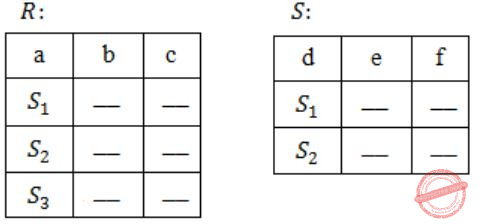
Here 'd' is the foreign key of S and let 'a' is the primary key of R.
(A) Insertion into R: will cause no violation.
(B) Insertion into S: may cause violation because there may not be entry of the tuple in relation R. Example entry of 〈S4, __, __〉 is not allowed.
(C) Delete from R: may cause violation. For example, deletion of tuple 〈S2, __, __〉 will cause violation as there is entry of S2 in the foreign key table.
(D) Delete from S: will cause no violation as it does not result inconsistency.
Question 20 |
V → W
VW → X
Y → VX
Y → Z
Which of the following is irreducible equivalent for this set of functional dependencies?
V→W V→X Y→V Y→Z | |
V→W W→X Y→V Y→Z | |
V→W V→X Y→V Y→X Y→Z | |
V→W W→X Y→V Y→X Y→Z |
V → W, VW → X, Y → V, Y → X, Y→ Z
Step 2:
V → W, VW → X, Y → V, Y → X, Y→ Z
(V)+ = V ×
(VW)+ = VW ×
(Y)+ = YXZ
(Y)+ = YVW ×
(Y)+ = YVWX
Without Y → X, the closure of Y is deriving ‘X’ from the remaining attributes.
So, we can remove Y → X as its redundant.
Step 3:
V → W, VW → X, Y → V, Y → Z
(V)+ = VW, the closure of V is deriving W from the remaining FD’s.
So, W is redundant. We can remove it.
So, the final canonical form is
V→W, V→X, Y→V, Y→Z
⇾ So, option (A) is correct.
Question 21 |
Consider a database that has the relation schema EMP (EmpId, EmpName, and DeptName). An instance of the schema EMP and a SQL query on it are given below.
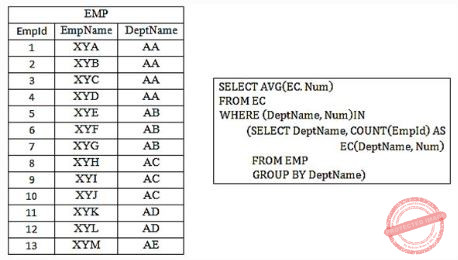
The output of executing the SQL query is ___________.
2.6 | |
2.7 | |
2.8 | |
2.9 |
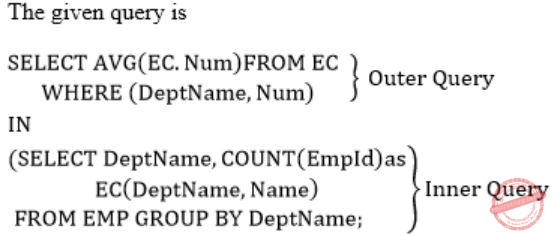
⇾ We start evaluating from the inner query.
The inner query forms DeptName wise groups and counts the DeptName wise EmpIds.
⇾ In inner query DeptName, Count(EmpId) is the alias name DeptName, Num.
So, the output of the inner query is,
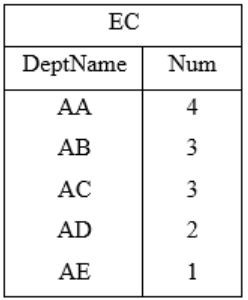
The outer query will find the
Avg(Num) = (4+3+3+2+1)/5 = 2.6
Question 22 |
(I) {t│∃u ∈ EMP(t[EmpName] = u[EmpName] ∧ ∀v ∈ DEPT(t[DeptId] ≠ v[DeptId]))}
(II) {t│∃u ∈ EMP(t[EmpName] = u[EmpName] ∧ ∃v ∈ DEPT(t[DeptId] ≠ v[DeptId]))}
(III) {t│∃u ∈ EMP(t[EmpName] = u[EmpName] ∧ ∃v ∈ DEPT(t[DeptId] = v[DeptId]))}
Which of the above queries are safe?
(I) and (II) only | |
(I) and (III) only | |
(II) and (III) only | |
(I), (II) and (III) |
(I) Gives EmpNames who do not belong to any Department. So, it is going to be a finite number of tuples as a result.
(II) Gives EmpNames who do not belong to some Department. This is also going to have finite number of tuples.
(III) Gives EmpNames who do not belong to same Department. This one will also give finite number of tuples.
All the expressions I, II and III are giving finite number of tuples. So, all are safe.
Question 23 |
if TS(T2)<TS(T1) then
T1 is killed
else T2 waits.
Assume any transaction that is not killed terminates eventually. Which of the following is TRUE about the database system that uses the above algorithm to prevent deadlocks?
The database system is both deadlock-free and starvation-free. | |
The database system is deadlock-free, but not starvation-free. | |
The database system is starvation-free, but not deadlock-free. | |
The database system is neither deadlock-free nor starvation-free. |
So, there will be no equal timestamps.
Lamport’s logical clock:
In this timestamps are assigned in increasing order only.
According to the given algorithm,
TS(T2) < TS(T1)
then T1 is killed
else
T2 will wait
So, in both the cases, it will be deadlock free and there will be no starvation.
Question 24 |
Consider a database that has the relation schema CR(StudentName, CourseName). An instance of the schema CR is as given below.
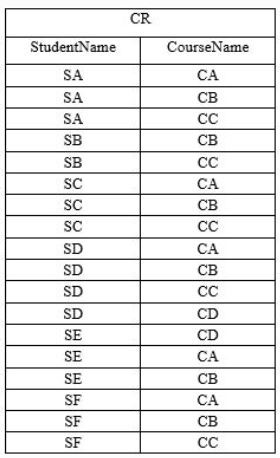
The following query is made on the database.
         T1 ← πCourseName(σStudentName='SA'(CR))
         T2 ← CR ÷ T1
The number of rows in T2 is ____________.
4 | |
5 | |
6 | |
7 |
The σStudentName = 'SA'(CR) will produce the following
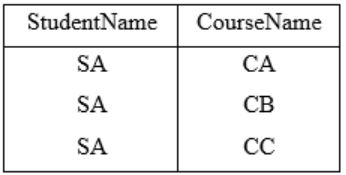
⇾ The result of T1 ← πCourseName(σStudentName='SA'(CR)) is
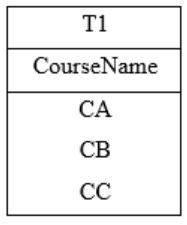
(2) T2 ← CR÷T1
⇾ We see that SA is enrolled for CA, CB and CC.
⇾ T2 will give the StudentNames those who have enrolled for all the CA, C, CC courses. So, the following Students are enrolled for the given 3 courses.
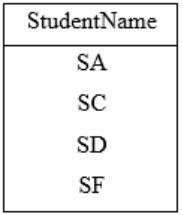
⇾ So, the output of T2 will have 4 rows.
Question 25 |
Given two union compatible relations R1(A,B) and R2(C,D), what is the result of the operation R1A = CAB = DR2?
R1 ∪ R2 | |
R1 × R2 | |
R1 - R2 | |
R1 ∩ R2 |
Question 26 |
Which normal form is considered adequate for normal relational database design?
2 NF | |
5 NF | |
4 NF | |
3 NF |
Question 27 |
There are 5 records in a database.
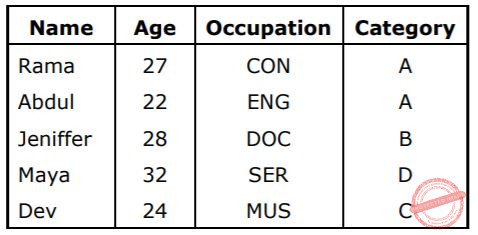
There is an index file associated with this and it contain the values 1, 3, 2, 5 and 4. Which one of the fields is the index built form?
Age | |
Name | |
Occupation | |
Category |
Question 28 |
Which of the following query transformations (i.e. replacing the l.h.s. expression by the r.h.s. expression) is incorrect? R1 and R2 are relations, C1, C2 are selection conditions and A1, A2 are attributes of R1?
σC1(σC1(R1)) → σC2(σC2(R1)) | |
σC1(σA1(R1)) → σA1(σC1(R1)) | |
σC1(R1 ∪ R2) → σC1(R1) ∪ σC1 | |
πA1(σC1(R1)) → σC1(σA1(R1)) |
Question 29 |
(a) Suppose we have a database consisting of the following three relations.
FREQUENTS(student, parlor) giving the parlors each student visits.
SERVES(parlor, ice-cream) indicating what kind of ice-creams each parlor serves.
LIKES(student, ice-cream) indicating what ice-creams each parlor serves.
(Assuming that each student likes at least one ice-cream and frequents at least one parlor)
Express the following in SQL:
Print the students that frequent at least one parlor that serves some ice-cream that they like.
(b) In a computer system where the 'best-fit' algorithm is used for allocating 'jobs' to 'memory partitions', the following situation was encountered:

When will the 20K job complete? Note - This question was subjective type.
Theory Explanation. |
Question 30 |
(a) Four jobs are waiting to be run. Their expected run times are 6, 3, 5 and x. In what order should they be run to minimize the average response time?
(b) Write a concurrent program using par begin - par end to represent the precedence graph shown below.
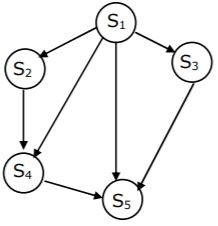
Theory Explanation. |
Question 31 |
Consider the following database relations containing the attributes
Book_id
Subject_Category_of_book
Name_of_Author
Nationality_of_Author
with Book_id as the Primary Key.
(a) What is the highest normal form satisfied by this relation?
(b) Suppose the attributes Book_title and Author_address are added to the relation, and the primary key is changed to (Name_of_Author, Book_Title), what will be the highest normal form satisfied by the relation?
Theory Explanation. |
Question 32 |
Consider the following relational database schemes:
  COURSES(Cno, name)
  PRE-REQ(Cno, pre_Cno)
  COMPLETED(student_no, Cno)
COURSES give the number and the name of all the available courses.
PRE-REQ gives the information about which course are pre-requisites for a given course.
COMPLETED indicates what courses have been completed by students.
Express the following using relational algebra:
List all the courses for which a student with student_no 2310 has completed all the pre-requisites.
Theory Explanation. |
Question 33 |
Consider the join of a relation R with a relation S. If R has m tuples and S has n tuples then the maximum and minimum sizes of the join respectively are
m + n and 0 | |
mn and 0 | |
m + n and |m – n| | |
mn and m + n |
Suppose there is no common attribute in R and S due to which natural join will act as cross product. So then in cross product total no. of tuples will be mn.
For minimum:
Suppose there is common attribute in R and S, but none of the row of R matches with rows of S then minimum no. of tuples will be 0.
Question 34 |
The relational algebra expression equivalent to the following tuple calculus expression:
{t| t ∈ r ∧(t[A] = 10 ∧ t[B] = 20)} isσ(A=10∨B=20) (r) | |
σ(A=10) (r) ∪ σ(B=20) (r) | |
σ(A=10) (r) ∩ σ(B=20) (r) | |
σ(A=10) (r) - σ(B=20) (r) |
σ(A=10) (r) ∩ σ(B=20) (r)
Question 35 |
Let R = (A, B, C, D, E, F) be a relation scheme with the following dependencies: C→F, E→A, EC→D, A→B. Which of the following is a key of R?
CD | |
EC | |
AE | |
AC |
A) (CD)+ = cdf
Not a key.
B) (EC)+ = ecdabf
Yes, it is a key.
C) (AE)+ = aeb
Not a key. D) (AC)+ = abcf
Not a key.
Question 36 |
Which of the following is correct?
B-trees are for storing data on disk and B+ trees are for main memory. | |
Range queries are faster on B* trees. | |
B-trees are for primary indexes and B* trees are for secondary indexes. | |
The height of a B* tree is independent of the number of records. |
Question 37 |
1 Read A
2 Read B
3 Write A
4 Read A
5 Write A
6 Write B
7 Read B
8 Write B
This schedule is serialized and can occur in a scheme using 2PL protocol | |
This schedule is serializable but cannot occur in a scheme using 2PL protocol | |
This schedule is not serialiable but can occur in a scheme using 2PL protocol | |
This schedule is not seralisable and cannot occur in a scheme using 2PL protocol. |
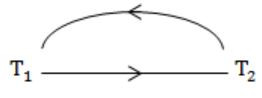
Since cycle exist so not conflict serializable.
And we know that if the schedule is not serializable then it is not 2PL.
Hence correct option is (D).
Question 38 |
Consider the schema R = (S T U V) and the dependencies S → T, T → U, U → V and V → S. Let R = (R1 and R2) be a decomposition such that R1 ∩ R2 ≠ ∅ . The decomposition is
not in 2NF | |
in 2NF but not 3NF | |
in 3NF but not in 2NF | |
in both 2NF and 3NF |
And since every attribute is key so the decomposed relation will be in BCNF and hence in 3NF.
Question 39 |
Consider the circuit shown below. In a certain steady state, the line Y is at '1'. What are the possible values of A, B and C in this state?

A = 0, B = 0, C = 1 | |
A = 0, B = 1, C = 1 | |
A = 1, B = 0, C = 1 | |
A = 1, B = 1, C = 1 |
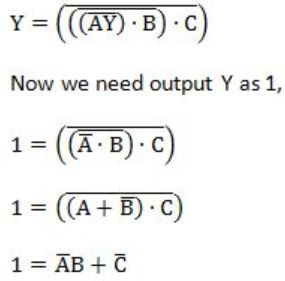
So the above equation is satisfied if either C=0 or A=0 and B=1.
Hence, Option (B) is correct.
Question 40 |
Which of the following sets of component(s) is/are sufficient to implement any arbitrary Boolean function?
XOR gates, NOT gates | |
2 to 1 multiplexors | |
AND gates, XOR gates | |
Three-input gates that output (A⋅B) + C for the inputs A⋅B and C | |
Both B and C |
(B) 2 to 1 multiplexors is functionally complete.
(C) XOR gate can be used to make a NOT gate. So, (AND, NOT) is functionally complete.
(D) With given gates and inputs NOT gate cannot be derived.
Hence, not complete.
Question 41 |
Which of the following is/are correct?
An SQL query automatically eliminates duplicates | |
An SQL query will not work if there are no indexes on the relations | |
SQL permits attribute names to be repeated in the same relation | |
None of the above |
→ If there are no indexes on the relation SQL, then also it works.
→ SQL does not permit 2 attributes to have same name in a relation.
Question 42 |
Consider a B-tree with degree m, that is, the number of children, c, of any internal node (except the root) is such that m ≤ c ≤ 2m-1. Derive the maximum and minimum number of records in the leaf nodes for such a B-tree with height h, h≥1. (Assume that the root of a tree is at height 0.)
Theory Explanation. |
Question 43 |
Consider the set of relations
EMP(Employee-no, Dept-no, Employee-name, Salary)
DEPT(Dept-no, Dept-name, Location)
Write an SQL query to:
(a) Find all employee names who work in departments located at "Calcutta" and whose salary is greater than Rs. 50,000.
(b) Calculate, for each department number, the number of employees with a salary greater than Rs. 100,000.
Theory Explanation. |
Question 44 |
B+-trees are preferred to binary trees in databases because
Disk capacities are greater than memory capacities | |
Disk access is much slower than memory access | |
Disk data transfer rates are much less than memory data transfer rates | |
Disks are more reliable than memory |
Question 45 |
Given the relations
   employee (name, salary, deptno) and
   department (deptno, deptname, address)
Which of the following queries cannot be expressed using the basic relational algebra operations (σ, π, ×, ⋈, ∪, ∩, -)?
Department address of every employee | |
Employees whose name is the same as their department name | |
The sum of all employees’ salaries | |
All employees of a given department |
Question 46 |
Given the following relation instance.
          x  y  z
          1  4  2
          1  5  3
          1  6  3
          3  2  2
Which of the following functional dependencies are satisfied by the instance?
XY → Z and Z → Y | |
YZ → X and Y → Z | |
YZ → X and X → Z | |
XZ → Y and Y → X |
If for t1[A] = t2[A] then t1[Y] = t2[Y].
Question 47 |
Given relations r(w, x) and s(y, z), the result of
    select distinct w, x
    from r, s
is guaranteed to be same as r, provided
r has no duplicates and s is non-empty | |
r and s have no duplicates | |
s has no duplicates and r is non-empty | |
r and s have the same number of tuples |
Question 48 |
In SQL, relations can contain null values, and comparisons with null values are treated as unknown. Suppose all comparisons with a null value are treated as false. Which of the following pairs is not equivalent?
x = 5 not AND (not (x = 5) | |
x = 5 AND x > 4 and x < 6, where x is an integer | |
x ≠ 5 AND not (x = 5) | |
None of the above |
Question 49 |
(a) Suppose you are given an empty B+-tree where each node (leaf and internal) can store up to 5 key values. Suppose values 1,2,….. 10 are inserted, in order, into the tree, Show the tree pictorially
(i) After 6 insertions, and
(ii) After all 10 insertions
Do NOT show intermediate stages.
(b) Suppose instead of splitting a node when it is full, we try to move a value to the left sibling. If there is no left sibling, or the left sibling is full, we split the node. Show the tree after values, 1, 2,….., 9 have been inserted. Assume, as in (a) that each node can hold up to 5 keys.
(c) In general, suppose a B+-tree node can hold a maximum of m keys, and you insert a long sequence of keys in increasing order. Then what approximately is the average number of keys in each leaf level node.
(i) In the normal case, and
(ii) With the insertion as in (b).
Theory Explanation is given below. |
(i)
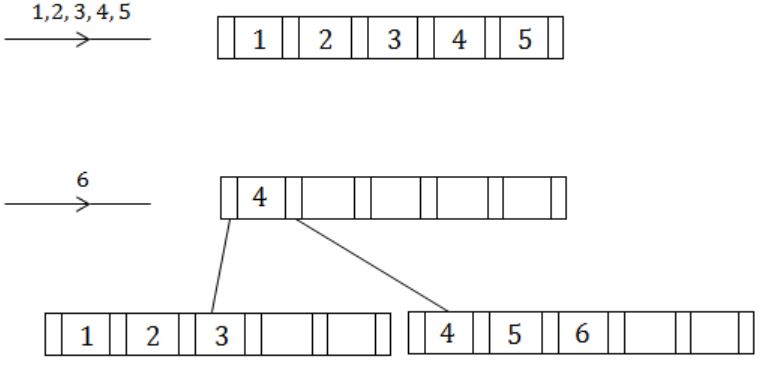
(ii)

(b)
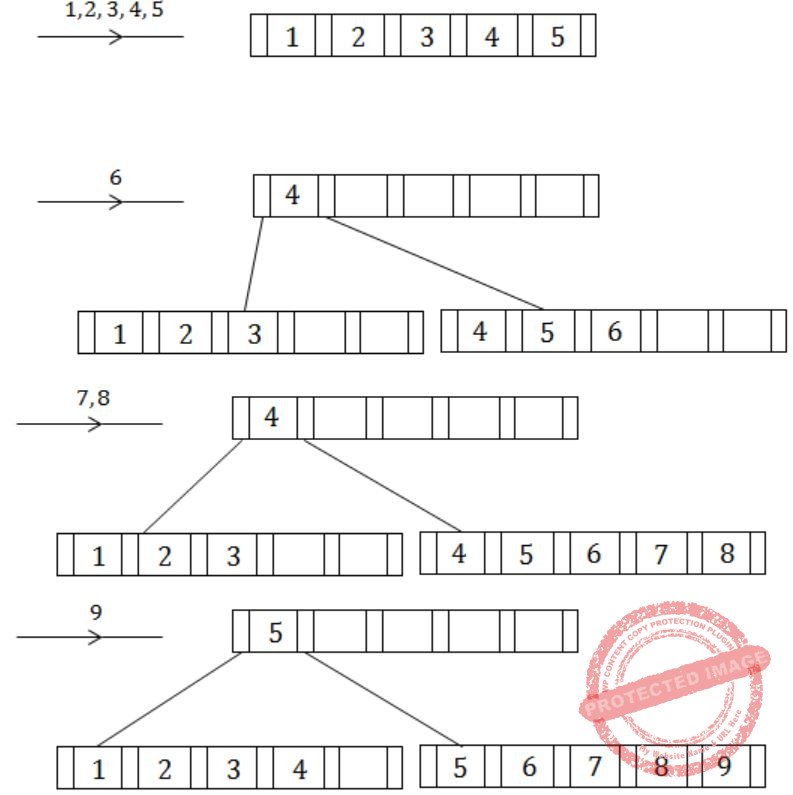
Question 50 |
Consider a bank database with only one relation
transaction (transno, acctno, date, amount)
The amount attribute value is positive for deposits and negative for withdrawals.
(a) Define an SQL view TP containing the information.
(acctno, T1.date, T2.amount)
for every pair of transactions T1, T2 such that T1 and T2 are transaction on the same account and the date of T2 is ≤ the date of T1.
(b) Using only the above view TP, write a query to find for each account the minimum balance it ever reached (not including the 0 balance when the account is created). Assume there is at most one transaction per day on each account, and each account has had atleast one transaction since it was created. To simply your query, break it up into 2 steps by defining an intermediate view V.
Theory Explanation is given below. |