
Functional-dependency
Question 1 |
Consider the relation X(P, Q, R, S, T, U) with the following set of functional dependencies
F = {
       {P, R} → {S,T},
       {P, S, U} → {Q, R}
    }
Which of the following is the trivial functional dependency in F+ is closure of F?
{P,R}→{S,T} | |
{P,R}→{R,T} | |
{P,S}→{S} | |
{P,S,U}→{Q} |
Question 2 |
Consider the relation scheme R = (E, F, G, H, I, J, K, L, M, N) and the set of functional dependencies {{E,F} → {G}, {F} → {I,J}, {E,H} → {K,L}, {K} → {M}, {L} → {N}} on R. What is the key for R?
{E,F} | |
{E,F,H} | |
{E,F,H,K,L} | |
{E} |
B) (EFH)+ = EFHGIJKLMN, EFH is deriving all the attributes of R. So, EFH is a key.
C) If EFH is a key, then EFHKL will become the super key.
D) (E)+ = E
Question 3 |
The following functional dependencies are given:
AB → CD, AF → D, DE → F, C → G, F → E, G → A.
Which one of the following options is false?
{CF}+ = {ACDEFG} | |
{BG}+ = {ABCDG}
| |
{AF}+ = {ACDEFG} | |
{AB}+ = {ABCDFG} |
AF → D
DE → F
C → G
F → E
G → A
CF+ = {G,E,A,D,C,F} = {A,C,D,E,F,G} (✔️)
BG+ = {B,G,A,C,D} = {A,B,C,D,G} (✔️)
AF+ = {D,E,A,F} = {A,D,E,F} (❌)
AB+ = {A,B,C,D,G} (❌)
Question 4 |
V → W
VW → X
Y → VX
Y → Z
Which of the following is irreducible equivalent for this set of functional dependencies?
V→W V→X Y→V Y→Z | |
V→W W→X Y→V Y→Z | |
V→W V→X Y→V Y→X Y→Z | |
V→W W→X Y→V Y→X Y→Z |
V → W, VW → X, Y → V, Y → X, Y→ Z
Step 2:
V → W, VW → X, Y → V, Y → X, Y→ Z
(V)+ = V ×
(VW)+ = VW ×
(Y)+ = YXZ
(Y)+ = YVW ×
(Y)+ = YVWX
Without Y → X, the closure of Y is deriving ‘X’ from the remaining attributes.
So, we can remove Y → X as its redundant.
Step 3:
V → W, VW → X, Y → V, Y → Z
(V)+ = VW, the closure of V is deriving W from the remaining FD’s.
So, W is redundant. We can remove it.
So, the final canonical form is
V→W, V→X, Y→V, Y→Z
⇾ So, option (A) is correct.
Question 5 |
Consider a relation scheme R = (A, B, C, D, E, H) on which the following functional dependencies hold: {A → B, BC → D, E → C, D → A}. What are the candidate keys of R?
AE, BE | |
AE, BE, DE | |
AEH, BEH, BCH | |
AEH, BEH, DEH |
So only option (D) contains E and H as part of candidate key.
Question 6 |
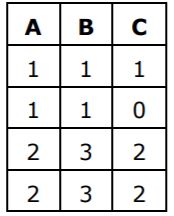
From the following instance of a relation scheme R(A,B,C), we can conclude that:
A functionally determines B and B functionally determines C | |
A functionally determines B and B does not functionally determines C | |
B does not functionally determines C | |
A does not functionally determines B and B does not functionally determines C |
But for the given instance it can be seen that B does not functionally determines C, and it can be concluded for entire relation.
Question 7 |
Consider a schema R(A,B,C,D) and functional dependencies A → B and C → D. Then the decomposition of R into R1(AB) and R2(CD) is
dependency preserving and lossless join | |
lossless join but not dependency preserving | |
dependency preserving but not lossless join | |
not dependency preserving and not lossless join |
R1∩R2 ≠ 0
Given R1(A,B), R2
R1∩R2 = 0
Not lossless.
The given relation decomposed into R1(A,B) and R2(C,D) and there are only two functional dependencies A→B and C→D. So the given decomposition is dependency preserving.
Question 8 |
Given the following relation instance.
          x  y  z
          1  4  2
          1  5  3
          1  6  3
          3  2  2
Which of the following functional dependencies are satisfied by the instance?
XY → Z and Z → Y | |
YZ → X and Y → Z | |
YZ → X and X → Z | |
XZ → Y and Y → X |
If for t1[A] = t2[A] then t1[Y] = t2[Y].
Question 9 |
Let R = (A, B, C, D, E, F) be a relation scheme with the following dependencies: C→F, E→A, EC→D, A→B. Which of the following is a key of R?
CD | |
EC | |
AE | |
AC |
A) (CD)+ = cdf
Not a key.
B) (EC)+ = ecdabf
Yes, it is a key.
C) (AE)+ = aeb
Not a key. D) (AC)+ = abcf
Not a key.
Question 10 |
Consider a relation R with five attributes V, W, X, Y, and Z. The following functional dependencies hold: VY → W, WX → Z, and ZY → V.
Which of the following is a candidate key for R?
VXZ | |
VXY | |
VWXY | |
VWXYZ |
Candidate keys are
VXY, WXY, ZXY
Question 11 |
Let R (A, B, C, D) be a relational schema with the following functional dependencies: A → B, B → C, C → D and D → B.
The decomposition of R into (A, B), (B, C), (B, D)
gives a lossless join, and is dependency preserving | |
gives a lossless join, but is not dependency preserving | |
does not give a lossless join, but is dependency preserving | |
does not give a lossless join and is not dependency preserving
|
(A, B, C) (B, D) - common attributes is B and B→D is a FD (via B→C, C→D), and hence, B is a key for (B, D). So, decomposition of (A, B, C, D) into (A, B, C) (B, D) is lossless.
Thus the given decomposition is lossless.
The given decomposition is also dependency preserving as the dependencies A→B is present in (A, B), B→C is present in (B, C), D→B is present in (B, D) and C→D is indirectly present via C→B in (B, C) and B→D in (B, D).
Question 12 |
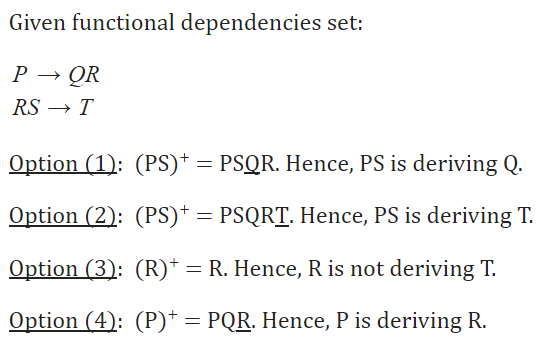
P⟶ QR
RS⟶ T
Which of the following functional dependencies can be inferred from the above functional dependencies?
PS ⟶ Q | |
PS ⟶ T | |
R ⟶ T | |
P ⟶ R |
Question 13 |
AB → C; BC → D; C → E;
The number of superkeys in the relation R is _____________.
8 |
AB → C
BC → D
C → E
¯ The attributes A, B are not there in the right hand side of any of the given FDs.
¯ So, AB can be a candidate key.
(AB)^+ = ABCDE
¯ (AB)^+ is deriving all the attributes of R Hence, AB is a candidate key.
¯ The number of super keys possible for R with “AB” candidate kay is:
2^5 – 2 = 2^3
= 8
Question 14 |
(X,Y)→ (Z,W) implies X→ (Z,W)
| |
(X,Y)→ (Z,W) implies (X,Y)→ Z | |
((X,Y)→ Z and W→ Y) implies (X,W)→ Z
| |
(X→Yand Y→ Z) implies X→ Z |
Question 15 |
First normal form but not in second normal form | |
Second normal form but not in third normal form | |
Third normal form | |
None of the above |
→ So option A is right it is not in second normal form because its part of key(candidate key) determines non-key.
→ The domains of a, b, c and d include only atomic values.
So, which satisfies the definition of first normal form.
Question 16 |
X is functionally dependent on Y | |
X is not functionally dependent on any subset of Y | |
Both (a) and (b) | |
None of these |
→ An attribute is fully functional dependent on another attribute, if it is Functionally Dependent on that attribute and not on any of its proper subset.
For example, an attribute X is fully functional dependent on another attribute Y, if it is Functionally Dependent on X and not on any of the proper subset of Y.
Must satisfied conditions:
i) X is functionally dependent on Y and
ii) X is not functionally dependent on any subset of Y.
Question 17 |
Reflexive, Augmentation and Decomposition | |
Transitive, Augmentation and Reflexive | |
Augmentation, Transitive, Reflexive and Decomposition | |
Reflexive, Transitive and Decomposition |
The axioms are sound in generating only functional dependencies in the closure of a set of functional dependencies when applied to that set
Axiom of Reflexivity:
→If X is a set of attributes and Y is a subset of X, then X holds Y. Hereby, X holds Y ( X -> Y) means that X functionally determines Y.
Axiom of Augmentation:
→If X holds Y and Z is a set of attributes, then XZ holds YZ. It means that attribute in dependencies does not change the basic dependencies.
Axiom of Transitivity:
The axiom of transitivity says if X holds Y, and Y holds Z, then X must also hold Z.
Question 18 |
Preserves dependency but cannot perform lossless join | |
Preserves dependency and performs lossless join | |
Does not perform dependency and cannot perform lossless join | |
Does not preserve dependency but perform lossless join |
Schema R(A, B, C, D)
Functional dependencies are A→ B and C→ D
Decomposed Schema is R1(A,B) and R2(C,D)
Dependency preservation decomposition:
It is another property of decomposed relational database schema D in which each functional dependency X → Y specified in F either appeared directly in one of the relation schemas Ri in the decomposed D or could be inferred from the dependencies that appear in some Ri.
Decomposition D={ R1 , R2, R3,,.., ,Rm} of R is said to be dependency-preserving with respect to F if the union of the projections of F on each Ri , in D is equivalent to F.
In other words, R ⊂ join of R1, R1 over X. The dependencies are preserved because each dependency in F represents a constraint on the database. If decomposition is not dependency-preserving, some dependency is lost in the decomposition.
→ R1(A,B) is covered A→ B
→ R2(C,D) is covered C→ D
It is Functional Dependency preserving because both the functional dependencies are covered.
Lossless join:
The decomposition is a lossless-join decomposition of R if at least one of the following functional dependencies are in F+ (where F+ stands for the closure for every attribute or attribute sets in F):
R1 ∩ R2 → R1
R1 ∩ R2 → R2
According to functional dependency R1(A,B) ∩ R2(C,D) = null. There is no common key in both the tables. So, it is not lossless join.
Question 19 |
A→ (B,C) | |
A → B, A→→ C | |
A→ B, C→→A | |
A→→B, B→ C |
→→ is multivalued dependency.
Functional Dependency:
A → B means that the values of B are determined by the values of A. Two tuples sharing the same values of A will necessarily have the same values of B.
Multivalued dependency: It is a special case of a join dependency, with only two sets of values involved, i.e. it is a binary join dependency.
A multivalued dependency exists when there are at least three attributes (like A,B and C) in a relation and for a value of A there is a well defined set of values of B and a well defined set of values of C. However, the set of values of B is independent of set C and vice versa.