
computer-organization
Question 1 |
DMA based I/O transfer | |
Interrupt driven I/O transfer | |
Polling based I/O transfer | |
Programmed I/O transfer |
DMA or direct memory access allows the peripherals to directly communicate with each other using the memory buses, removing the intervention of the CPU. Hence it is the fast mode of IO transfer compared to all other methods. In polling, the processor wastes countless processor cycles by repeatedly checking each IO device if it needs attention.
Question 2 |
Each cache block in WB and WT has a dirty bit. | |
Every write hit in WB leads to a data transfer from cache to main memory. | |
Eviction of a block from WT will not lead to data transfer from cache to main memory | |
A read miss in WB will never lead to eviction of a dirty block from WB. |
Option B: Every write hit in WB need not lead to data transfer from cache to main memory, rather only when that particular block is being evicted there will be transfer from cache to main memory. There can be several write hits in WB before the block is evicted and all those writes will be propagated to the main memory at once. Hence the given statement is false.
Option C: The given statement is true because in WT the writes happen in parallel both in cache and main memory so at the eviction of a block in WT it will not lead to data transfer from cache to main memory.
Option D: A read miss in WB will fetch a new block from main memory and can lead to eviction of a dirty block. Hence the given statement is false.
Question 3 |
0.85 |
h1 = 0.8
t1 = 10 ns
t2 = 100ns
After the optimization the average memory access time remains the same,
Let the new hit rate be h2. The new cache access time is 15ns.
Applying the average access time formula h1t1+(1-h1)(t1+t2)
0.8*10+0.2*(10+100) = h2*15+(1-h2)(15+100)
30 = 15 + (1-h2)*100
1-h2 = 0.15
h2 = 0.85
Question 4 |
The TLB performs an associative search in parallel on all its valid entries using page number of incoming virtual address. | |
If the virtual address of a word given by CPU has a TLB hit, but the subsequent search for the word results in a cache miss, then the word will always be present in the main memory. | |
The memory access time using a given inverted page table is always same for all incoming virtual addresses. | |
In a system that uses hashed page tables, if two distinct virtual addresses V1 and V2 map to the same value while hashing, then the memory access time of these addresses will not be the same. |
(B) True: TLB hit implies no page fault. Hence, the page-frame will always be in main memory.
(C) False: Inverted page table depends on the size of the process. Hence, the memory access time also varies.
(D) True: Collision resolution techniques are applied. Hence, the each address may take different time.
Question 5 |
Every access to S is a hit. | |
Once P is brought to the cache it is never evicted. | |
At the end of the execution only R and S reside in the cache. | |
Every access to R evicts Q from the cache. |
Block size = 64 bytes = 2^6 bytes, we need 6 bits OFFSET to identify each byte in the block.
No. of blocks in the cache = 2^11 / 2^6 = 2^5, since it is a direct mapped cache we need 5 bits in the physical address to identify the LINE number.
Each word is 16 bits long = 2 bytes.
Number of words in each block = 64/2 = 32 words.
The physical memory is 64KB = 2^16 bytes, so the physical address is 16 bits.
In direct mapped cache the physical address is divided into (TAG, LINE, OFFSET)
In the 16 bits physical address OFFSET is 6 bits and LINE number is 5 bits, so there are 5 TAG bits.
The given physical addresses of P, Q, R, S can be written in binary as below (each hexadecimal digit represents 4 binary digits):
P: 0xA248 (10100 01001 001000 )
Q: 0xC28A (11000 01010 001010)
R: 0xCA8A (11001 01010 001010)
S: 0xA262 (10100 01001 100010)
Here P is mapped to line number 9 in the cache. S also is mapped to line number 9 and not only that they both are from the same block as even the TAG bits are matching. So, even the first access of S will be a hit as it gets prefetched along with P. Once P is fetched it is never evicted.
Both Q and R are mapped to line number 10 in the cache. But they are from different blocks as the TAG bits are different. Since it is a direct mapped cache, every access of R evicts Q from the cache.
Hence options A, B, D are true. Option C is false as at the end of execution P, R, S are in the cache not just R, S.
Question 6 |
1.43 |
It is given that there are 30% branch instructions and each branch instruction causes 2 stall cycles.
= 1+0.3*2 = 1.6
In X2 there is a branch predictor which predicts correctly 80% of the time. Only in 20% cases the prediction is wrong. So, out of the 30% of branch instructions only 20% of them now lead to stalls.
The effective CPI in X2 : (1+Stall frequency * No. of stall cycles) = (1+0.3*0.2*2) = 1.12
Since the processor speed remains the same, the clock cycle time also doesn’t change. Hence speedup of X2 over X1 : 1.6/1.12 = 1.43
Question 7 |
Which one of the following statements is true?
Macro definitions cannot appear within other macro definitions in assembly language programs | |
Overlaying is used to run a program which is longer than the address space of computer | |
Virtual memory can be used to accommodate a program which is longer than the address space of a computer | |
It is not possible to write interrupt service routines in a high level language |
Question 8 |
State True or False with one line explanation
Multiplexing of address/data lines in 8085 microprocessor reduces the instruction
execution time.
True | |
False |
The major reason of multiplexing address and data bus is to reduce the number of pins for address and data and dedicate those pins for other several functions of micro-processor.
Question 9 |
State True or False with one line explanation
Expanding opcode instruction formats are commonly employed in RISC. (Reduced Instruction Set Computers) machines.
True | |
False |
Now the challenge is: How to fit multiple sets of instructions types into limited or fixed size instruction format.
Here comes expanding opcode into the picture, So RISC system uses expanding opcode technique to have fixed size instructions.
Question 10 |
State True or False with one line explanation
A FSM (Finite State Machine) can be designed to add two integers of any arbitrary length (arbitrary number of digits).
True | |
False |
→ q0: Start state to represent carry bit is 0.
→ q1: State to represent carry bit is 1.
The inputs to the FA will be pairs of bits, i.e., 00, 01, 10, 11.
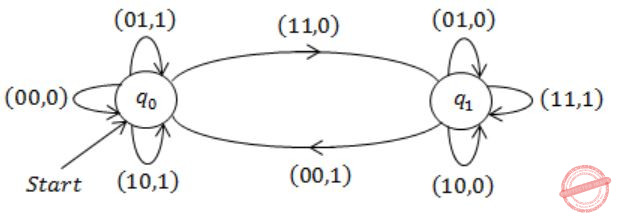
The FA starts in state 1 (since carry is 0) and inputs a pair of bits. If the pair is 11, the FA outputs a '0' and switches to state 2 (since the carry is 1), where the next pair of bits is input and is added to a carry bit of 1.
Question 11 |
Match the following items
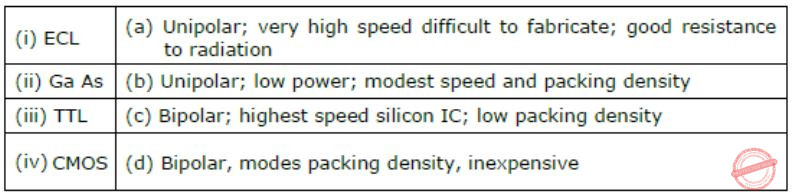
(i) - (a), (ii) - (b), (iii) - (d), (iv) - (c) |
Question 12 |
State whether the following statements are True or False with reasons for your answer:
(a) Coroutine is just another name for a subroutine.
(b) A two pass assembler uses its machine opcode table in the first pass of assembly.
Theory Explanation. |
Question 13 |
State whether the following statements are True or False with reasons for your answer
(a) A subroutine cannot always be used to replace a macro in an assembly language program.
(b) A symbol declared as ‘external’ in assembly language is assigned an address outside the program by the assembler itself.
Theory Explanation. |
Question 14 |
Consider the following statements.
- I. Daisy chaining is used to assign priorities in attending interrupts.
II. When a device raises a vectored interrupt, the CPU does polling to identify the source of the interrupt.
III. In polling, the CPU periodically checks the status bits to know if any device needs its attention.
IV. During DMA, both the CPU and DMA controller can be bus masters at the same time.
Which of the above statements is/are TRUE?
I and IV only | |
I and II only
| |
III only | |
I and III only
|
Statement-II is false as vectored interrupt doesn’t involve polling but non-vectored interrupt involves polling.
Statement-III is true as polling means that CPU periodically checks the status bits to know if any device needs attention.
Statement-IV is false as during DMA only one of the CPU or DMA can be bus master at a time.
Question 15 |
A direct mapped cache memory of 1 MB has a block ize of 256 bytes. The cache has an access time of 3 ns and a hit rate of 94%. During a cache miss, it takes 20 ns to bring the first word of a block from the main memory, while each subsequent word takes 5 ns. The word size is 64 bits. The average memory access time in ns (round off to 1 decimal place) is _____.
13.5 |
Hit ratio of cache = 0.94
Word size is 64 bits = 8 bytes.
Cache line size = 256 bytes = 32 words
Main memory access time = 20ns(time for first word) + 155ns(time for remaining 31 words, 31*5 = 155ns) = 175 ns
Average access time = h1*t1 + (1-h1)(t1+t2) = t1 +(1-h1)t2
⇒ 3 + (0.06)(175) = 13.5 ns
Question 16 |
Consider the following data path diagram.
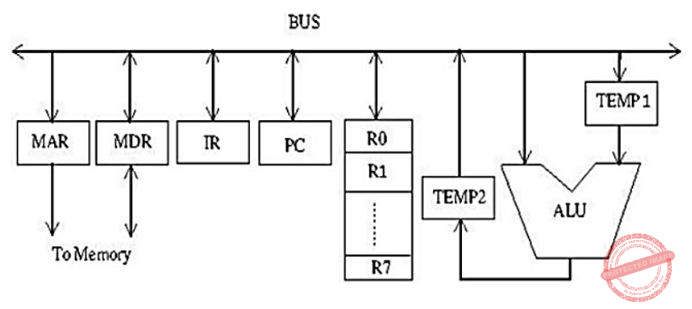
Consider an instruction: R0 ← R1 + R2. The following steps are used to execute it over the given data path. Assume that PC is incremented appropriately. The subscripts r and w indicate read and write operations, respectively.
1. R2r, TEMP1r, ALUadd, TEMP2w
2. R1r, TEMP1w
3. PCr, MARw, MEMr
4. TEMP2r, ROw
5. MDRr, IRw
Which one of the following is the correct order of execution of the above steps?
3, 5, 1, 2, 4
| |
3, 5, 2, 1, 4
| |
1, 2, 4, 3, 5 | |
2, 1, 4, 5, 3
|
First the PC value has to be moved into MAR (step-3 from the given sequence), then the instruction has to be fetched(step-5 from the given sequence). Then Temp1 is loaded with the value of R1 (step-2 from the given sequence), then the addition operation is performed by accessing the R2 value directly and adding it to Temp1 value and storing the result in Temp2 (step-1 from the given sequence).
Finally the result from Temp2 is stored in R0 (step-4 from the given sequence).
Hence the correct sequence is (3, 5, 2, 1, 4).
Question 17 |
Consider a non-pipelined processor operating at 2.5 GHz. It takes 5 clock cycles to complete an instruction. You are going to make a 5-stage pipeline out of this processor. Overheads associated with pipelining force you to operate the pipelined processor at 2 GHz. In a given program, assume that 30% are memory instructions, 60% are ALU instructions and the rest are branch instructions. 5% of the memory instructions cause stalls of 50 clock cycles each due to cache misses and 50% of the branch instructions cause stalls of 2 cycles each. Assume that there are no stalls associated with the execution of ALU instructions. For this program, the speedup achieved by the pipelined processor over the non-pipelined processor (round off to 2 decimal places) is _____.
2.16 |
It is given that each instruction takes 5 clock cycles to execute in the non-pipelined architecture, so time taken to execute each instruction = 5 * 0.4 = 2ns
In the pipelined architecture the clock cycle time = 1/2G = 0.5 ns
In the pipelined architecture there are stalls due to memory instructions and branch instructions.
In the pipeline, the updated clocks per instruction CPI = (1 + stall frequency due to memory operations * stalls of memory instructions + stall frequency due to branch operations * stalls due to branch instructions)
Out of the total instructions , 30% are memory instructions. Out of those 30%, only 5% cause stalls of 50 cycles each.
Stalls per instruction due to memory operations = 0.3*0.05*50 = 0.75
Out of the total instructions 10% are branch instructions. Out of those 10% of instructions 50% of them cause stalls of 2 cycles each.
Stalls per instruction due to branch operations = 0.1*0.5*2 = 0.1
The updated CPI in pipeline = 1 + 0.75 + 0.1 = 1.85
The execution time in the pipeline = 1.85 * 0.5 = 0.925 ns
The speed up = Time in non-pipelined architecture / Time in pipelined architecture = 2 / 0.925 = 2.16
Question 18 |
A computer system with a word length of 32 bits has a 16 MB byte-addressable main memory and a 64 KB, 4-way set associative cache memory with a block size of 256 bytes. Consider the following four physical addresses represented in hexadecimal notation.
A1 = 0x42C8A4, A2 = 0x546888, A3 = 0x6A289C, A4 = 0x5E4880
Which one of the following is TRUE?
A1 and A4 are mapped to different cache sets. | |
A1 and A3 are mapped to the same cache set. | |
A3 and A4 are mapped to the same cache set. | |
A2 and A3 are mapped to the same cache set. |
The word length is given as 32 bits and the physical addresses mentioned are all contain 6 hexadecimal digits, so the the physical address is 32 bits long.
Block size is 256 bytes, block offset = 8 bits as it is a byte addressable memory.
Cache size = 64KB
Number of blocks in the cache = 64KB/256B = 256
It is a 4-way set associative cache, so no. of sets in the cache = 256/4 = 64 = 26
In the physical address we need 6 bits for the SET number.
TAG bits = 32 - 6 - 8 = 18
So the 32 bits physical address is divided as (18 TAG bits + 6 SET number bits + 8 OFFSET bits)
Since in all the options we are asked about SET numbers of the given addresses, we need to find the SET number of each of the addresses.
A1 = 0x42C8A4, here SET number is (00 1000) which includes the last 2 bits of C(1100) and binary representation of 8 (1000).
A2 = 0x546888, here SET number is (10 1000) which includes the last 2 bits of 6(0110) and binary representation of 8 (1000).
A3 = 0x6A289C here SET number is (10 1000) which includes the last 2 bits of 2(0010) and binary representation of 8 (1000).
A4 = 0x5E4880 here SET number is (00 1000) which includes the last 2 bits of 4 (0100) and binary representation of 8 (1000).
From the given options option-4 is TRUE as A2, A3 are mapped to the same cache SET.
Question 19 |
A processor has 64 registers and uses 16-bit instruction format. It has two types of instructions: I-type and R-type. Each I-type instruction contains an opcode, a register name, and a 4-bit immediate value. Each R-type instruction contains an opcode and two register names. If there are 8 distinct I-type opcodes, then the maximum number of distinct R-type opcodes is _____.
14 |
All possible binary combinations = 216
There are 64 registers, so no. of bits needed to identify a register = 6
I-type instruction has (Opcode+Register+4-bit immediate value). There are 8 distinct I-type instructions.
All the binary combinations possible with the I-type instructions are = 8*26*24 = 213
R-type instructions have 2 register operands.
Let x be the number of R-type instructions.
All the possible binary combinations of R-type instructions = x*26*26 = x*212
The sum of I-type and R-type binary combinations should be equal to 216.
x*212 + 213 = 216
212 (x+2) = 216
x+2 = 24
x = 16 - 2 = 14
Question 20 |
Relative mode of addressing is most relevant to writing
coroutines | |
position – independent code | |
shareable code | |
interrupt handlers |
Question 21 |
Number of machine cycles required for RET instruction in 8085 microprocessor is
1 | |
2 | |
3 | |
5 |
2 for stack operation.
Total no. of cycles = 2+1 = 3
Question 22 |
For the daisy chain scheme of connecting I/O devices, which of the following statements is true?
It gives non-uniform priority to various devices. | |
It gives uniform priority to all devices | |
It is only useful for connecting slow devices to a processor device. | |
It requires a separate interrupt pin on the processor for each device. |
→ In this all devices connected serially.
→ High priority devices placed first, followed by low priority devices.
Question 23 |
A micro program control unit is required to generate a total of 25 control signals. Assume that during any microinstruction, at most two control signals are active. Minimum number of bits required in the control word to generate the required control signals will be
2 | |
2.5 | |
10 | |
12 |
= 5+5
= 10 bits
Question 24 |
An 8052 based system has an output port with address 00H. Consider the following assembly language program.
     ORG    0100H
     MVI    A, 00H
     LXI    H, 0105H
     OUT    00H
     INR    A
     PCHL
     HLT
(a) What does the program do with respect to the output port 00H?
(b) Show the wave forms at the three least significant bits of the port 00H.
Theory Explanation. |
Question 25 |
Consider the following program in pseudo-pascal syntax. What is printed by the program if parameter a in procedure test 1 is passed as
(i) call-by-reference parameter
(ii) call-by-value-result parameter
     program Example (input, output)
     var b: integer;
     procedure test2:
     begin b:=10; end
    procedure test1 (a:integer):
     begin 	a:=5;
                writeln ('point 1: ', a, b);
                test2;
                writeln ('point 2: ', a, b);
     end
     begin(*Example*)
     b:=3; test1(b);
     writeln('point3:', b);
end Theory Explanation. |
Question 26 |
A hard disk is connected to a 50 MHz processor through a DMA controller. Assume that the initial set-up of a DMA transfer takes 1000 clock cycles for the processor, and assume that the handling of the interrupt at DMA completion requires 500 clock cycles for the processor. The hard disk has a transfer rate of 2000 Kbytes/sec and average block transferred is 4 K bytes. What fraction of the processor time is consumed by the disk, if the disk is actively transferring 100% of the time?
Theory Explanation. |
Question 27 |
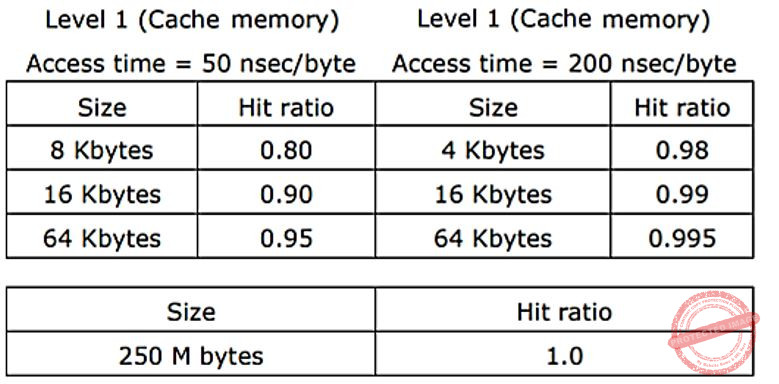
A computer system has a three level memory hierarchy, with access time and hit ratios as shown below:
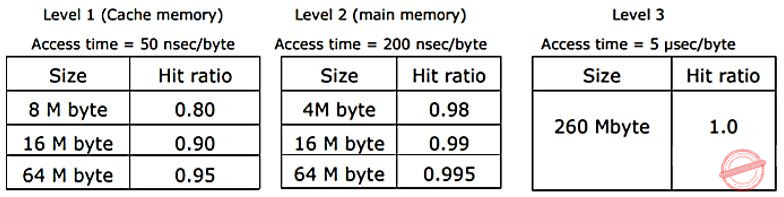
(a) What should be the minimum sizes of level 1 and 2 memories to achieve an average access time of less than 100 nsec?
(b) What is the average access time achieved using the chosen sizes of level 1 and level 2 memories?
Theory Explanation. |
Question 28 |
RST 7.5 interrupt in 8085 microprocessor executes the interrupt service routine from interrupt vector location
0000H | |
0075H | |
003CH | |
0034H |
→ 60 in hexa decimal is 003CH.
Question 29 |
Purpose of a start bit in RS 232 serial communication protocol is
to synchronize receiver for receiving every byte | |
to synchronize receiver for receiving a sequence of bytes | |
a parity bit | |
to synchronize receiver for receiving the last byte |
Question 30 |
The correct matching for the following pairs is
(A) DMA I/O                    (1) High speed RAM
(B) Cache                      (2) Disk
(C) Interrupt I/O              (3) Printer
(D) Condition Code Register    (4) ALU
A – 4 B – 3 C – 1 D – 2 | |
A – 2 B – 1 C – 3 D – 4
| |
A – 4 B – 3 C – 2 D – 1 | |
A – 2 B – 3 C – 4 D – 1 |
Cache → High speed RAM
Interrupt I/O → Printer
Condition code register → ALU
Question 31 |
When an interrupt occurs, an operating system
ignores the interrupt | |
always changes state of interrupted process after processing the interrupt | |
always resumes execution of interrupted process after processing the interrupt
| |
may change state of interrupted process to 'blocked’ and schedule another process
|
Option B: Not always.
Option C: Not always. If some high priority interrupt comes during execution of current interrupt then it fails.
Option D: It is True always.
Question 32 |
The expression (a*b)* c op....
where 'op' is one of '+', '*' and '↑' (exponentiation) can be evaluated on a CPU with a single register without storing the value of (a * b) if
‘op’ is ’+’ or ‘*’ | |
‘op’ is ’↑’ or ‘*’ | |
‘op’ is ’↑’ or ‘+’ | |
not possible to evaluate without storing |
(a*b)*c + d
(a*b)*c * d
(a*b)*c ∧ d
In any case, brackets has the highest priority always. So I have to compute brackets first. Now, for + and *, I can do the rest of the operation and save results in the same register. But for exponentiation, I have to store the result of a*b, then do the computation of c∧d, then multiply these two results.
Hence, (A) is correct.
Question 33 |
Contents of A register after the execution of the following 8085 microprocessor program is
MVI  A, 55 H
MVI  C, 25 H
ADD  C
DAA
7AH | |
80H | |
50H | |
22H |
Question 34 |
A micro instruction into be designed to specify
- (a) none or one of the three micro operations of one kind and
(b) none or upto six micro operations of another kind
The minimum number of bits in the micro-instruction is
9 | |
5 | |
8 | |
None of the above |
So, no. of bits required
⌈log2 (3)⌉ = 2
(b) This is a horizontal micro-programming because at any given time atmost six micro-operations will be activated.
So, no. of bits required = 6
So, total minimum no. of bits required = 6+2 = 8
Question 35 |
Consider the C struct defined below:
    struct data   {
        int marks [100];
        char grade;
        int cnumber;
    };
    struct data student;
The base address of student is available in register R1. The field student.grade can be accessed efficiently using
Post-increment addressing mode, (R1)+ | |
Pre-decrement addressing mode, -(R1) | |
Register direct addressing mode, R1 | |
Index addressing mode, X(R1), where X is an offset represented in 2’s complement 16-bit representation |
{
int marks[100];
char grade;
int cnumber;
}; struct data student
Base Address of student is available in R1.
So student.grade can be accessed efficiently by Relative Indexed Addressing Mode.
It is clearly mentioned X is the offset address to be summed with Base Address of R1.
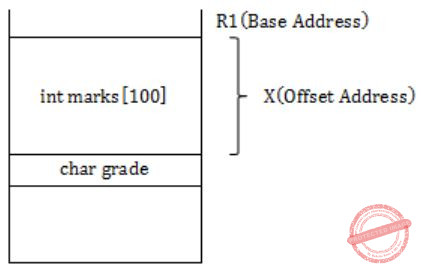
Hence Index Addressing mode X(R1), where X is an offset represented in 2’s complement 16-bit representation.
⇾ Relative, Base Indexed & all subtypes of Indirect addressing modes are used with Arrays.
Question 36 |
Consider a two-level cache hierarchy with L1 and L2 caches. An application incurs 1.4 memory accesses per instruction on average. For this application, the miss rate of L1 cache is 0.1; the L2 cache experiences, on average, 7 misses per 1000 instructions. The miss rate of L2 expressed correct to two decimal places is __________.
0.05 | |
0.06 | |
0.07 | |
0.08 |
For 1000 instructions total number of memory references = 1000 * 1.4 = 1400
These 1400 memory references are first accessed in the L1.
Since the miss rate of L1 is 0.1, for 1400 L1 references the number of misses = 0.1 * 1400 = 140
We know when there is a miss in L1 we next access the L2 cache.
So number of memory references to L2 = 140
It is given that there are 7 misses in L2 cache. Out of 140 memory references to L2 cache there are 7 misses.
Hence the miss rate in L2 cache = 7/140 = 0.05
Question 37 |
Consider a RISC machine where each instruction is exactly 4 bytes long. Conditional and unconditional branch instructions use PC-relative addressing mode with Offset specified in bytes to the target location of the branch instruction. Further the Offset is always with respect to the address of the next instruction in the program sequence. Consider the following instruction sequence
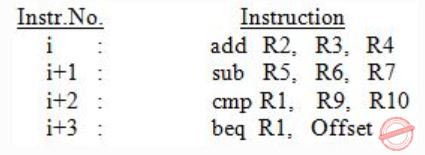
If the target of the branch instruction is i, then the decimal value of the Offset is ___________.
-16 | |
-17 | |
-18 | |
-19 |
Program counter Relative Addressing Mode
⇾ Assuming the first instruction starts at address zero
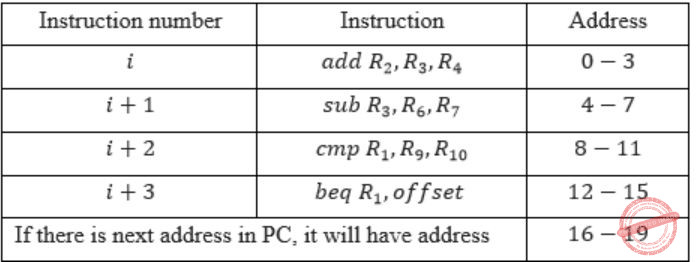
Offset should go from Address 16 to Address 0
⇒ Offset = 0 – 16 = (-16) ⇾ Final answer
Question 38 |
1.51 | |
1.52 | |
1.53 | |
1.54 |
The stage delays are 5, 4, 20, 10 and 3. And buffer delay = 2ns
So clock cycle time = max of stage delays + buffer delay
= max(5, 4, 20, 10,3)+2
= 20+2
= 22ns
Execution time for n-instructions in a pipeline with k-stages = (k+n-1) clock cycles
= (k+n-1)* clock cycle time
In this case execution time for 20 instructions in the pipeline with 5-stages
= (5+20-1)*22ns
= 24*22
= 528ns
Efficient Pipeline implementation:
OF phase is split into two stages OF1, OF2 with execution times of 12ns, 8ns
New stage delays in this case = 5, 4, 12, 8, 10, 3
Buffer delay is the same 2ns.
So clock cycle time = max of stage delays + buffer delay
= max(5, 4, 12, 8, 10,3) + 2
= 12+2
= 14ns
Execution time = (k+n-1) clock cycles
= (k+n-1)* clock cycle time
In this case no. of pipeline stages, k = 6
No. of instructions = 20
Execution time = (6+20-1)*14 = 25*14 = 350ns
Speed up of Efficient pipeline over native pipeline
= Naive pipeline execution time / efficient pipeline execution time
= 528 / 350
≌ 1.51
Question 39 |
Consider a 2-way set associative cache with 256 blocks and uses LRU replacement. Initially the cache is empty. Conflict misses are those misses which occur due to contention of multiple blocks for the same cache set. Compulsory misses occur due to first time access to the block. The following sequence of accesses to memory blocks
(0, 128, 256, 128, 0, 128, 256, 128, 1, 129, 257, 129, 1, 129, 257, 129)is repeated 10 times. The number of conflict misses experienced by the cache is __________.
76 | |
79 | |
80 | |
81 |
If a block is accessed once and then before its second access if there are k-unique block accesses and the cache size is less than k, and in that case if the second access is amiss then it is capacity miss. In this case the cache doesn't have the size to hold all the k-unique blocks that came and so when the initial block came back again it is not in the cache because capacity of the cache is less than the unique block accesses k. Hence it is capacity miss.
If a block is accessed once and then before its second access if there are k-unique block accesses and the cache size is greater than k, and in that case if the second access is a miss then it is conflict miss. In this case the cache can hold all the k-unique blocks that came and even then when the initial block came back again it is not in the cache because it got replaced, then it is conflict miss.
LRU will use the function xmod128
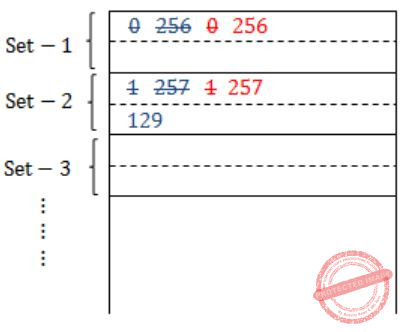
Cache size = 256 Bytes
2 way set associative cache
So, no. of cache sets = 256/2 = 128
Blue → Compulsory miss
Red → Conflict miss
At the end of first round we have 4, compulsory misses & 4 conflict misses.
Similarly, if we continue from Round-2 to last round, in every round we will get 8 conflict misses.
Total conflict misses = 4+9(8) = 4+72 = 76 (conflict misses)
Question 40 |
A cache memory unit with capacity of N words and block size of B words is to be designed. If it is designed as a direct mapped cache, the length of the TAG field is 10 bits. If the cache unit is now designed as a 16-way set-associative cache, the length of the TAG field is ___________ bits.
14 | |
15 | |
16 | |
17 |
(Tag bits + bits for block number + bits for block offset)
With block size being B words no. of bits for block offset = log (B)
Because the cache capacity is N words and each block is B words, number of blocks in cache = N / B
No. of bits for block number = log (N/B)
So, the physical address in direct mapping case
= 10 + log (N/B) + log (B)
= 10 + log (N) – log B + log B
= 10 + log (N)
If the same cache unit is designed as 16-way set associative, then the physical address becomes
(Tag bits + bits for set no. + Bits for block offset)
There are N/B blocks in the cache and in 16-way set associative cache each set contains 16 blocks.
So no. of sets = (N/B) / 16 = N / (16*B)
Then bits for set no = log (N/16B)
Bits for block offset remain the same in this case also. That is log (B).
So physical address in the set associative case
= tag bits + log (N/16*B) + log B
= tag bits + log (N) – log (16*B) + log B
= tag bits + log (N) – log 16 – log B + log B
= tag bits + log N – 4
The physical address is the same in both the cases.
So, 10 + log N = tag bits + log N – 4
Tag bits = 14
So, no. of tag bits in the case 16-way set associative mapping for the same cache = 14.
Question 41 |
In serial communication employing 8 data bits, a parity bit and 2 stop bits, the minimum band rate required to sustain a transfer rate of 300 characters per second is
2400 band | |
19200 band | |
4800 band | |
1200 band |
(8+2+1+1) * 300
= 3600
Minimum band rate required is 4800 band.
Question 42 |
Which of the following devices should get higher priority in assigning interrupts?
Hard disk | |
Printer | |
Keyboard | |
Floppy disk |
Question 43 |
Which of the following addressing modes permits relocation without any change whatsoever in the code?
Indirect addressing | |
Indexed addressing | |
Base register addressing | |
PC relative addressing |
Question 44 |
Which of the following is true?
Unless enabled, a CPU will not be able to process interrupts. | |
Loop instructions cannot be interrupted till they complete. | |
A processor checks for interrupts before executing a new instruction. | |
Only level triggered interrupts are possible on microprocessors. |
Option 'C' also false. A processor checks for the interrupt before fetching an instruction.
Question 45 |
Formatting for a floppy disk refers to
arranging the data on the disk in contiguous fashion | |
writing the directory | |
erasing the system area | |
writing identification information on all tracks and sectors |
Question 46 |
The address space of 8086 CPU is
one Megabyte | |
256 Kilobytes | |
1 K Megabytes | |
64 Kilobytes |
Question 47 |
(a) Draw the schematic of an 8085 based system that can be used to measure the width of a pulse. Assume that the pulse is given as a TTL compatible signal by the source which generates it.
(b) Write the 8085 Assembly Language program to measure the width of the pulse. State all your assumption clearly.
Theory Explanation. |
Question 48 |
Calculate the total time required to read 35 sectors on a 2-sided floppy disk. Assume that each track has 8 sectors and the track-to-track step time is 8 milliseconds. The first sector to be read is sector 3 on track 10. Assume that the diskette is soft stored and the controller has a 1-sector buffer. The diskette spins at 300 RPM and initially, the head is on track 10.
Theory Explanation. |
Question 49 |
For a set-associative Cache Organization, the parameters are as follows:
- tc -- Cache access tine
tm -- Main memory access time
l -- number of sets
b -- block size
k*b -- set size
Calculate the hit ratio for a loop executed 100 times where the size of the loop is n * b and n= k * m is a non-zero integer and 1 < m ≤ l.
Given the value of the hit ratio for l = 1.
Theory Explanation. |
Question 50 |
The main memory of a computer has 2 cm blocks while the cache has 2c blocks. If the cache uses the set associative mapping scheme with 2 blocks per set, then block k of the main memory maps to the set
(k mod m) of the cache | |
(k mod c) of the cache | |
(k mod 2c) of the cache | |
(k mod 2 cm) of the cache |
= 2c/c
= c
∴ Cache set no. to which block k of main memory maps to
= (Main memory block no.) mod (Total set in cache)
= k mod c